
Silver is one of the most accessible ways to start investing in precious metals — yet many beginners overlook it.
At a time when inflation is eroding purchasing power and economic uncertainty continues to rise, more investors are looking for ways to protect their wealth outside traditional financial systems. While gold often gets the most attention, silver offers a unique combination of affordability, real-world demand, and long-term potential that makes it especially attractive for first-time investors.
But knowing how to invest in silver for beginners isn’t always straightforward.
If you’ve ever wondered:
- Should I buy silver coins or bars?
- How much silver should I actually own?
- Where can I buy silver safely without overpaying?
- Is silver even a good investment right now?
— you’re not alone.
The silver market can feel confusing at first. Prices fluctuate daily, dealer premiums can vary widely, and there are multiple ways to invest — from physical silver to ETFs and mining stocks. Without a clear plan, it’s easy to make costly mistakes or feel stuck before you even begin.
That’s exactly why this guide exists.
In this step-by-step beginner’s guide, you’ll learn how to invest in silver with confidence — even if you’re starting from scratch. We’ll break down everything you need to know in plain, practical terms, including:
- The best ways to invest in silver as a beginner
- The difference between silver coins, bars, and rounds
- How to avoid paying high premiums
- Where to buy silver safely and securely
- How much silver you should consider owning
- And how to store and eventually sell your silver
Whether your goal is to hedge against inflation, diversify your portfolio, or build a tangible store of value outside the banking system, silver can play a powerful role — when approached correctly.
The key is starting with the right knowledge.
Once you understand how the silver market works and what options are available, investing becomes far less intimidating — and far more strategic.
Let’s begin with a simple question:
Why do investors buy silver in the first place?
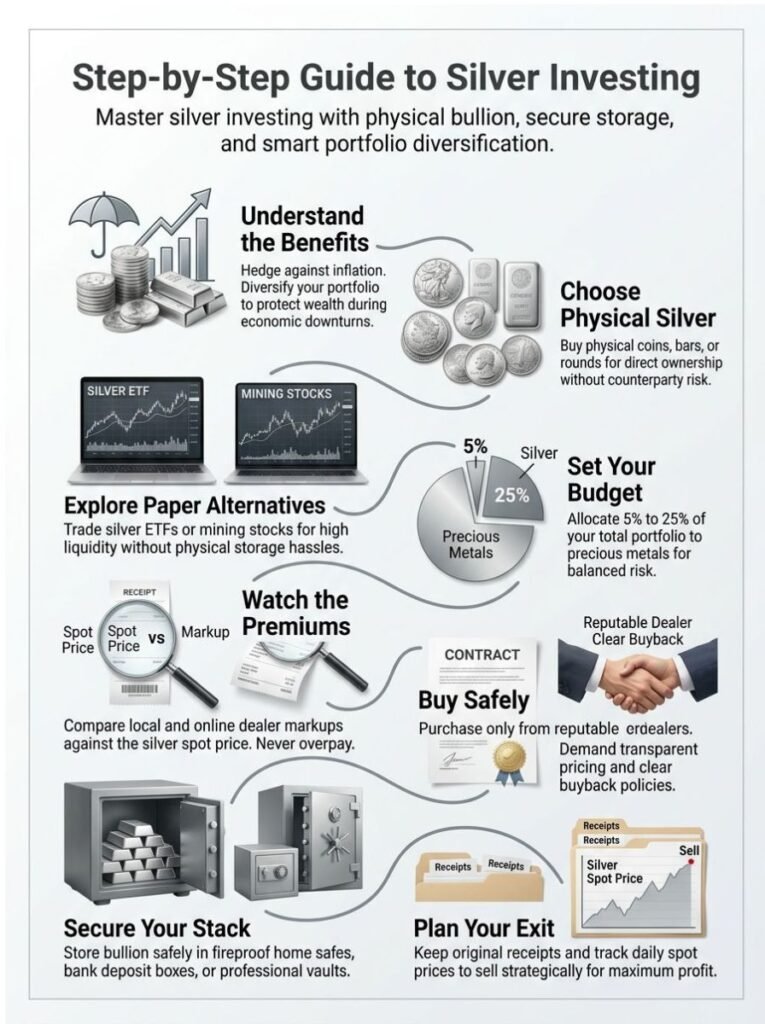
Why Do Investors Buy Silver?
Quick Summary: Why Invest in Silver
- Hedge against inflation
- Affordable entry into precious metals
- Strong industrial demand
- Tangible asset outside the financial system
- High liquidity and global recognition
Silver is a popular investment because it offers a combination of affordability, inflation protection, industrial demand, and tangible value outside the traditional financial system.
Investors are drawn to silver for both its historical role as money and its modern use in global industries. Unlike many financial assets, physical silver provides direct ownership and can act as a hedge during periods of economic uncertainty.
Below are the main reasons investors choose to invest in silver:
Hedge Against Inflation
One of the primary reasons investors buy silver is to protect purchasing power during inflation.
When the value of paper currency declines, tangible assets like silver often retain or increase their value. Historically, precious metals have served as a store of wealth during periods of rising prices and economic instability.
For beginners looking to preserve wealth, silver offers a lower-cost entry point compared to gold.
Affordable Entry Into Precious Metals
Silver is significantly more affordable than gold, making it ideal for new investors.
You can start investing in silver with a relatively small amount of capital, which allows beginners to build a position gradually over time. This accessibility makes silver especially appealing for those who want to start “stacking” physical assets without a large upfront investment.
Strong Industrial Demand
Silver is not just a monetary metal — it is also a critical industrial resource.
It is widely used in:
- Solar panels
- Electronics and semiconductors
- Electric vehicles
- Medical applications
This dual role as both an industrial and investment metal creates long-term demand that can support silver’s value over time.
Tangible Asset Outside the Financial System
Physical silver provides direct ownership without reliance on banks, brokers, or digital platforms.
For investors concerned about financial system risks, silver offers a way to hold wealth in a form that cannot be easily frozen, devalued, or manipulated by third parties.
This makes silver particularly attractive to those seeking greater financial independence and security.
High Liquidity and Global Recognition
Silver is widely recognized and easily traded around the world.
Popular silver coins and bars can be bought and sold through dealers, coin shops, and private buyers, making it a highly liquid asset. This means investors can convert silver into cash relatively easily when needed.
Different Ways to Invest in Silver
Quick Summary: Ways to Invest in Silver
- Physical silver (coins, bars, rounds)
- Silver ETFs
- Silver mining stocks
- Silver futures and derivatives
There are several ways to invest in silver, but not all options are equally suitable for beginners.
The main ways to invest in silver include physical silver (coins and bars), exchange-traded funds (ETFs), mining stocks, and futures contracts. Each method has its own advantages, risks, and level of complexity.
For most beginners, owning physical silver is the simplest and most practical starting point.
Here’s a breakdown of the most common options:
Buying Physical Silver (Coins, Bars, and Rounds)
Buying physical silver is the most direct and beginner-friendly way to invest.
When you purchase physical silver, you own the metal outright — with no reliance on financial institutions or third parties. This makes it a popular choice for investors focused on wealth preservation and financial independence.
Common forms of physical silver include:
- Government-issued coins (e.g., American Silver Eagles)
- Silver bars (ranging from 1 oz to 100 oz or more)
- Silver rounds (privately minted, coin-like pieces)
Best for: Beginners, long-term investors, and those who want tangible assets.
Investing in Silver ETFs
Silver ETFs (exchange-traded funds) allow you to gain exposure to silver prices without owning physical metal.
These funds track the price of silver and can be bought and sold through a brokerage account, just like stocks.
While ETFs offer convenience and liquidity, they do not provide direct ownership of physical silver and may involve management fees.
Best for: Investors who prefer digital assets and short-term trading flexibility.
Investing in Silver Mining Stocks
Silver mining stocks represent shares in companies that produce silver.
These stocks can provide leveraged exposure to silver prices — meaning they may rise faster than silver itself during bull markets. However, they also carry additional risks tied to company performance, management decisions, and operational costs.
Best for: Experienced investors seeking higher risk/reward opportunities.
Trading Silver Futures and Derivatives
Silver futures contracts allow investors to speculate on the future price of silver using leverage.
This is the most complex and high-risk way to invest in silver. Futures trading requires a deep understanding of the market and can lead to significant losses if not managed carefully.
For this reason, it is generally not recommended for beginners.
Best for: Advanced traders only.
Which Silver Investment Option Is Best for Beginners?
For most beginners, physical silver is the best place to start.
It offers:
- Direct ownership with no counterparty risk
- A simple, easy-to-understand investment approach
- The ability to hold a tangible asset outside the financial system
While ETFs and stocks may be useful for certain strategies, they introduce additional complexity and risk that most new investors don’t need.
Starting with physical silver allows you to build confidence, understand the market, and develop a long-term investment strategy.
Why Physical Silver Is the Best Option for Beginners
For most new investors, buying physical silver is the simplest, safest, and most practical way to get started.
While there are multiple ways to gain exposure to silver, physical ownership stands out because it is easy to understand, widely accessible, and does not rely on financial institutions or complex investment strategies.
Instead of dealing with brokerage accounts, paper assets, or leveraged positions, you can simply purchase silver coins or bars and own them outright.
Here’s why physical silver is the preferred starting point for beginners:
Direct Ownership With No Counterparty Risk
When you own physical silver, you own it outright.
There is no bank, broker, or financial intermediary involved. Unlike ETFs or mining stocks, your investment does not depend on a company, fund manager, or third party to maintain its value.
This eliminates counterparty risk — the risk that another party could fail, default, or restrict access to your investment.
For many investors, this is one of the most compelling reasons to buy physical silver.
Simple and Easy to Understand
Physical silver is one of the most straightforward investments available.
You don’t need to understand financial markets, analyze company earnings, or manage a trading account. If you can understand the concept of owning a tangible asset, you can understand silver investing.
This simplicity makes it ideal for beginners who want to start building wealth without unnecessary complexity.
Tangible Asset You Can Hold and Control
Physical silver is a real, tangible asset that you can hold in your hand.
This provides a level of security and control that digital or paper investments cannot offer. You are not relying on online platforms, account access, or institutional systems to manage your wealth.
For investors concerned about economic instability or financial system risks, this level of control can be especially valuable.
High Liquidity and Global Demand
Physical silver is widely recognized and easy to sell.
Popular silver coins and bars can be sold through dealers, coin shops, and private buyers around the world. This makes silver a highly liquid asset that can be converted into cash relatively quickly when needed.
Liquidity is an important consideration for beginners, and silver performs well in this area.
Flexible Entry Point for Any Budget
One of the biggest advantages of silver is its affordability.
Unlike gold, which may require a significant upfront investment, silver allows you to start small and build your position over time. You can begin with just a few ounces and gradually expand your holdings as your budget allows.
This makes silver an ideal option for beginners who want to ease into precious metals investing.
A Practical Foundation for Long-Term Investing
Starting with physical silver allows you to build a strong foundation before exploring more complex investment options.
As you gain experience, you may choose to diversify into gold, ETFs, or mining stocks. But physical silver provides a clear, low-risk starting point that helps you understand how the market works.
The Bottom Line
For beginners, physical silver offers the best balance of simplicity, control, affordability, and long-term value.
It allows you to start investing quickly, avoid unnecessary risks, and build confidence as you grow your portfolio.
If you’re ready to start with physical silver, the next step is understanding the different types available — including coins, bars, and rounds — and which ones make the most sense for beginners.
Silver Coins vs Silver Bars: Which Should Beginners Choose?
Both silver coins and silver bars are popular ways to invest in physical silver, but they serve slightly different purposes depending on your goals, budget, and experience level.
For beginners, choosing between coins and bars often comes down to trust, liquidity, and cost.
Here’s how they compare:
Still unsure which format makes the most sense? Read our detailed silver coins vs bars comparison before deciding what to buy.
What Are Silver Coins?
Silver coins are government-issued bullion products with a guaranteed weight and purity.
Popular examples include:
- American Silver Eagle (USA)
- Canadian Silver Maple Leaf (Canada)
- Austrian Silver Philharmonic (Austria)
Because they are minted by national governments, silver coins are widely recognized and trusted around the world.
Advantages of Silver Coins
- High trust and recognition
Government-backed coins are easy to verify and widely accepted. - Easier to sell
Dealers and private buyers are more likely to purchase well-known coins quickly. - Lower risk of counterfeits
Popular coins have advanced security features and are easier to authenticate. - Ideal for beginners
Simplicity and liquidity make coins a great starting point.
What Are Silver Bars?
Silver bars are rectangular pieces of silver produced by private mints or refiners.
They come in a variety of sizes, including:
- 1 oz bars
- 10 oz bars
- 100 oz bars
Bars are typically stamped with weight, purity (usually .999 fine silver), and the manufacturer’s mark.
Advantages of Silver Bars
- Lower premiums over spot price
Bars usually cost less per ounce compared to coins. - Better for bulk investing
Larger bars allow you to accumulate more silver efficiently. - Simple and compact storage
Bars are easy to stack and store in larger quantities.
Silver Coins vs Silver Bars: Key Differences
| Feature | Silver Coins | Silver Bars |
|---|---|---|
| Premium | Higher | Lower |
| Recognition | Very high | Moderate |
| Liquidity | Very high | High |
| Counterfeit Risk | Lower | Slightly higher |
| Best For | Beginners | Bulk investors |
Which Is Better for Beginners?
For most beginners, silver coins are the better choice.
If you want beginner-friendly options, see our guide to the best silver coins for investment and discover the most trusted choices.
They offer:
- Greater trust and recognition
- Easier resale
- Lower risk of buying counterfeit products
While silver bars can be more cost-efficient, the difference in premiums is often worth it for the added security and flexibility that coins provide — especially when you’re just starting out.
When Silver Bars Make More Sense
Silver bars may be a better option if:
- You are investing larger amounts
- You want to minimize premiums
- You are comfortable verifying authenticity
Many investors eventually use a combination of both coins and bars as their silver holdings grow.
Bottom Line: Coins First, Then Bars
If you’re new to silver investing, start with widely recognized silver coins.
Once you gain experience and confidence, you can incorporate silver bars to reduce costs and build larger positions more efficiently.
In the next section, we’ll look at another popular form of silver — junk silver — and why many investors include it in their portfolios.
What Is Junk Silver?
“Junk silver” refers to old coins that contain real silver but have little or no collectible (numismatic) value.
Despite the name, junk silver is not “junk” at all — it simply means the coins are valued primarily for their silver content rather than rarity or condition.
These coins are one of the most practical and widely used forms of silver for everyday investors.
What Coins Are Considered Junk Silver?
In the United States, junk silver typically refers to pre-1965 coins, which were minted with 90% silver.
Common examples include:
- Dimes (e.g., Roosevelt dimes)
- Quarters (e.g., Washington quarters)
- Half dollars (e.g., Franklin half dollars)
In 1965, the U.S. government removed silver from most circulating coins, making earlier coins valuable for their metal content.
Why Is It Called “Junk” Silver?
The term “junk” simply means the coins are not rare or collectible.
They may be worn from circulation and lack numismatic value, but they still contain a known amount of silver. Because of this, they are bought and sold based on their melt value rather than appearance.
Why Do Investors Buy Junk Silver?
Junk silver is popular for several practical reasons:
- Recognizable and trusted
These coins were issued by the U.S. government and are widely known. - Smaller denominations
Ideal for fractional transactions or gradual selling. - Useful for barter scenarios
Many investors view junk silver as a practical form of “everyday silver” in uncertain economic conditions. - Lower premiums (in many cases)
Compared to some modern bullion coins, junk silver can sometimes be purchased closer to spot price.
When Junk Silver Makes Sense for Beginners
Junk silver can be a good option if you:
- Want smaller, divisible units of silver
- Are interested in preparedness or barter scenarios
- Prefer recognizable U.S. coins
- Are looking to diversify beyond standard bullion coins
However, beginners should also be aware that junk silver requires a basic understanding of silver content and pricing.
Is Junk Silver Better Than Bullion Coins?
Junk silver and bullion coins serve different purposes.
- Bullion coins are typically better for beginners due to their simplicity and global recognition
- Junk silver is more specialized and often used for flexibility and barter
Many investors choose to hold a mix of both.
Bottom Line: Practical, Recognizable Silver
Junk silver is a practical and accessible way to own real silver in smaller denominations.
While it may not be the first choice for every beginner, it can play a useful role in a well-rounded silver strategy — especially for those interested in flexibility and long-term preparedness.
How Much Silver Should Beginners Buy?
Most beginners should aim to allocate around 5% to 10% of their portfolio to silver and other precious metals.
However, the exact amount depends on your financial goals, risk tolerance, and overall investment strategy.
For some investors, silver is a small diversification tool. For others, it plays a larger role in protecting wealth against inflation and economic uncertainty.
If you’re just getting started, the most important thing is not the exact amount — it’s simply taking the first step.
A Simple Rule of Thumb for Beginners
A common guideline is:
- 5% allocation → Conservative approach
- 10% allocation → Moderate wealth protection strategy
- 10%+ allocation → More aggressive hedge against inflation and financial instability
This range gives you exposure to silver without overcommitting too early.
Example Starter Silver Investment Amounts
If you’re unsure where to begin, here are some practical starting points:
- $250–$500 → Entry-level position (a few ounces of silver)
- $500–$1,000 → Solid beginner stack
- $1,000–$5,000 → More meaningful long-term position
Starting small allows you to learn the market, understand pricing, and build confidence before committing larger amounts.
Should You Buy All at Once or Over Time?
Many beginners choose to buy silver gradually.
This approach — often called “dollar-cost averaging” — involves purchasing silver in smaller amounts over time instead of making one large purchase.
Benefits include:
- Reducing the impact of price volatility
- Avoiding poor timing decisions
- Building a consistent long-term position
Balancing Silver With Gold
While silver is a strong investment on its own, many investors choose to hold both gold and silver.
Trying to decide between the two? Our gold vs silver investment comparison breaks down the pros and cons of each.
A common approach is:
- Gold for stability and wealth preservation
- Silver for growth potential and affordability
For beginners, starting with silver can be a practical first step before adding gold later.
Many investors eventually branch into gold. Here’s our complete guide to gold investing for beginners.
Factors That Influence How Much Silver You Should Buy
Your ideal allocation may vary based on:
- Your income and savings
- Your investment goals
- Your confidence in traditional financial markets
- Your interest in long-term wealth preservation
There is no one-size-fits-all answer — your strategy should reflect your personal situation.
Common Mistakes to Avoid
- Overinvesting too quickly
Avoid putting too much into silver before understanding the market. - Trying to time the market
Focus on consistency rather than perfect timing. - Ignoring diversification
Silver should complement your portfolio, not replace it entirely.
Bottom Line: Start Small and Build Over Time
The best approach for beginners is to start with a manageable amount and build gradually.
You don’t need a large investment to get started with silver. Even a small position can help you gain experience, understand the market, and begin building a tangible store of value.
As your confidence grows, you can expand your holdings and refine your strategy over time.
Once you’ve made your first purchase, explore practical silver stacking strategies to build a long-term position.
Once you’ve decided how much to invest, the next step is choosing where to buy silver safely and at a fair price.
Where to Buy Silver Safely
Buying silver from a reputable source is just as important as choosing the right type of silver.
For beginners, the biggest risks are overpaying, dealing with unreliable sellers, or unknowingly purchasing counterfeit products. Fortunately, these risks can be avoided by sticking with trusted, well-established sources.
There are three main ways to buy silver:
Online Bullion Dealers (Best Option for Most Beginners)
Buying silver online from established bullion dealers is the most popular and convenient option.
Reputable online dealers offer:
- A wide selection of silver coins and bars
- Transparent pricing based on the current spot price
- Secure shipping and insured delivery
- Customer reviews and established reputations
Need help choosing a dealer? Our guide on where to buy silver safely compares the most beginner-friendly options.
Because of their scale, online dealers often provide more competitive pricing and better availability than local shops.
Best for: Most beginners and long-term investors.
If you’re just getting started, choosing a trusted online dealer is usually the safest and simplest option.
Local Coin Shops
Local coin shops allow you to buy silver in person.
Advantages include:
- Immediate possession of your silver
- The ability to inspect products before purchasing
- No shipping delays
However, prices can sometimes be higher due to lower inventory and overhead costs.
Best for: Investors who prefer face-to-face transactions.
Peer-to-Peer and Private Sellers (Higher Risk)
Some investors buy silver through private sellers, auctions, or online marketplaces.
While this can sometimes result in lower prices, it comes with increased risks:
- Counterfeit products
- Lack of guarantees
- Limited recourse if something goes wrong
For beginners, this option is generally not recommended.
How to Choose a Reputable Silver Dealer
Before buying, take a few minutes to evaluate the dealer:
- Look for established companies with strong reputations
- Check customer reviews and ratings
- Compare pricing across multiple dealers
- Ensure the dealer offers insured shipping and clear return policies
Avoid deals that seem too good to be true — unusually low prices can be a red flag.
Tips for Buying Silver Safely
- Always check the current spot price before buying
- Understand the premium you are paying over spot
- Stick with well-known coins and bars
- Avoid unfamiliar or unverified sellers
- Start with a small purchase to test the process
Bottom Line: Stick With Trusted Sources
The safest way to buy silver is through reputable dealers with transparent pricing and strong customer feedback.
For most beginners, online bullion dealers offer the best combination of convenience, selection, and competitive pricing.
Once you’ve purchased your silver, the next step is making sure it’s stored safely and securely.
Understanding Silver Prices and Premiums
Quick Summary: Silver Price vs Premium
- Spot price = market value of silver
- Premium = extra cost for physical products
- Total price = spot price + premium
When buying silver, you’ll notice that the price you pay is always higher than the “spot price.”
This difference is completely normal — and understanding it is one of the most important things for beginner investors.
To make smart buying decisions, you need to understand two key concepts:
- The spot price of silver
- The premium over spot price
What Is the Silver Spot Price?
The spot price is the current market price of silver per ounce.
It is determined by global supply and demand and constantly fluctuates throughout the trading day. This is the baseline price you’ll see quoted on financial websites and market trackers.
However, the spot price represents the value of raw silver in large wholesale markets — not the price of physical silver products you can buy as an individual investor.
Why Physical Silver Costs More Than Spot Price
When you buy physical silver, you are not just paying for the metal itself.
The final price includes additional costs such as:
- Minting and manufacturing
- Distribution and logistics
- Dealer overhead
- Market demand
This additional cost is called the premium.
What Is a Premium Over Spot Price?
The premium is the amount you pay above the spot price for a silver coin or bar.
For example:
- Spot price = $25 per ounce
- Coin price = $30 per ounce
- Premium = $5 per ounce
Premiums can vary depending on the type of silver you buy, the dealer, and current market conditions.
Why Premiums Vary Between Products
Not all silver products have the same premium.
In general:
- Government-issued coins → Higher premiums (due to recognition and demand)
- Silver bars → Lower premiums (more cost-efficient)
- Junk silver → Often moderate premiums
Premiums can also increase during times of high demand or supply shortages.
How to Avoid Paying High Premiums
While premiums are unavoidable, you can take steps to avoid overpaying:
Paying too much can quietly reduce long-term returns. Learn how to avoid high premiums when buying silver before making your first purchase.
- Compare prices across multiple dealers
- Stick with well-known products
- Avoid collectible or numismatic coins if you’re investing
- Buy in slightly larger quantities when possible
- Pay attention to market conditions (premiums rise during shortages)
Being aware of premiums helps you get more silver for your money.
Spot Price vs Premium: What Matters Most?
Both the spot price and the premium matter — but for physical investors, the premium often has a bigger impact on your total cost.
A small difference in premiums can significantly affect how much silver you accumulate over time.
Bottom Line: Focus on Total Cost, Not Just Spot Price
The key is not to find the lowest spot price — it’s to get the best overall value.
Understanding how premiums work allows you to make smarter buying decisions, avoid overpaying, and build your silver position more efficiently.
How to Store Your Silver Safely
Once you’ve purchased silver, the next step is making sure it’s stored securely.
Storage becomes increasingly important as your stack grows. Learn how to store silver securely and avoid common mistakes.
For many beginners, storage is one of the biggest concerns. The good news is that there are several safe and practical options — and the right choice depends on how much silver you own and your personal comfort level.
The most common storage options include home storage, bank safe deposit boxes, and professional vault storage.
Storing Silver at Home
Storing silver at home is the most direct and commonly used option.
It gives you immediate access to your assets and full control over your holdings — something many investors value, especially in uncertain economic conditions.
To store silver safely at home:
- Use a high-quality safe that is fireproof and securely anchored
- Keep your holdings discreet and private
- Avoid obvious or easily accessible hiding places
- Consider spreading storage across multiple locations
Best for: Investors who prioritize control, privacy, and quick access.
Bank Safe Deposit Boxes
Bank safe deposit boxes offer a more traditional storage solution.
They provide:
- Physical security within a bank facility
- Protection from theft
- Relatively low annual cost
However, there are some trade-offs:
- Limited access (only during bank hours)
- Dependence on the banking system
- Contents are not always fully insured
Best for: Investors who prefer institutional security over direct access.
Professional Precious Metals Vaults
Professional vault storage services specialize in storing precious metals.
These facilities offer:
- High-level security
- Full insurance coverage (in many cases)
- Segregated or allocated storage options
Vault storage is often used by larger investors or those holding significant amounts of metal.
Best for: Investors with larger holdings who want maximum security and insurance.
How to Choose the Right Storage Option
The best storage method depends on your situation.
Consider:
- How much silver you own
- Your need for quick access vs long-term storage
- Your comfort level with banks or third-party services
- Your focus on privacy vs convenience
Many investors choose to use a combination of storage methods.
Common Silver Storage Mistakes to Avoid
- Leaving silver in obvious locations
- Failing to use a proper safe
- Telling too many people about your holdings
- Ignoring insurance or protection options
Security is not just about where you store your silver – it’s also about how discreet and careful you are.
Bottom Line: Balance Security and Accessibility
The best storage solution is one that balances security, accessibility, and peace of mind.
For many beginners, starting with a secure home storage setup is the simplest approach. As your holdings grow, you can explore additional options such as vault storage or diversification across locations.
Once your silver is securely stored, it’s also important to understand how to sell it when the time comes – which we’ll cover next.
How to Sell Silver When the Time Comes
One of the biggest advantages of silver is that it is easy to sell when you need to convert it back into cash.
Many beginners worry about liquidity – but in reality, silver is widely recognized and can be sold through multiple channels, often quickly and with minimal hassle.
Understanding how the selling process works will help you feel more confident when making your initial purchase.
Selling Silver Back to Dealers
One of the most common ways to sell silver is through bullion dealers.
Most reputable dealers will also buy back silver, often at prices based on the current spot price.
Advantages include:
- Simple and straightforward process
- Transparent pricing
- Ability to sell online or by mail
Before selling, it’s a good idea to compare buyback prices across multiple dealers to ensure you’re getting a fair rate.
Best for: Most investors looking for a reliable and efficient selling process.
Selling Silver to Local Coin Shops
Local coin shops provide another convenient option.
Benefits include:
- Immediate payment
- No shipping required
- In-person transaction
However, pricing may vary, and it’s still wise to visit multiple shops or call ahead to compare offers.
Best for: Investors who want quick, in-person transactions.
Selling to Private Buyers
Some investors choose to sell directly to private buyers through marketplaces or personal networks.
This can sometimes result in higher prices, but it also comes with added risks:
- Time and effort to find a buyer
- Safety concerns
- No guarantees or protections
For beginners, this option is usually less practical than selling through established dealers.
Best for: More experienced sellers comfortable handling private transactions.
Understanding Buy-Back Prices
When selling silver, you will typically receive slightly less than the spot price.
This difference reflects:
- Dealer margins
- Market conditions
- Demand for specific products
Highly recognized products — such as popular silver coins — often command better resale prices and are easier to sell.
Tips for Getting the Best Price When Selling Silver
- Check the current spot price before selling
- Compare offers from multiple dealers or shops
- Sell well-known products (coins often perform better than obscure items)
- Avoid selling in a rush unless necessary
- Keep your silver in good condition when possible
A little preparation can make a noticeable difference in your final return.
When Is the Right Time to Sell Silver?
The best time to sell depends on your goals.
Some investors sell when:
- Silver prices rise significantly
- They need liquidity
- They are rebalancing their portfolio
Trying to perfectly time the market is difficult, so many investors focus on long-term strategy rather than short-term price movements.
Bottom Line: Silver Is a Highly Liquid Asset
Silver is easy to buy, easy to hold, and easy to sell.
With multiple selling options and strong global demand, you can convert your silver into cash when needed — which makes it a practical and flexible investment.
Now that you understand how to buy, store, and sell silver, let’s look at some of the most common mistakes beginners should avoid.
Common Mistakes Beginner Silver Investors Should Avoid
Investing in silver is relatively straightforward, but beginners often make a few common mistakes that can reduce returns or create unnecessary risk.
By understanding these pitfalls upfront, you can avoid costly errors and build your silver position with confidence.
Here are the most important mistakes to watch out for:
Paying Too Much in Premiums
One of the most common mistakes is overpaying for silver.
Beginners often don’t realize how much premiums can vary between products and dealers. Buying high-premium items unnecessarily can reduce how much silver you actually acquire for your money.
How to avoid it:
- Compare prices across multiple dealers
- Stick with widely recognized bullion products
- Understand the difference between spot price and premium
Buying Collectible or Numismatic Coins Instead of Bullion
Some sellers promote rare or collectible coins as “investments,” but these often come with significantly higher premiums.
While numismatic coins can have value, they are not ideal for beginners focused on silver investing.
How to avoid it:
- Focus on bullion coins and bars
- Avoid paying extra for rarity unless you fully understand the market
- Prioritize silver content over collectibility
Not Verifying the Dealer’s Reputation
Buying from an unreliable or unknown seller increases the risk of overpaying or receiving counterfeit products.
How to avoid it:
- Choose established dealers with strong customer reviews
- Look for transparent pricing and clear policies
- Avoid deals that seem too good to be true
Trying to Time the Market
Many beginners wait for the “perfect” time to buy silver.
In reality, trying to predict short-term price movements is difficult and often leads to missed opportunities.
How to avoid it:
- Focus on long-term accumulation
- Consider buying gradually over time
- Avoid making decisions based on short-term price swings
Ignoring Storage and Security
Some investors focus on buying silver but overlook how it will be stored.
Poor storage practices can increase the risk of loss or theft.
How to avoid it:
- Plan your storage strategy before buying
- Use a secure safe or trusted storage option
- Keep your holdings private
Overinvesting Too Quickly
It’s easy to get excited and invest too much too soon.
This can create unnecessary financial pressure or limit flexibility.
How to avoid it:
- Start with a manageable amount
- Build your position gradually
- Maintain a balanced overall portfolio
Bottom Line: Avoid Mistakes and Focus on Consistency
Successful silver investing is not about perfection — it’s about consistency and informed decision-making.
By avoiding these common mistakes, you can build your silver holdings more efficiently, reduce risk, and gain confidence as you continue investing.
Now that you know what to avoid, let’s take a final look at whether silver is a good long-term investment.
Is Silver a Good Long-Term Investment?
Silver can be a strong long-term investment — but it works best when viewed as part of a broader wealth preservation strategy rather than a quick profit opportunity.
Unlike stocks or real estate, silver does not generate income or dividends. Instead, its value comes from its role as a tangible asset that has historically held purchasing power over time.
For many investors, silver is less about rapid growth and more about protection, diversification, and long-term resilience.
Silver’s Historical Role as Money
Silver has been used as money for thousands of years.
Across different civilizations and economic systems, it has consistently served as a store of value and medium of exchange. While modern currencies have replaced silver in everyday transactions, its historical role still influences how investors view it today.
This long track record gives silver a level of credibility that few other assets can match.
Silver as a Hedge Against Inflation
Over the long term, silver has often maintained its purchasing power during periods of inflation.
When the value of paper currency declines, tangible assets like silver tend to perform better. While prices can fluctuate in the short term, silver is commonly used as a hedge against:
- Inflation
- Currency devaluation
- Economic uncertainty
This makes it particularly attractive for investors focused on preserving wealth.
Industrial Demand and Future Growth Potential
Silver’s value is not based solely on its role as a precious metal.
It is also a critical component in modern industries, including:
- Solar energy production
- Electronics and semiconductors
- Electric vehicles
- Medical technologies
Some investors believe silver’s industrial role creates major upside potential. See why some consider silver the most undervalued asset today.
This growing industrial demand provides an additional layer of long-term support for silver prices.
Volatility: What Beginners Should Expect
Silver is more volatile than gold.
Prices can rise quickly — but they can also fall just as fast. This volatility can be challenging for beginners who are expecting steady, predictable returns.
However, for long-term investors, short-term price swings are less important than overall trends and accumulation over time.
How Silver Fits Into a Diversified Portfolio
Silver works best as part of a balanced investment strategy.
It is typically used to:
- Diversify a portfolio
- Reduce reliance on traditional financial assets
- Provide exposure to tangible assets
Many investors pair silver with gold, using:
- Gold for stability
- Silver for growth potential
When Silver May Outperform Gold
In certain market conditions, silver can outperform gold.
Because of its smaller market size and industrial demand, silver often experiences larger price movements during bullish periods. This gives it potential upside — though it also comes with increased volatility.
Bottom Line: A Long-Term Store of Value
Silver is not a get-rich-quick investment — but it can be a valuable long-term asset for preserving wealth and diversifying your portfolio.
When approached with a long-term mindset, silver offers a combination of:
- Tangible ownership
- Inflation protection
- Industrial demand
- Accessibility for investors at all levels
If you’re ready to get started, our guide to the best silver coins for investment shows you exactly what to buy as a beginner.
Final Thoughts: Getting Started With Silver Investing
.Investing in silver doesn’t have to be complicated — and you don’t need a large amount of money to get started.
By now, you understand the fundamentals:
- Why investors buy silver
- The different ways to invest
- Why physical silver is often the best starting point
- How to choose between coins, bars, and junk silver
- Where to buy safely
- How pricing, storage, and selling work
That knowledge alone puts you ahead of most beginners.
Want a broader foundation beyond silver? Start with our beginner’s guide to precious metals investing.
The key now is simple:
Start small, stay consistent, and focus on long-term value.
You don’t need to time the market perfectly or make a large investment upfront. Many successful investors begin with just a few ounces of silver and gradually build their holdings over time.
Silver is not about quick gains — it’s about:
- Preserving purchasing power
- Diversifying your portfolio
- Owning a tangible asset you control
If those goals align with your investment strategy, silver can play a valuable role in your financial plan.
Key Takeaways for First-Time Silver Investors
Keep your goal clear. Buy bullion for bullion goals, and treat funds, stocks, and futures as separate tools with separate risks.
Track the silver spot price, compare silver premiums, store securely, and keep clean paperwork for taxes and resale.
Next Steps for Building Your First Silver Stack
Use this step-by-step approach to build a stack you can hold through volatility.
- Pick one product type to start, such as common one-ounce rounds or a widely recognized sovereign coin.
- Compare at least two sellers and write down the all-in cost (spot, premium, shipping, taxes).
- Buy a small first order, then test your storage plan in real life.
- Add a second product type only after your first feels easy to buy, store, and price.
- Open a brokerage account if you want to explore paper silver like silver ETFs, but keep the core plan simple.
- Keep receipts and an inventory from day one to simplify selling and capital gains reporting later.
- Review your plan once a year, and adjust based on your investment goals and risk tolerance.
Your Next Step
If you’re ready to take the next step, the most important decision is what type of silver to buy first.
👉 Our guide to the best silver coins for investment breaks down the most trusted and beginner-friendly options — so you can start building your silver position with confidence.
Final Takeaway
The hardest part of investing in silver is getting started — and now you have everything you need to do exactly that.
Frequently Asked Questions About Investing in Silver
Is silver a good investment for beginners?
Yes, silver is one of the most accessible ways for beginners to start investing in precious metals. It offers a lower entry cost than gold and provides both industrial demand and long-term value potential.
How much silver should a beginner buy?
Most beginners start with 5% to 10% of their portfolio in silver and other precious metals. However, many investors begin with a small amount and gradually build their position over time.
What is the best type of silver to buy?
For beginners, widely recognized bullion coins such as American Silver Eagles or Canadian Maple Leafs are often the best choice due to their liquidity and trust.
Where is the safest place to buy silver?
Reputable online bullion dealers are generally the safest option for beginners, offering transparent pricing, insured shipping, and a wide selection of products.
Can silver lose value?
Yes, silver prices can fluctuate in the short term. However, many investors view silver as a long-term store of value rather than a short-term investment.
Is it better to buy silver coins or bars?
Silver coins are usually better for beginners because they are easier to sell and widely recognized, while bars are more cost-efficient for larger purchases.