
Is Silver the Most Undervalued Asset in 2026? The Data, Risks, and Reality
Is silver the most undervalued asset in 2026?
Silver appears undervalued relative to its role in the global economy because demand from solar energy, electrification, and electronics continues to rise while supply remains constrained. At the same time, silver prices are heavily influenced by volatility, leverage, and short-term macro forces, which can mask longer-term fundamentals. Understanding whether silver is truly undervalued requires examining supply deficits, industrial demand, policy shifts, and the risks that come with silver’s small, fast-moving market.
What matters now is whether the 2026 volatility is just a late-cycle blowoff, or the market finally repricing a metal that modern industry keeps consuming.
Below, I’ll walk you through what the silver market data is signaling, the practical drivers behind “undervaluation,” and the cleanest ways to get exposure (without getting surprised by leverage, premiums, or taxes).
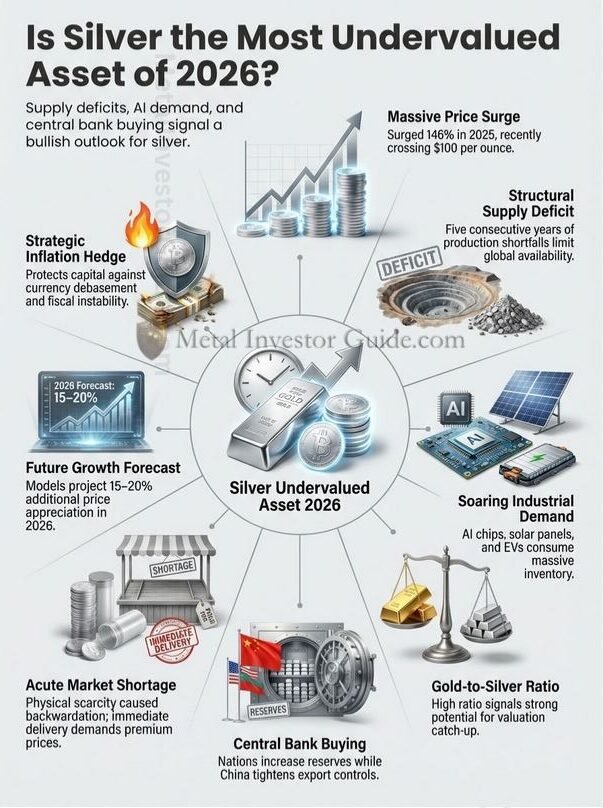
Key Takeaways
- Silver’s 2025 rally was extreme: pricing data compiled by StatMuse shows silver finished 2025 up about 147.7% in U.S. dollars.
- Structural deficits have been more than a headline: the Silver Institute reported a 148.9 million ounce market deficit in 2024 and projected another deficit in 2025.
- The 2026 tape has been violent: silver traded above $121 per ounce in late January 2026, then fell sharply into early February, a reminder that market volatility is part of the package.
- Policy shifted in a way industrial buyers care about: the U.S. Geological Survey’s final 2025 List of Critical Minerals (published November 6, 2025) added silver, increasing the odds of more active supply-chain policy.
- China tightened trade rules starting January 1, 2026 by moving silver exports into a licensing system, which can amplify regional shortages and price premiums in stressed periods.
- If you trade futures, the rulebook matters: CME Group announced a new 100-ounce silver futures contract launching on February 9, 2026, aimed at making silver access “smaller,” even as margins rose during the spike.
What Does It Mean for Silver to Be “Undervalued” in 2026?
Silver is considered undervalued when its market price does not fully reflect long-term demand, supply constraints, and strategic importance. In 2026, silver’s valuation is shaped by persistent supply deficits, rising industrial demand from energy and technology sectors, and short-term price volatility that can obscure underlying fundamentals.
The silver market still feels “small” compared to stocks or even gold, and that’s why it can whip around so hard when liquidity thins or sentiment flips.
At the same time, the fundamentals are not purely financial. Silver demand is increasingly tied to solar photovoltaics, electrification, and the electronics stack behind data centers and AI hardware.
The result is a market where headlines about the Fed, interest rates, and geopolitical uncertainty can move price fast, while the underlying industrial pull keeps chipping away at available supply.
- Macro trigger: real interest rates and dollar strength, which can raise or lower the opportunity cost of holding bullion.
- Industrial trigger: solar panels, grid buildout, and vehicle electrification, which consume metal rather than just store it.
- Market plumbing: futures margin changes, delivery incentives, and regional premiums that can disconnect paper pricing from physical availability.
- Behavioral risk: bubbles form fastest in assets with small market size and easy leverage.
Persistent supply deficits
Silver’s “deficit story” is real, but the useful takeaway is not the drama. It’s the math of what happens when industry and investors repeatedly consume more ounces than mining and recycling deliver.
In the latest full-year figures, the Silver Institute said the market posted a 148.9 million ounce structural deficit in 2024, and its 2025 outlook pointed to another deficit, which would extend the run of annual shortfalls.
- Action for investors: treat deficits as a time factor, not a timing tool. You still need an entry plan because silver can stay irrational longer than your risk tolerance.
- Action for operators: if your business uses silver (electronics, solar, specialty manufacturing), build procurement buffers and supplier redundancy before the next squeeze.
In tight markets, silver doesn’t just rise, it can gap. That’s why position sizing and liquidity planning matter as much as your thesis.
One more practical point: much of the world’s silver is produced as a byproduct of base-metal mining. That slows supply response, because miners expand output based on copper, lead, and zinc economics, not just the silver price.
Rising demand from industrial sectors
Industrial demand has been the anchor under silver’s long-term story. The Silver Institute reported industrial demand hit a record 680.5 million ounces in 2024, driven by the green economy and electronics growth tied to AI workloads.
Silver’s edge is physics. It has the highest electrical conductivity of any metal, which is why engineers keep using it in circuit boards, connectors, and many high-reliability electrical contacts.
- Solar photovoltaics: silver demand can rise even when manufacturers “thrift” silver per panel, because total installations keep scaling.
- Data centers: the buildout of power delivery, high-performance networking, and hardware refresh cycles keeps pulling on electrical demand.
- Automotive electrification: more sensors, power electronics, and charging infrastructure tend to mean more silver-bearing components.
- Recycling lag: silver is often dispersed in tiny amounts across products, which makes recovery slower and more expensive than people assume.
Key Drivers of Silver’s Undervaluation in Precious Metals Portfolios
Calling any asset “the most undervalued” is a big claim, especially after silver already proved it can go parabolic.
So here’s a cleaner way to frame it for investing: silver can be undervalued relative to its strategic importance when markets price it like a low-priority industrial metal, even as policy and manufacturing treat it like a constrained input.
In 2026, the drivers to watch are still the same categories, but the weight shifted: industrial demand and supply-chain policy now matter almost as much as monetary policy.
The gold-to-silver ratio
The gold-to-silver ratio is a blunt tool, but it’s useful for one thing: keeping you from anchoring on the last price you saw.
In early 2026, the ratio compressed sharply during silver’s spike, which is exactly what you see when silver trades like “high beta gold.” That compression can reverse fast on any risk-off shock.
| Topic | Summary Points |
|---|---|
| Definition | The gold-to-silver ratio shows how many ounces of silver equal one ounce of gold.It’s a quick check on relative pricing between two key precious metals. |
| 2026 snapshot | The ratio swung sharply during the late-January 2026 silver surge, then widened again during the pullback.That behavior is typical when silver is being driven by leverage and positioning, not just slow-moving fundamentals. |
| What it’s good for | Rebalancing: trimming after sharp ratio compression, adding after ratio spikes.Comparing opportunity cost: silver often moves more than gold in both directions. |
| Common mistake | Using the ratio as a short-term trading signal without a volatility plan.Ignoring that silver can overshoot in both bull and bear phases. |
| Actionable notes | Decide your rebalancing rule in advance (for example, add only after a drawdown, not after a spike).Size silver smaller than gold if you want a steadier ride, because silver’s daily ranges can be punishing. |
Increasing use in green technologies and AI
Silver demand is no longer a niche “green tech” story. It’s embedded in how the U.S. and global economy are rebuilding power systems, scaling solar farms, and expanding high-density computing.
A detail people miss: even when manufacturers reduce silver loadings per unit (thrifting), total industrial demand can still rise if deployment grows faster than thrift rates.
That’s why silver can behave differently from gold. Gold’s value is mostly about monetary policy and store of value narratives. Silver also has an industrial floor, and the floor rises when physical supply chains tighten.
Silver links renewable energy buildout and AI infrastructure, and supply often can’t respond quickly enough to calm short-term squeezes.
If you want a clean, trackable way to monitor this driver, watch the annual industrial demand numbers and the photovoltaic and electronics commentary in major silver market surveys. Those are the spots where “story” turns into measurable silver demand.
Market Trends for Silver in 2026
2026 has already shown you the two sides of silver: it can act like a safe haven during currency debasement fears, and it can also trade like a crowded momentum position that snaps back hard.
That mix is why technical analysis matters more in silver than many long-term investors like to admit. Entry discipline can be the difference between holding a hedge and riding a bubble.
Predictions for price growth
Instead of pretending anyone can forecast a clean path, use scenario thinking. Silver’s 2026 direction will hinge on inflation prints, the Fed’s interest rate path, and whether industrial buyers keep paying up for physical supply.
- Bull case: rate-cut expectations rise, the dollar softens, and industrial demand stays firm, which can pull retail investors back into physical silver and silver-linked funds.
- Base case: wide ranges continue, with sharp rallies and sharp pullbacks that reward planned entries more than impulse buying.
- Bear case: a stronger dollar policy, tighter monetary policy rhetoric, or a growth scare hits industrial demand and forces leveraged longs to unwind.
- Reality check: late January 2026 showed how quickly silver can move above $100 per ounce, and early February showed how quickly it can give a large chunk back.
- Practical takeaway: if you can’t tolerate a 20% to 35% drawdown in a short window, you need a smaller position or a different vehicle.
A practical playbook for 2026 volatility
Most mistakes I see come from treating silver like a “set it and forget it” asset. In this tape, you need rules.
- Pick your vehicle first: physical silver, bullion-style funds, mining stocks, or futures all behave differently in drawdowns.
- Decide position size in advance: silver’s market volatility can make even a “small” allocation feel big.
- Use staged entries: split buys across multiple dates or price levels to avoid chasing spikes.
- Respect premiums: when retail demand surges, the spread between spot and what you can actually buy widens.
- Plan for taxes: the iShares Silver Trust prospectus warns that U.S. individual gains can be taxed at a maximum 28% long-term rate because silver is treated as a collectible in many structures. Talk to a tax professional before you build a large position.
- Avoid accidental leverage: futures, options, and leveraged products can force selling at the worst time, especially after margin hikes.
| Investment vehicle | What you’re really buying | Best use case | Main tradeoff |
|---|---|---|---|
| Physical silver (coins, rounds, bars) | Metal in-hand or in insured storage | Long-term hedge against currency debasement and systemic stress | Premiums, storage, liquidity friction |
| Silver bullion-style funds | Exposure designed to track silver bullion | Liquidity and simpler account management | Fees, structure risk, tax treatment can differ from stocks |
| Mining stocks | Operating businesses with cost curves and execution risk | Upside torque in a bull market | Company risk, dilution, geopolitics, equity selloffs |
| Futures | Contract exposure with margin requirements | Short-term hedging or tactical trading | Leverage risk, margin calls, forced liquidation |
If you do want futures access with a smaller footprint, CME Group launched a 100-ounce silver futures contract on February 9, 2026, which can lower the “contract size shock” versus the 5,000-ounce standard contract.
Impact of global economic shifts
Silver has been trading like a macro barometer. Shifts in interest rates, quantitative tightening expectations, and dollar strength can overwhelm fundamentals in the short run.
One sign the market has been stressed is how exchanges reacted. In late January 2026, CME Group raised margin requirements on Comex silver futures after prices surged, which can push smaller, leveraged traders out of positions quickly.
If you’re holding silver as a hedge, avoid structures that can force you to sell your hedge at the exact moment you need it.
Finally, keep a clear eye on correlation regimes. When equities wobble, silver can either act like a safe haven or behave like a risk asset, depending on whether industrial demand fears dominate that week.
Why Silver Remains a Strategic Asset
Silver’s strategic role is clearer in 2026 than it was a few years ago. It sits inside the energy transition supply chain, and it’s also a psychological hedge when people worry about money printing and government deficit dynamics.
That dual identity is why it can outperform in bursts, and why it can also punish investors who treat it like a stable store of value.
Government interest in silver reserves
Central banks still focus on gold far more than silver, so don’t base your thesis on “central bank buying” of silver itself. But government actions can still tighten silver supply chains.
For example, the U.S. Geological Survey’s final 2025 List of Critical Minerals added silver on November 6, 2025. That matters because “critical mineral” status can influence federal priorities around permitting, stockpiles, and domestic supply resilience.
On the trade side, China’s tighter export-licensing rules effective January 1, 2026 created another pathway for supply chain constraints, especially for industrial buyers who can’t easily substitute away from silver without redesigning products.
- Investor takeaway: policy can widen the gap between paper pricing and physical availability in short squeezes.
- Business takeaway: if you rely on silver inputs, treat procurement as a risk-management function, not a purchasing function.
Silver’s role in renewable energy and electric vehicles
Silver’s role in solar farms is straightforward: it’s used in electrical conduction inside solar cells, and scale drives ounces. Even with thrift improvements, solar panels remain a major structural driver of silver demand.
For EVs, the Silver Institute summarized the direction years ago, and it still holds up: a 2021 Metals Focus report produced for the Institute estimated battery electric vehicles use roughly 25 to 50 grams of silver per vehicle, with hybrids also carrying elevated silver loadings.
Recycling will help, but it’s not a quick fix. A real-world example is Solarcycle, which announced plans for a Georgia facility opening in 2026 and said its process can recover materials including silver from end-of-life panels. That’s meaningful progress, but it takes time to scale and it doesn’t erase near-term deficits.
- If you’re investing: treat renewable energy growth as a long-term tailwind, and use pullbacks for measured adds instead of chasing spikes.
- If you’re hedging: consider silver’s industrial sensitivity, it can drop with recession fears even when gold holds up.
- If you’re buying physical silver: compare premiums across product types. In stressed markets, “cheap silver” is often the silver you can’t actually get delivered quickly.
Conclusion
Silver has a credible case in 2026, but it’s not a free lunch. The same forces that make it compelling also make it volatile.
If you’re building exposure for a precious metals sleeve, the cleanest approach is to size smaller than you think you need, use staged entries, and pick an investment vehicle that matches your time horizon.
Keep your eyes on silver demand, interest rates, and policy-driven supply chain constraints. If those stay tight while the Fed turns less restrictive, silver can still surprise on the upside, even after a wild start to 2026.