
Beginner’s Guide to Precious Metals Investing
When inflation rises and markets swing wildly, most investors react.
Smarter investors prepare.
Precious metals have protected wealth through currency resets, banking crises, and decades of monetary policy shifts. But buying gold or silver impulsively — or without understanding premiums, taxes, and liquidity — can cost you more than volatility itself.
The real advantage isn’t owning metal.
It’s owning it correctly.
This guide shows you how to use precious metals as a disciplined investment strategy — without overpaying or overexposing your portfolio.
Key Takeaways
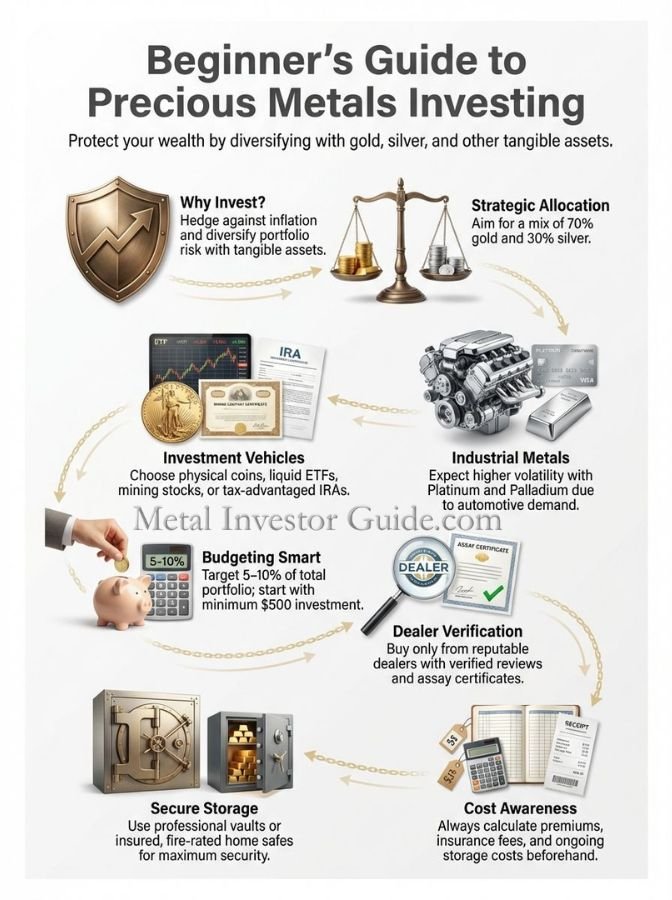
- Start with sizing: many portfolios use 5–10% in precious metals, and a common beginner split inside that metals slice is about 70% gold and 30% silver.
- Know what you’re paying today: as of early February 2026, spot gold has traded around $4,900–$5,000/oz and spot silver around $75–$85/oz, so a $500–$1,000 starter budget usually means fractional gold, silver, or an ETF position.
- Price spikes are real: Forbes Advisor noted silver’s intraday high of $121.58/oz on January 29, 2026, and late-January coverage in Barron’s described gold hitting a record in the mid-$5,600s.
- Taxes can surprise beginners: physical metals are “collectibles” for U.S. tax purposes, and many physically backed gold ETFs also fall under the collectible rate structure, which can mean a maximum 28% long-term rate in some cases (per the SPDR Gold Shares tax FAQ and SEC filings).
Why Invest in Precious Metals?
Investors buy gold and silver to balance stocks and bonds and to add tangible assets like gold bars and silver coins. Precious metals can act as a store of value in economic uncertainty, and they can help diversify your investments when traditional asset classes move together.
The key is to match the vehicle to the job. If you want day-to-day liquidity, exchange-traded funds can be a clean fit. If you want “no counterparty” ownership, physical metals can make sense, but you have to manage storage, premiums, and resale spreads.
Portfolio diversification
“Precious metals cut risk and add balance to a mixed portfolio.”
Precious metals often behave differently than stocks and bonds, which is exactly why they can reduce portfolio swings. A March 2025 analysis published by VanEck showed gold’s long-run correlation was about 0.01 with U.S. stocks and about 0.06 with U.S. bonds.
Use that idea in a practical way: keep your metals allocation modest, then rebalance. If gold prices surge and your metals position grows beyond your target, trim back and redeploy into your other asset classes.
- Use a target range: pick a metals range (example: 5–10% of your total portfolio), then keep it there.
- Split roles inside metals: gold often acts as the “stability” piece, silver often acts as the “higher-volatility” piece tied to industrial demand.
- Reduce timing risk: dollar-cost average with smaller buys instead of one large purchase at a single spot price.
- Pick the right wrapper: physical metals, precious metal ETFs, and mining company stocks each diversify in different ways.
Hedge against inflation
Gold can hedge certain inflation scenarios, but it works best when you treat it as a long-term diversifier, not a month-to-month CPI tracker. In the World Gold Council’s 2026 “Case for Gold” update, the council noted that since 1971, gold outpaced U.S. CPI over the long run, and in years when inflation ran between 2% and 5%, gold’s price rose by about 10% per year on average (as of December 31, 2025).
Action step: if you’re buying metals mainly as an inflation hedge, focus on keeping costs low (tight premiums and low annual fees). High costs can erase the very protection you’re trying to buy.
Also plan for taxes up front. Physical gold (coins, bars, bullion) is generally taxed as a collectible in the U.S., with a maximum 28% long-term rate on gains in many situations. Many physically backed gold ETFs are also treated as interests in metal held by a trust, which can place gains in the collectible-rate framework as well.
Long-term value retention
Precious metals keep value over decades because supply is finite, and the global market treats them as real money adjacent assets. World Gold Council reserve data continues to list the United States at 8,133.46 metric tons of gold.
Still, metals do not produce cash flow. So the cleanest way to use them is as a portfolio tool: keep your “growth and income engines” in equities, bonds, and cash-flowing assets, and use precious metals as a stabilizer around the edges.
Types of Precious Metals
These rare metals act as a store of value, and their spot price moves with supply and demand, industrial demand, and interest rates. If you’re building a precious metals portfolio, it helps to be clear about what each metal is “for” in real-world terms.
A
| Metal | What drives demand | Best fit for beginners | Common pitfall |
|---|---|---|---|
| Gold | Store of value, central bank reserves, jewelry, investment demand | Core holding for diversification | Overpaying premiums on collectible-style coins |
| Silver | Investment plus heavy industrial demand (electronics, solar, manufacturing) | Smaller budgets, dollar-cost averaging | Underestimating bulk storage and volatility |
| Platinum | Industrial uses, especially auto catalysts, plus jewelry | Small satellite allocation only | Treating it like “gold but cheaper” |
| Palladium | Strong link to catalytic converters and industrial cycles | Advanced or tactical exposure | Ignoring liquidity and sharp drawdowns |
Gold
Gold traded in the mid-$5,000s per ounce during late January 2026, then moved back under that level in early February. That kind of swing is your reminder to treat gold as a position you size and maintain, not a price you chase.
In physical form, beginners usually start with widely recognized bullion coins and bars. The American Gold Eagle is a popular option, and it’s 22-karat (91.67% gold), but the coin is made heavier so it still contains 1 full troy ounce of fine gold.
If you want higher purity, many buyers prefer .9999 fine products like the American Gold Buffalo or well-known minted bars. Your practical decision is usually about cost and resale ease:
- Lowest friction: 1 oz bullion coins and common bar sizes tend to have better resale liquidity.
- Higher cost per ounce: fractional coins often carry higher premiums per ounce, even though they lower the cash needed to get started.
- Plan the exit: ask any dealer how they price buybacks (spot minus what spread) before you buy.
Silver
Silver can be exciting, and it can be unforgiving. Forbes Advisor noted silver’s intraday high of $121.58/oz on January 29, 2026, and it has also seen sharp pullbacks since then.
Silver’s “two engines” are what matter for your strategy: investors buy it as a store of value, and manufacturers buy it for industrial demand. That mix is why silver often moves more than gold.
If you’re new, use silver coins and smaller bars for flexibility, then track two costs that beginners often miss: storage volume and resale spreads. A meaningful amount of silver gets heavy fast.
Platinum
Platinum is rarer than gold and is heavily tied to industrial cycles. Automakers drive a large share of demand through catalytic converters, and the metal also shows up in jewelry and specialized industrial applications.
From a product standpoint, platinum bullion tends to be very high purity. CME Group’s investor education notes that platinum bullion bars and coins commonly use 99.95% purity as a key criterion.
Use platinum as a satellite position. If you want exposure without dealing with wider physical spreads, many investors use exchange-traded funds for liquidity, then keep position sizes small.
Palladium
Palladium demand is dominated by catalytic converters, so prices can react fast to shifts in vehicle demand, emissions rules, and substitution trends. Supply concentration adds another layer of volatility.
A 2025 U.S. Geological Survey outlook report estimated 2024 palladium production capacity was concentrated in a few countries, led by South Africa (about 40.2%), Russia (about 36.5%), and Canada (about 9.1%).
If you choose to invest in palladium, treat it as a higher-risk, more tactical slice of your precious metal exposure. Focus on liquidity first, then worry about “perfect entry prices.”
Ways to Invest in Precious Metals
You can hold gold ingots or silver rounds, or own exposure through exchange-traded funds and mining company stocks. Each path has different storage, liquidity, and tax rules, so the best choice is the one you can stick with through volatility.
A
| Investment vehicle | What you own | Main costs | Best use case |
|---|---|---|---|
| Physical coins and bars | Metal in your possession or vault | Premiums, shipping, storage, insurance, buy/sell spread | Long-term tangible asset ownership |
| Precious metal ETFs | Fund shares (often backed by metal or derivatives) | Expense ratio, bid-ask spread, potential collectible-style tax treatment | Fast, liquid exposure in brokerage accounts |
| Mining stocks | Company equity tied to mining economics | Market risk, operational risk, geopolitical risk | Growth-oriented exposure, sometimes dividends |
| Precious metal IRAs | Eligible metals held by an approved custodian | Custodian fees, storage fees, account rules | Retirement exposure with strict compliance |
Physical assets: coins, bars, and jewelry
Coins offer quick recognition, and they often sell faster than bars in the precious metals market. Bars can come with lower premiums, especially in common weights (1 oz, 10 oz, 1 kg).
Coin World reported U.S. Mint bullion program premiums charged to authorized purchasers are formula-based, and for 1-ounce American Eagle and American Buffalo gold coins the Mint premium is listed at 3% of spot, with different percentages for fractional sizes. Retail premiums can differ a lot because dealer inventory, demand, and spreads change week to week.
- Know your units: 1 troy ounce equals 31.1035 grams, and 1 kilogram equals 32.1507 troy ounces.
- Separate “spot” from “real cost”: your actual entry price is spot plus premium, plus shipping, plus any payment surcharge.
- Keep it liquid: stick to widely recognized bullion products unless you truly want collectible exposure.
- Be realistic about jewelry: jewelry markups can be high, so it often works poorly as a pure inflation hedge.
Precious metal ETFs
Exchange-traded funds let you buy exposure to gold, silver, platinum, or palladium on major exchanges, offering high liquidity and easy trading. You do not own physical metals when you hold a precious metal ETF, you own shares in a product structure.
Costs matter. Kiplinger’s January 2026 roundup of low-cost gold ETFs listed expense ratios such as 0.40% for SPDR Gold Shares (GLD), 0.25% for iShares Gold Trust (IAU), and lower-fee options like SPDR Gold MiniShares (GLDM) and iShares Gold Trust Micro (IAUM) near 0.10% or below.
Also take taxes seriously. The SPDR Gold Shares tax FAQ and its SEC filings describe the trust as a grantor trust for U.S. federal tax purposes and explain why long-term gains for many individuals can fall under the collectible framework with a maximum 28% rate in some situations.
Mining company stocks
Mining stocks can move more than the metals they produce. You get operating leverage, which can help when prices rise, but it can hurt when costs rise, mines face delays, or jurisdictions change rules.
If you want to use mining stocks inside a precious metals investing strategy, keep them in the “equities” bucket in your mind. They can diversify your portfolio, but they do not replace the role of bullion as a tangible asset.
- Metal-price leverage: profits can rise faster than the underlying metal price in good cycles.
- Company risk: labor, energy costs, permitting, and reserve quality can dominate performance.
- Better liquidity: shares trade like other equities, which can make rebalancing easier.
Precious metal IRAs
Precious metal IRAs let investors hold select metals in a tax-advantaged retirement account, but the rulebook is strict. The IRS spells out that most coins and metals are “collectibles” for retirement plans, with limited exceptions for certain coins and qualifying bullion held in the physical possession of a bank or an approved non-bank trustee.
That trustee rule is the deal-breaker for many DIY investors: home storage does not qualify for IRA-held bullion. If your retirement account acquires a non-qualified collectible, the IRS explains it can be treated as a distribution in the year it’s acquired, which may trigger taxes and penalties.
- Confirm eligibility before you fund: get the exact product list from the custodian, not a sales pitch.
- Ask for the full fee schedule: custodial fees, storage tiers, transaction fees, and any termination fees.
- Know your timeline: IRA metals are built for long-term investment, not quick flips.
Steps to Start Investing in Precious Metals
Set a budget, check the spot price, pick physical metals, precious metal ETFs, or mining company stocks, then decide on storage and documentation. If you keep the process simple, you’ll make better investment decisions and avoid the most expensive mistakes.
Determine your budget
Decide how much you can risk, and target 5–10% of your total portfolio for precious metals if you want a modest diversifier. Then match your budget to real entry costs, not just the spot price.
As of early February 2026, spot gold has traded around $4,900–$5,000 per ounce and spot silver around $75–$85 per ounce. That means a $500–$1,000 starting point often works best through silver, fractional gold, or an exchange-traded fund position.
- Pick your target allocation (example: 5% of your portfolio).
- Choose your vehicle (physical, ETF, mining stocks, or an IRA).
- Budget for friction (premiums, fees, storage, and insurance).
Choose your preferred metal(s)
Pick metals that match your goals and your tolerance for volatility. For many beginners, gold and silver are enough, with a simple split like 70% gold and 30% silver inside the metals portion of the portfolio.
- If you want the “anchor” metal: start with gold bullion coins, gold bars, or a low-fee gold ETF.
- If you can handle bigger swings: add silver coins or silver bars, or a silver-focused ETF.
- If you want industrial-cycle exposure: consider platinum or palladium in a small satellite slice.
Research reputable dealers or platforms
Reputation matters more in physical metals than in most other investment products because authenticity and buyback terms decide your outcome. Look for dealers that are transparent about how they price products (spot, premium, and buyback spread).
Britannica Money notes that investors often look for dealers connected to established industry groups such as the Industry Council for Tangible Assets. Another practical signal is whether a firm participates in official supply channels for bullion coins.
If you’re buying U.S. Mint bullion coins in size, Coin World’s reporting on the U.S. Mint authorized purchaser network highlights firms such as Dillon Gage, FideliTrade, Manfra, Tordella & Brookes, StoneX Bullion, and SD Bullion. You can still buy from many other reputable dealers, but this list gives you real names to sanity-check against.
- Compare at least three quotes on the same product.
- Ask how buybacks work before you buy.
- For higher-value coins: consider third-party authentication and encapsulation from services like PCGS or NGC.
Understand storage options: home vs. professional storage
Storage is part of the investment, not an afterthought. Your choices affect security, access, and insurance.
The FDIC is blunt on one key point: safe deposit boxes and their contents are not insured by FDIC deposit insurance. Investopedia has also reported that safe deposit box rental fees are often in a broad range, commonly about $40 to $300 per year, depending on size and institution.
- Home safe: choose a fire-rated safe, bolt it down if possible, and keep a private inventory with photos and serial numbers.
- Safe deposit box: good for infrequent access, but plan around bank hours and insurance limitations.
- Professional vaulting: can add security and insurance options, but confirm fees and withdrawal procedures in writing.
- IRA metals: must be held by an approved custodian or depository, not at your home.
Common Beginner Mistakes
Many new investors buy without research and chase low spot price offers. They ignore premiums, resale spreads, and storage reality, then wonder why their “hedge” feels expensive.
- Confusing spot with your real cost (premium and spread decide your break-even point).
- Buying illiquid products you can’t easily resell at a fair price.
- Skipping a storage plan until after you’ve already purchased.
Buying without research
The biggest pricing mistake is not understanding the three numbers that matter: spot, premium, and spread. Two products can track the same spot price and still deliver very different results because one carries higher premiums and a worse buyback spread.
For physical metals, do basic checks every time: verify weight, diameter, and thickness against the mint specs, and keep packaging and receipts. Dealers often use advanced tools like XRF analysis for authentication, but your first-line defense is still measurement and documentation.
Overinvesting in one metal
Putting most funds into one metal raises risk, since spot price swings can hit gold, silver, platinum, or palladium hard. Diversification inside your precious metals portfolio matters, and diversification across your full portfolio matters even more.
If you already hold plenty of commodity exposure or leveraged positions elsewhere, keep your metals slice smaller and focus on the “portfolio insurance” role, not the thrill of a big move.
Ignoring storage and insurance costs
Storage and insurance can quietly drain returns on physical precious metals. You also want to avoid false confidence. A safe deposit box can be secure, but the FDIC explains that the contents are not covered by FDIC deposit insurance.
Build storage costs into your plan from day one. If that math makes physical metals unattractive, consider exchange-traded funds or other investment vehicles that better fit your budget and lifestyle.
Conclusion
This beginner’s guide gives you a practical framework for investing in precious metals like gold and silver.
Keep your allocation intentional, then choose the vehicle that matches your real needs for liquidity, storage, and taxes.
Use precious metal ETFs and mining stocks for easier trading, and consider precious metal IRAs only if you’re ready for stricter rules.
Track spot price, premiums, and storage costs so you can diversify your portfolio without surprises.
Done right, precious metals can support your financial future through inflation and economic uncertainty.