
Gold vs Silver: Which Should You Buy in 2026?
You’ve decided to invest in precious metals.
Now comes the real question:
Should you buy gold — or silver?
Both have preserved wealth for centuries. Both sit outside the traditional banking system. Both are widely recognized, globally traded, and tangible. But beyond those similarities, they behave very differently — and choosing the right one for your situation can meaningfully impact your long-term results.
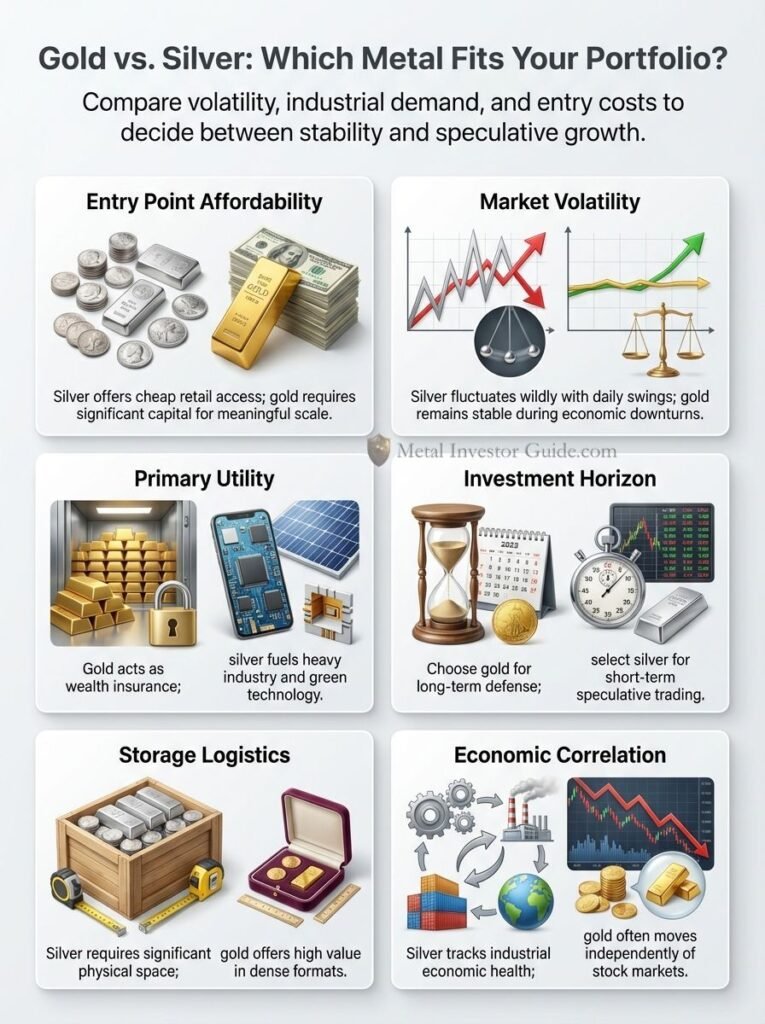
Gold is often seen as stability and wealth preservation. Silver, by contrast, tends to offer greater volatility and growth potential, but with wider price swings. One may be better suited for protecting retirement savings. The other may appeal more to investors building long-term reserves or seeking higher upside.
The right choice depends on your budget, goals, risk tolerance, and how you plan to use precious metals in your portfolio.
Before diving deeper, here are the key takeaways to help frame the comparison.
Key Takeaways
- Gold is built for stability. It has lower volatility, stronger central bank demand, and a long track record as a core wealth-preservation asset — making it a foundation in many long-term portfolios and retirement strategies.
- Silver offers greater upside — and greater swings. Its industrial demand and smaller market size can create stronger bull runs, but also sharper pullbacks, particularly during periods of economic expansion.
- Gold requires more capital per ounce. Silver allows investors to accumulate more ounces with a smaller upfront investment — which is why many new buyers begin with silver before transitioning into gold.
- Storage considerations differ significantly. Silver takes up far more physical space for the same dollar value, which makes understanding your storage options for precious metals essential before building a large position.
- Premiums tend to be higher on silver. Buyers should pay close attention to the premium over spot price and compare dealer spreads carefully before making a purchase.
- Portfolio role matters more than metal preference. The right choice depends on whether your goal is stability, growth potential, liquidity, or long-term accumulation within a broader precious metals allocation strategy.
- Many investors ultimately hold both. Gold and silver often complement each other rather than compete — balancing stability with growth potential.
What Is the Difference Between Gold and Silver as Investments?
Gold is usually bought for stability: it’s a globally recognized store of value, and central banks play an active role in demand. The World Gold Council reported central banks and other institutions bought 863.3 tonnes of gold in 2025 (down from 1,092.4 tonnes in 2024), and that demand tends to show up most when confidence in currencies and geopolitics gets shaky.
Silver can behave like “gold plus an industrial metal.” It benefits from safe-haven flows at times, but it can also react sharply to manufacturing, solar, electronics, and inventory tightness.
| Category | Gold | Silver |
|---|---|---|
| Main role in portfolios | Safe haven, store of value, diversification | Hybrid: precious metal plus industrial demand exposure |
| Big demand driver you can track | Central bank net buying (reported annually/quarterly) | Industrial fabrication (electronics, PV, autos, grid) |
| Volatility feel | Typically smoother day-to-day | Often sharper, can gap on news and liquidity |
| Practical storage | High value density, small footprint | Bulkier for the same dollar value |
| Account protection nuance | Coins and bars are not SIPC-protected | Coins and bars are not SIPC-protected |
Affordability: Is Gold or Silver Better for First-Time Investors?
In February 2026, the “unit price” difference is still the most obvious contrast: gold has been trading around $5,000 per ounce, while silver has been trading in the double digits per ounce after a wild January spike.
That price gap changes how you build a position. About $10,000 can buy roughly 2 ounces of gold at $5,050 per ounce, or about 124 ounces of silver at $80.50 per ounce, which is about 8.5 pounds of metal before you even think about tubes, cases, or a safe.
If you want exposure without home storage, exchange-traded funds (ETFs) are the most common “click-to-buy” route in the U.S. Here are a few widely used, physically backed products and what their sponsors list as ongoing fees.
| Option | What you’re buying | Ongoing costs to watch | Why people use it |
|---|---|---|---|
| Physical bullion (coins, bars) | Metal you take delivery of | Dealer spread, shipping, storage, insurance | No fund structure, direct ownership feel |
| SPDR Gold Shares (GLD) | Shares backed by physical gold | Expense ratio commonly listed at 0.40% | Large scale liquidity and simple brokerage access |
| iShares Gold Trust (IAU) | Shares backed by physical gold | Sponsor fee listed as 0.25% | Lower ongoing fee, simple brokerage access |
| iShares Silver Trust (SLV) | Shares backed by physical silver | Sponsor fee listed as 0.50% | Easy silver exposure without home storage |
| Sprott Physical Silver Trust (PSLV) | Closed-end trust holding allocated silver bars | Management expense ratio listed around 0.57% | Structure some investors prefer for vaulted metal |
For coins, it helps to know what you’re actually getting. The U.S. Mint states a one-ounce American Gold Eagle contains one troy ounce of fine gold, but the coin weighs about 1.0909 troy ounces because it’s a durable gold alloy. The American Silver Eagle is struck as a one-troy-ounce .999 fine silver coin.
One practical warning from FINRA’s investor bulletin: the dealer “spread” (the gap between a dealer’s buy and sell price) is where many people lose money, and FINRA notes some fraud cases have involved spreads over 300%. Your best defense is simple math, compare the metal’s weight times spot price to the all-in price you’re being quoted.
Good deals feel boring. If the pitch is urgent, your spread is probably doing the talking.
Volatility Comparison: Is Gold More Stable Than Silver?
Gold usually earns its place in a portfolio by being steadier during stress, not by being exciting. Even in a hot market, its moves often look more like a climb and a pullback than a vertical spike.
Silver is the opposite. In early 2026, silver printed an all-time high around $121.67 per ounce on January 29, then fell to about $79.45 by February 2, a drop that shows why silver position sizing matters.
Gold has moved too. Market coverage in February 2026 described gold peaking above $5,500 per ounce earlier in the year and then correcting back near $5,000, which is still a very large move, just not as violent as silver’s swings.
- Use smaller sizing for silver: if a 20% drawdown would force you to sell, you’re sized too big.
- Decide your rebalancing rule upfront: percentage bands work well (example: rebalance when you drift 25% off target).
- Match the vehicle to your temperament: ETFs can reduce friction, physical can add friction, futures can amplify everything.
- Don’t confuse “volatile” with “profitable”: volatility is only helpful if you can hold through it.
Industrial Demand vs Store of Value: Why Silver Behaves Differently Than Gold
Silver’s industrial demand is not a footnote, it is a primary driver. The Silver Institute reported industrial demand of 680.5 million ounces in 2024, and it also reported a 2024 market deficit of 148.9 million ounces as demand exceeded supply again.
That demand shows up in places you can name: electronics, grid infrastructure, vehicle electrification, and photovoltaic applications. The World Silver Survey 2025 also highlighted how manufacturers try to “thrift” silver in solar cells, which can soften demand growth even while solar installations rise.
Gold’s demand profile is different. It has limited industrial use, so it tends to trade more on monetary drivers: real rates, confidence in currencies, and risk sentiment. The World Gold Council’s 2025 data also calls out named buyers, such as the National Bank of Poland adding 102 tonnes in 2025.
Action step: if your thesis is “energy transition plus electronics demand,” silver belongs in the conversation. If your thesis is “reserve asset behavior and crisis insurance,” gold usually matches that job more cleanly.
Gold vs Silver for Long-Term Wealth vs Short-Term Growth
The gold-to-silver ratio can help you frame relative value, as long as you treat it as context, not a promise. Investopedia notes the ratio has averaged about 65:1 since the 1970s, and it can swing dramatically during crises.
In February 2026, the ratio has been closer to the low-to-mid 60s at times. That’s not an extreme “silver is obviously cheap” signal. It’s more a reminder that today’s pricing is already reflecting a strong silver move.
Also be honest about the income question. Gold and silver do not pay a dividend, and that matters if you’re comparing them to stocks or bonds for long-term compounding. Kiplinger cited data showing that from 1984 to 2024, gold’s inflation-adjusted annual return was about 1.5% versus about 8.6% for the S&P 500 and about 2.2% for 10-year Treasuries.
| If your priority is | Gold tends to fit better | Silver tends to fit better |
|---|---|---|
| Wealth defense and diversification | Yes, usually steadier in stress | Sometimes, but swings can be bigger |
| Short-term trading opportunities | Possible, typically calmer moves | Yes, volatility creates bigger percent moves |
| Cash flow and income | No dividend, consider miners or other assets | No dividend, consider miners or other assets |
Gold defends wealth, silver can amplify a view, neither one replaces an income plan.
Is Gold a Good Investment? Pros, Cons, and When It Makes Sense
Gold can work as monetary insurance against currency stress and falling stock valuations. Still, it can be expensive to buy and store, and it does not generate yield.
You can own it as physical coins and bars, through exchange-traded funds, through mining stocks, or through futures. Each investment vehicle changes your costs, taxes, and operational risk.
Advantages of Gold
- Diversification potential: gold often behaves differently than stocks and bonds, which can help reduce portfolio volatility.
- Deep liquidity in common vehicles: large gold ETFs and futures markets make entering and exiting positions straightforward for many investors.
- Central bank demand is real: World Gold Council data shows central banks have remained large net buyers in recent years, which can support demand even when retail interest cools.
- High value density: physical gold stores meaningful value in a small space compared with silver bars.
Disadvantages of Gold
The biggest drawback is simple: gold doesn’t pay interest or a dividend, so you rely entirely on price appreciation for return.
Costs can also surprise first-time buyers. You can pay premiums for small or “fractional” coins, and you may face meaningful spreads when you sell, especially if you bought niche products.
Account protections are easy to misunderstand. SIPC explains that gold and silver coins do not qualify as “securities” under the Securities Investor Protection Act, so physical coins and bars are not eligible for SIPC protection.
Taxes can be another trap in taxable accounts. The IRS treats precious metals as collectibles for many purposes, and long-term gains can face a higher maximum federal rate than stocks.
- Buy list price second: first ask the dealer’s buyback price for tomorrow, then compare.
- Prefer widely recognized bullion: it can tighten spreads when you sell.
- If you’re considering a gold IRA: the IRS notes certain coins and bullion are exceptions to the “collectibles” rule only if an approved trustee keeps physical possession, so custody matters.
- If you need income: consider whether a mining stock or a diversified dividend strategy fits better than bullion.
Is Silver a Good Investment? Pros, Risks, and Ideal Use Cases
Silver offers a lower per-ounce entry point and heavy industrial demand, which can drive powerful rallies. The tradeoff is bigger drawdowns, bulkier storage, and wider swings that can punish impatient investors.
You can own silver bullion (coins, rounds, silver bars), use exchange-traded funds, buy shares of miners, or use futures for advanced strategies. Your best choice depends on whether you’re investing, trading, or building a hedge.
Advantages of Silver
- Industrial backbone: the Silver Institute reported record industrial demand in 2024, tied to electronics, grid investment, vehicle electrification, and photovoltaic applications.
- More “torque” than gold: silver can move fast, which can help if your timing and sizing are disciplined.
- Accessibility for physical stacking: buying a single ounce is feasible for many budgets, especially with common coins like Silver Eagles.
- Multiple liquid tickers exist: SLV is a common brokerage option for spot-like exposure, while some investors prefer trusts that hold allocated bars.
Disadvantages of Silver
Silver’s volatility is the headline risk. The late January 2026 move above $120 per ounce and the early February pullback into the $70s to $90s shows how quickly sentiment can flip.
Storage is the next issue. Silver takes real space and weight, so insurance, transport, and secure storage can become meaningful frictions as your position grows.
Retail pricing can also work against you. Recent market commentary has described heavy retail selling of large bars and older U.S. coinage in some periods, which can pressure local buyback prices even when “spot” prices look strong.
Finally, don’t assume “brokerage account” equals “protection.” SIPC is clear that gold and silver coins are not eligible for SIPC protection, and physical bullion held outside a securities account is a different custody world entirely.
- Size your silver for survival: plan for 30% drawdowns without changing your thesis.
- Pick your form with the exit in mind: the easiest product to buy is not always the easiest to sell.
- Track premiums, not just spot: your realized return depends on the spread you paid and the spread you’ll receive.
Should You Buy Gold, Silver, or Both?
If you’re still asking should I buy gold or silver, start by defining the job: stability or higher-volatility upside.
Gold usually fits long-term wealth defense and diversification, while silver leans harder on industrial demand and can swing more.
Choose the investment vehicle, coins, gold and silver bullion, exchange-traded funds, mining equities, or futures, that matches your time horizon, tax situation, and tolerance for volatility, then rebalance on a schedule you can stick with.
FAQs
Which Should I Buy Right Now: Gold or Silver?
If you want stability and wealth preservation, start with gold. If you want lower entry cost and more upside potential (with higher volatility), start with silver. Many investors begin with silver to build ounces, then add gold for long-term stability.
2. Is Silver Always a Bargain Compared to Gold?
No. Silver can look cheap per ounce, but it is more volatile and can drop fast, and industrial demand can push prices up.
3. Which is easier to sell: gold or silver?
Gold is usually easier to sell in large dollar amounts because it’s high value and widely recognized. Silver is also liquid, but selling large positions can be slower due to bulk and sometimes wider buy/sell spreads.
4. How Much Gold or Silver Should I Own in My Portfolio?
Aim for about 5 to 15 percent of your investable assets in gold, and 1 to 5 percent in silver, adjust by your risk tolerance. If you want safety, favor gold, if you want growth and can handle swings, add more silver.
5. Is Gold or Silver a Better Hedge Against Inflation?
Gold is generally the more consistent inflation hedge because it’s widely held as a monetary reserve asset. Silver can also benefit during inflation, but it tends to move more sharply due to industrial demand and a smaller market size.
6. Are Silver Premiums Higher Than Gold Premiums?
Often, yes. Silver frequently carries higher premiums as a percentage of spot price due to manufacturing, shipping weight, and retail demand. Gold premiums can be lower percentage-wise, especially on larger bars, but vary by product and market conditions.
Should I Own Both Gold and Silver?
Many investors hold both because they can complement each other. Gold is typically held for stability and wealth preservation, while silver can add upside potential and smaller-unit flexibility. Owning both can balance risk and broaden exposure to different demand drivers.