
Gold can play a useful role in retirement, but how you own it matters.
Physical gold gives you direct ownership of coins or bars and can provide an asset outside the normal brokerage system. Paper gold, especially a physically backed gold ETF, makes it much easier to buy, sell, rebalance, and raise cash when needed.
For retirees, that difference becomes especially important. You are no longer thinking only about long-term growth. You may also need to consider withdrawals, liquidity, required minimum distributions, estate planning, and how easily an investment can be converted into spendable cash.
That changes the physical gold versus paper gold decision.
Quick Answer
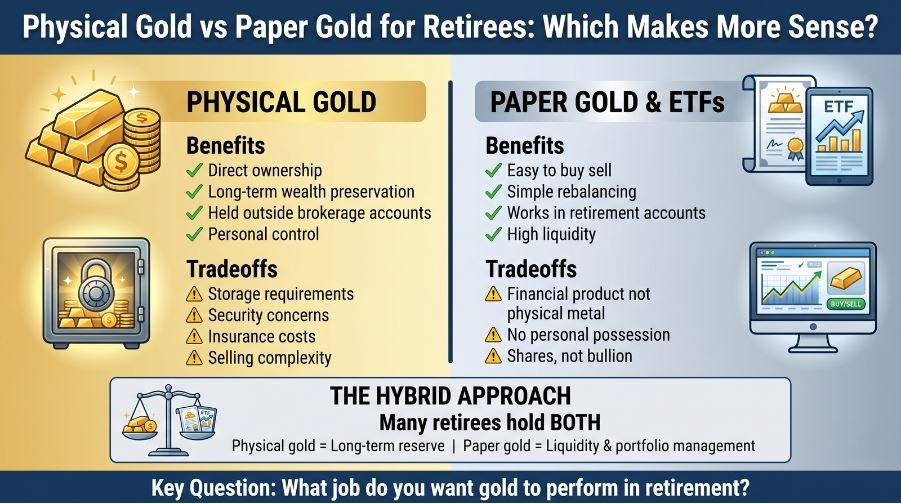
Physical gold and paper gold can both have a place in retirement, but they serve different purposes.
Physical gold may make more sense if you want direct ownership, long-term wealth preservation, and an asset that can be held outside a brokerage account. The tradeoff is that you must deal with storage, security, insurance, and eventually selling the metal.
Paper gold, particularly a physically backed gold ETF, may make more sense if you want gold exposure that is easy to buy, sell, and rebalance inside a brokerage or retirement account. The tradeoff is that you own shares of a financial product rather than personally controlled bullion.
For some retirees, owning both can make sense. Physical gold can serve as a long-term reserve, while a gold ETF can provide liquidity and easier portfolio management.
The important question is not simply which form of gold is better. It is what job you want gold to perform during retirement.
Key Takeaways
- Physical gold and paper gold solve different retirement problems. Physical bullion emphasizes direct ownership, while gold ETFs emphasize liquidity and convenience.
- Gold should generally be viewed as a portfolio asset, not a source of retirement income. Bullion and most physically backed gold ETFs do not pay interest or dividends.
- Liquidity matters more in retirement. If you may need to sell gold to fund withdrawals, ETFs are generally easier to convert to cash quickly.
- Physical gold requires a storage and estate plan. Your heirs should be able to identify, locate, value, and eventually transfer or sell the metal.
- Gold held inside an IRA follows retirement-account rules. Qualifying physical bullion generally must remain within the required custody arrangement while it is held by the IRA.
- A combination can be reasonable. Some retirees may prefer physical bullion for direct ownership and a gold ETF for rebalancing and liquidity.
Physical Gold vs Paper Gold for Retirees at a Glance
| Retirement Consideration | Physical Gold | Paper Gold, Especially Gold ETFs |
|---|---|---|
| What you own | Coins or bars directly | Shares of a fund or trust |
| Direct control | High if personally owned | You control the shares, not specific bullion |
| Liquidity | Requires a dealer or other buyer | Usually easy to sell during market hours |
| Retirement income | None | Usually none for physically backed gold ETFs |
| Rebalancing | Less convenient | Very convenient |
| Storage | You arrange it | No personal storage |
| Ongoing costs | Storage and insurance may apply | Fund expenses apply |
| System dependence | Can be held outside brokerage systems | Depends on brokerage and market infrastructure |
| IRA use | Requires the appropriate IRA structure and custody | Can often be held in a conventional brokerage IRA |
| Estate planning | Requires careful documentation and access planning | Generally transfers with the investment account |
| Best suited for | Direct ownership and long-term reserve | Liquidity and portfolio management |
If you want a broader comparison of the different ways to own gold, including personally held bullion, ETFs, and Gold IRAs, see Physical Gold vs Gold ETF vs Gold IRA.
Why the Physical vs Paper Gold Decision Changes in Retirement
Before retirement, an investor may be primarily concerned with accumulation and long-term returns.
Retirement adds another question:
How will this asset actually work when I need money from my portfolio?
A retiree may need investments to cover living expenses, rebalance after a market decline, satisfy retirement-account distribution requirements, or eventually pass assets to heirs.
That makes liquidity and ease of management more important.
A gold ETF can usually be sold through a brokerage account during market hours. Physical bullion can also be sold, but you need a buyer, a price quote, and sometimes authentication or shipping.
Neither is necessarily a problem. They are simply different forms of liquidity.
This is why the retirement decision should start with the purpose of the gold rather than the product.
Think of Gold as a Reserve, Not a Paycheck
One of the most important things retirees should understand about gold is what it does not do.
- Physical bullion does not pay interest.
- It does not pay dividends.
- A physically backed gold ETF generally does not provide meaningful investment income either.
That makes gold fundamentally different from bonds, dividend-paying stocks, CDs, and other assets that may contribute directly to retirement cash flow.
Gold can still serve as a diversifier or store of value, but retirement expenses ultimately have to be paid with cash.
If you need money from a gold position, you generally have to sell some of it.
That makes the size of the allocation important. A retiree who puts too much of a portfolio into gold may end up depending on the price of gold at the exact time money is needed.
If you are still deciding how large a gold position belongs in your overall portfolio, see How Much Gold Should You Buy?.
Physical Gold as a Long-Term Retirement Reserve
Physical gold has one characteristic that a gold ETF cannot duplicate: you can directly own the metal itself.
For some retirees, that is the entire reason for buying gold.
A personally owned gold coin or bar does not require a brokerage account to establish your ownership. If stored outside the financial system, it can provide a form of wealth that is separate from your stocks, bonds, bank accounts, and retirement accounts.
That can make physical gold appealing as a long-term reserve rather than an asset intended for frequent trading.
Where Physical Gold Can Fit Well
Physical bullion may be useful if you:
- Want some wealth outside your brokerage accounts
- Value direct ownership and control
- Plan to hold gold for many years
- Are comfortable arranging secure storage
- Want an asset that can eventually be transferred to heirs
- Do not expect to rely on the gold for frequent retirement withdrawals
For retirement purposes, widely recognized bullion coins and bars generally make more sense than high-premium collectible products because they tend to be easier to value and resell.
If you are choosing between the two primary forms of bullion, Gold Coins vs Gold Bars explains the differences in premiums, storage, divisibility, and resale.
Where Physical Gold Creates Friction
Direct ownership also creates responsibilities.
You need to decide where the gold will be stored, whether additional insurance is necessary, how ownership will be documented, and how it will eventually be sold.
Those details become more important as you get older.
A storage arrangement that seems simple at 60 may become inconvenient at 80. A home safe that only you know how to access can also become an estate problem if your family does not know it exists or cannot locate the necessary information.
Before accumulating a substantial amount of bullion, have a storage plan. Our guide to How to Store Gold Securely covers home safes, bank safe deposit boxes, and professional vault storage in greater detail.
Paper Gold as a Retirement Portfolio Tool
“Paper gold” can describe several different investments, including gold ETFs, futures, and gold-mining stocks.
For most retirees, however, the most useful comparison with physical bullion is a physically backed gold ETF or trust.
Mining stocks are shares of businesses, so their performance depends on management, production costs, debt, political risk, and other company-specific factors in addition to the gold price.
Futures are more specialized instruments that can introduce leverage and contract-management risks.
Neither is a direct substitute for owning bullion.
A physically backed gold ETF is a closer comparison because its primary purpose is to provide convenient exposure to the price of gold.
Why ETFs Can Work Well in Retirement
Gold ETFs solve several practical problems for retirees.
They can generally be bought and sold through the same brokerage account that holds stocks, bonds, and other funds.
That makes it easy to:
- Add or reduce a gold allocation
- Rebalance the portfolio
- Raise cash
- Hold gold exposure inside many conventional IRAs
- Keep investment records in one place
- Avoid personal bullion storage
That convenience becomes particularly useful when a retiree is drawing money from a portfolio.
Suppose stocks fall sharply while gold rises. If your plan calls for rebalancing, you can sell part of an ETF position and move the proceeds into cash or another asset without locating a bullion dealer or shipping coins.
That does not make an ETF better than physical gold. It makes it better suited to a particular job.
What You Give Up With Paper Gold
The main tradeoff is ownership.
When you buy shares of a gold ETF, you own shares of the investment product. You generally do not own specific coins or bars that you can simply request and take home.
The investment also remains inside the financial system.
You rely on your brokerage account, the fund structure, market trading, and the infrastructure that supports securities transactions.
For most day-to-day investing, that infrastructure is precisely what makes ETFs convenient.
But if your primary reason for buying gold is to own an asset independently of brokerage and banking systems, an ETF does not fully accomplish that objective.
Liquidity Matters More Once You Are Retired
Liquidity can mean something different in retirement than it does during your working years.
The question is no longer merely:
Can I sell this investment?
It becomes:
How quickly and predictably can I turn it into cash when I need it?
A gold ETF generally has the advantage here. You can normally sell shares during market hours through your brokerage account.
Physical gold is liquid too, especially widely recognized bullion, but selling it takes more steps.
You may need to contact a dealer, obtain a quote, transport or ship the metal, allow time for authentication, and wait for payment.
For an asset intended to remain untouched for years, that may not matter much.
For an asset that may need to fund next month’s expenses, it matters considerably.
This is one reason physical and paper gold can complement rather than replace each other.
Rebalancing Can Turn Gold Into a Useful Retirement Tool
Gold does not have to produce income to contribute to a retirement strategy.
It can also serve as an asset that you periodically rebalance.
Suppose you decide gold should represent a limited portion of your portfolio.
If gold rises significantly while other assets decline, your gold allocation may become larger than intended. Rebalancing means selling some gold and moving the proceeds into assets that have fallen or into your cash reserve.
That can turn a non-income-producing asset into a source of liquidity when it has performed well.
A gold ETF makes this particularly easy because you can sell only the amount necessary to bring the allocation back toward your target.
Physical gold can also be rebalanced, but product size matters.
If most of your holding consists of one-ounce coins or large bars, selling a small percentage of the position may be less precise.
This is one reason retirees who own physical bullion should think about eventual resale when choosing what to buy.
What About Physical Gold Inside a Gold IRA?
There is an important middle ground between personally owned bullion and a gold ETF.
A Gold IRA can hold qualifying physical precious metals within an IRA structure.
That gives you exposure to actual bullion, but it does not give you the same personal control as gold stored in your own safe.
Qualifying IRA bullion must satisfy applicable IRS requirements and remain within the required custody arrangement while it is held by the IRA. You should not assume you can buy IRA-owned bullion, take it home, and continue treating it as an asset inside the IRA.
A Gold IRA can therefore make sense when your objective is specifically to hold physical bullion within a retirement account.
If your primary objective is simply convenient gold-price exposure inside an IRA, a gold ETF may accomplish that with less administrative complexity.
For a direct comparison of personally owned bullion and IRA-owned bullion, see Gold IRA vs Physical Gold.
Required Minimum Distributions Add Another Consideration
If you hold gold inside a traditional IRA, retirement distribution rules eventually become part of the planning.
Under current federal rules, traditional IRA owners generally must begin taking required minimum distributions at the applicable starting age. Roth IRA owners generally are not required to take RMDs during their lifetime.
This matters because gold itself does not generate the cash needed for a distribution.
If your IRA holds a gold ETF, raising cash is straightforward. You can generally sell enough shares inside the account to create the necessary liquidity.
If a self-directed IRA holds physical bullion, the process can involve additional steps because the metal may need to be sold through the account or handled as a permitted distribution under IRA rules.
That does not make physical gold unsuitable for an IRA. It simply means retirees should think about future distributions before concentrating too much of an IRA in an asset that does not produce cash.
If you are considering physical bullion inside an IRA, review Gold IRA Rules and IRS Requirements before making the investment.
Taxes Can Differ Depending on How You Own Gold
Taxes should not be the only reason to choose physical or paper gold, but retirees should understand the basic differences.
Personally owned physical gold held in a taxable account is generally treated as a capital asset. Long-term gains on gold bullion and many gold coins can fall under the federal collectibles rules, which currently carry a maximum federal tax rate of 28% on collectibles gains.
That does not mean everyone who sells gold at a profit pays 28%. The actual tax depends on your circumstances.
Physically backed gold ETFs can also have specialized federal tax treatment, so investors should not automatically assume that every gold ETF is taxed like an ordinary stock ETF.
Inside an IRA, the account’s tax rules generally become more important than the capital-gains treatment that would apply to personally held bullion.
Because tax consequences depend on the account, investment structure, income, and individual circumstances, substantial gold positions are worth discussing with a qualified tax professional.
Estate Planning Is Different With Physical Gold
Estate planning is one of the strongest reasons to think about physical gold differently once you are retired.
A brokerage asset already exists inside a documented financial account.
Physical bullion may not.
If you own gold personally, your estate plan should answer four questions:
- What gold do you own?
- Where is it stored?
- How can the appropriate person access it?
- What should happen to it after your death?
Do not rely on family members simply discovering the gold.
Keep purchase records and an inventory, and make sure the appropriate person knows how to locate the information needed to access and value the metal.
You do not necessarily need to tell numerous people where valuables are stored. You do need a secure way for your executor, trustee, or other appropriate person to obtain that information when necessary.
Inherited property generally receives a basis determined under the federal rules applicable at death, often based on fair market value at the date of death. Because estate and tax circumstances vary, keep good records and make sure your heirs or executor can establish what was owned and its value.
Physical Gold May Be Better for Long-Term Resilience
Some retirees buy gold because they are concerned about more than portfolio volatility.
They want part of their wealth outside conventional financial accounts.
If that is the objective, personally owned physical gold has an advantage that an ETF cannot reproduce.
A gold ETF may track the price of gold efficiently, but you still access it through the financial system.
Physical bullion that you directly own can reduce that dependency.
That does not mean physical gold is risk-free. You exchange some financial-system dependence for other risks, including theft, loss, storage problems, insurance gaps, and difficulty accessing or selling the metal.
The important thing is to identify which risk you are trying to reduce.
If your concern is a stock-market decline, an easily rebalanced gold ETF may be sufficient.
If your concern is having some wealth outside brokerage systems, direct physical ownership addresses that goal more directly.
Should Retirees Own Physical Gold, Paper Gold, or Both?
There is no reason every retiree needs to make the same choice.
The right approach depends on what you expect gold to do.
Physical Gold May Fit Better If You Want
- Direct ownership
- A long-term store of value
- Some assets outside brokerage accounts
- Less dependence on financial-market infrastructure
- Bullion that can eventually be transferred to heirs
A Gold ETF May Fit Better If You Want
- Easy buying and selling
- Simple portfolio rebalancing
- Gold exposure inside a conventional brokerage account or IRA
- No personal storage responsibilities
- The ability to raise cash quickly from your gold allocation
Owning Both May Fit Better If You Want Both Functions
A retiree could keep part of a gold allocation in physical bullion as a long-term reserve and another part in a gold ETF for liquidity and rebalancing.
That does not mean everyone needs both.
It means the two holdings should have different jobs.
If you cannot explain why you own each one, adding another form of gold may simply create unnecessary complexity.
A Simple Way to Make the Decision
Before buying gold for retirement, ask yourself these questions:
Why do I want gold?
Is the goal diversification, wealth preservation, protection from financial-system risk, or some combination?
Will I need to sell this gold for retirement expenses?
If frequent or rapid access to cash matters, liquidity deserves more weight.
Do I want direct ownership?
If physically possessing or directly controlling bullion is important, an ETF cannot fully replace physical gold.
Am I willing to manage storage and security?
If not, physical bullion may create more burden than benefit.
Where will the gold be held?
Taxable account, conventional IRA, self-directed IRA, and personal ownership can have different tax and operational consequences.
How will my family deal with it later?
If you own physical gold, estate planning is part of the investment decision.
Answering those questions usually makes the physical-versus-paper decision much clearer.
Final Thoughts
For retirees, the most important difference between physical gold and paper gold is not simply what happens to the gold price.
It is how each asset works inside a retirement plan.
Physical gold provides direct ownership and can serve as a long-term reserve outside conventional brokerage accounts. In exchange, you accept responsibility for storage, security, documentation, liquidity, and estate planning.
A physically backed gold ETF provides convenient gold exposure that is easy to buy, sell, and rebalance. That can be especially useful when a retirement portfolio needs to produce cash or be adjusted over time. In exchange, you own a financial asset rather than personally controlled bullion.
Neither approach has to do every job.
For some retirees, physical gold may be enough. For others, an ETF may be the more practical choice. And for retirees who value both direct ownership and portfolio liquidity, a measured combination can serve two different purposes without forcing either investment to do something it was not designed to do.
Frequently Asked Questions
Is physical gold safer than paper gold for retirees?
It depends on the type of risk you are trying to reduce.
Personally owned physical gold reduces dependence on brokers and securities markets, but it introduces storage, theft, loss, and insurance risks. A gold ETF eliminates personal storage concerns and provides easier liquidity, but it remains part of the financial system.
Is physical gold or a gold ETF better for retirement income?
Neither is primarily an income-producing investment.
Physical bullion does not pay interest or dividends, and physically backed gold ETFs generally do not provide meaningful income. If retirement income is the priority, gold is usually better viewed as a supporting portfolio asset rather than the primary source of cash flow.
Can I hold physical gold in my IRA?
Certain qualifying gold coins and bullion can be held through an appropriate IRA structure, subject to IRS requirements. IRA-owned bullion must remain within the required custody arrangement while it is held by the IRA.
Can I keep Gold IRA bullion at home?
IRA-owned bullion is subject to custody requirements. Personally taking possession of IRA-owned metals can cause the metals to be treated as distributed from the IRA, so home-storage arrangements should not be treated as equivalent to personally owned gold purchased outside an IRA.
Is physical gold easier to leave to heirs?
Physical gold can be passed to heirs, but it requires more planning than an asset already documented inside a brokerage account.
Keep records showing what you own, where it is stored, and how the appropriate person can access it. Your estate plan should also make clear who is intended to receive the bullion.
Is a gold ETF easier to sell than physical gold?
Generally, yes.
Gold ETF shares can normally be sold through a brokerage account during market hours. Physical bullion requires a dealer or other buyer and may involve authentication, transportation, shipping, and settlement time.
How much gold should a retiree own?
There is no universal percentage that is appropriate for every retiree.
The amount should reflect your overall portfolio, income needs, liquidity requirements, risk tolerance, other assets, and reason for owning gold. The more dependent you are on your portfolio for current living expenses, the more important it becomes to avoid concentrating too much wealth in an asset that produces no income.