
Deciding how much gold to buy starts with understanding what you want it to do. You might value its potential diversification, its tangible ownership, or its role in preserving part of your wealth during uncertain conditions.
The amount should follow that purpose. Too much gold can leave you with less money for income, growth, and unexpected expenses. A small position may have only a limited effect on your portfolio, but that does not automatically make a larger position better.
This guide explains how to evaluate a gold allocation, translate percentages into dollar amounts, and account for the costs and practical responsibilities of ownership.
Quick Answer
There is no gold allocation that suits every investor. For someone who decides gold belongs in a diversified portfolio, a 5% to 10% allocation is one range to evaluate, rather than a universal recommendation. A smaller position, or no gold at all, may better suit your income needs, existing investments, and tolerance for losses. Larger positions increase your dependence on gold’s performance and do not guarantee greater inflation or market protection.
In this guide, allocation percentages refer to your total investment portfolio, including investments held across retirement and taxable accounts. They do not refer to your total net worth or just the account where you buy gold.
Key Takeaways
Decide whether gold serves a useful purpose before choosing a percentage. Owning gold is optional, and a diversified financial plan does not require it.
Treat allocation ranges as examples to evaluate. The appropriate amount depends on your objectives, spending needs, other holdings, and ability to absorb losses.
Gold may diversify some risks, but it can fall in price and lag inflation. Increasing your allocation does not automatically make your portfolio safer.
Bullion produces no interest or dividends. Retirees should consider whether buying it would reduce the assets available for withdrawals, income, or long-term growth.
Purchase premiums, selling spreads, storage, and account fees affect what you can afford and what you ultimately receive. Review your allocation as your finances change, with transaction costs and taxes in mind.
Start With the Role Gold Would Play
Gold has different price drivers from stocks and bonds. That can make it useful for diversification in some conditions, but its relationship with other assets changes over time. It can also decline when you would prefer it to provide protection.
Some investors value physical bullion because it is a tangible holding that does not depend on a company’s earnings or a borrower’s repayment promise. That preference comes with storage, security, and resale responsibilities.
Neither potential diversification nor tangible ownership establishes the right allocation by itself. Ask what gold would add to your current investments and whether the tradeoffs are worthwhile.
If your goal is building wealth over decades, consider how a non-income-producing holding fits alongside assets with growth and cash-flow potential. Our guide to investing in gold for long-term wealth] explores that broader role.
Avoid defining gold’s job as guaranteed protection. It has no contractual promise to match inflation, prevent losses, or return your purchase price on a particular date.
Factors That Determine How Much Gold Makes Sense
Your allocation should reflect your whole financial situation. Two people with portfolios of the same size can reasonably make different decisions about gold.
Your Income and Spending Needs
Before buying gold, consider upcoming expenses, emergency savings, debt, and the money you need for everyday life. A purchase that leaves you short of readily available funds can create pressure to sell at an unfavorable time.
For retirees, the relationship between dependable income and portfolio withdrawals is particularly important. Someone whose essential expenses are largely covered by income may have different flexibility from someone who must sell investments regularly to pay bills.
Gold pays no interest or dividends. Using bullion for spending generally means selling some of it. That can be part of a withdrawal plan, but a large position increases reliance on the price available when those sales are needed.
Inflation concerns also deserve a separate assessment. Gold may help preserve purchasing power in some conditions, but it does not reliably track rising consumer prices. See Is Gold a Good Inflation Hedge for Retirement? for a closer look at those limitations and other inflation defenses.
Your Ability to Tolerate Gold Losses
Consider how you would respond if gold declined substantially or underperformed for several years. Your ability to wait through a loss matters as much as your willingness to accept one.
Discomfort with stock market declines does not automatically justify buying more gold. Gold has its own volatility, and replacing a relatively stable holding with gold can increase some risks even if it reduces others.
A position that looks manageable as a percentage may feel different as a dollar amount. On a $200,000 portfolio, a 10% allocation is $20,000. A hypothetical 30% decline in that holding would mean a $6,000 loss before ownership costs, assuming everything else remained unchanged.
That example is a way to assess exposure, not a prediction or a worst-case limit.
Your Existing Investments
Ask which investment you would reduce to make room for gold. Using money from stocks, bonds, or a spending reserve creates different tradeoffs.
Reducing stocks could lower your exposure to business growth. Reducing bonds could change your income and portfolio stability. Drawing down a cash reserve could make unexpected expenses harder to cover.
Also count gold exposure you already have across accounts. Owning bullion, a gold fund, and physical metal in an IRA can create a larger combined position than any individual account suggests.
If you own silver as well, review your total precious metals exposure. The metals have different demand drivers, but adding silver does not necessarily offset gold’s risks. Our gold versus silver comparison explains their differences.
Your Time Horizon
Money needed for a known expense soon has a different job from money invested for a distant goal. Gold’s price fluctuations and trading costs can make it unsuitable for funds you cannot afford to see decline before spending them.
A longer horizon may give you more flexibility to hold through unfavorable markets. It does not guarantee that gold will recover by your intended sale date or outperform inflation over your holding period.
In retirement, separate near-term spending needs from the longer horizon of the overall portfolio. Having many years ahead does not mean every dollar can remain invested indefinitely.
Ownership Costs and Liquidity
Your allocation must work with the cost of the method you choose. Physical bullion can involve purchase premiums, selling spreads, storage, and insurance. Funds charge ongoing expenses, while physical-metal IRAs can add account and custody fees.
FINRA’s guidance on physical precious metals emphasizes understanding the full fees and costs before investing. Ask for them in writing and consider how they affect the return needed to break even.
Liquidity also means more than whether a buyer exists. Consider how quickly you can arrange a sale, the price you are likely to receive, and when usable proceeds will reach you. A dealer’s advertised buyback policy does not guarantee a favorable resale price.
Gold Allocation Examples to Evaluate
The following ranges illustrate different levels of exposure. They are not research-established prescriptions, recommended minimums, or promises of protection. None automatically identifies a portfolio as conservative or balanced.
No Gold Allocation
A 0% allocation can be a deliberate choice. You may already have adequate diversification, prefer other inflation tools, or need to prioritize income and liquidity.
Choosing no gold does not mean ignoring financial uncertainty. It means addressing your goals through the rest of your plan.
A Modest Allocation: 1% to 5%
A position in this range limits the share of your portfolio directly exposed to gold. Its contribution to total returns may be small, but so is its ability to dominate the portfolio’s results.
For investors who want some gold exposure, this is one range to assess against ownership costs and practical convenience. Fixed account or storage fees can be especially significant relative to a small holding.
A Larger Supporting Allocation: Above 5% to 10%
At this level, gold has a more noticeable influence on portfolio results. It remains a minority holding, but both its gains and losses matter more.
Evaluate what the position would replace, how much income or growth potential you would give up, and whether it fits your withdrawal plan. A 10% allocation does not inherently offer the best balance for your circumstances.
Greater Gold Exposure: Above 10% to 15%
Some investors deliberately choose this level of exposure because they place substantial value on gold ownership or its potential diversification. The choice increases dependence on gold’s price performance and reduces the share available for other investments.
Concern about inflation alone is not a sufficient reason to move into this range. More gold does not guarantee better purchasing-power protection or smaller losses during a downturn.
Positions Above 15%
As the allocation rises, gold becomes a more consequential portfolio decision. Carefully assess concentration, costs, liquidity, and the effect on your other objectives.
The 15% figure is not a universal safety boundary. A position below it can still be too large for someone who needs the money soon, while a larger position requires particularly careful consideration of the overall plan.
Translate Your Target Into a Dollar Amount
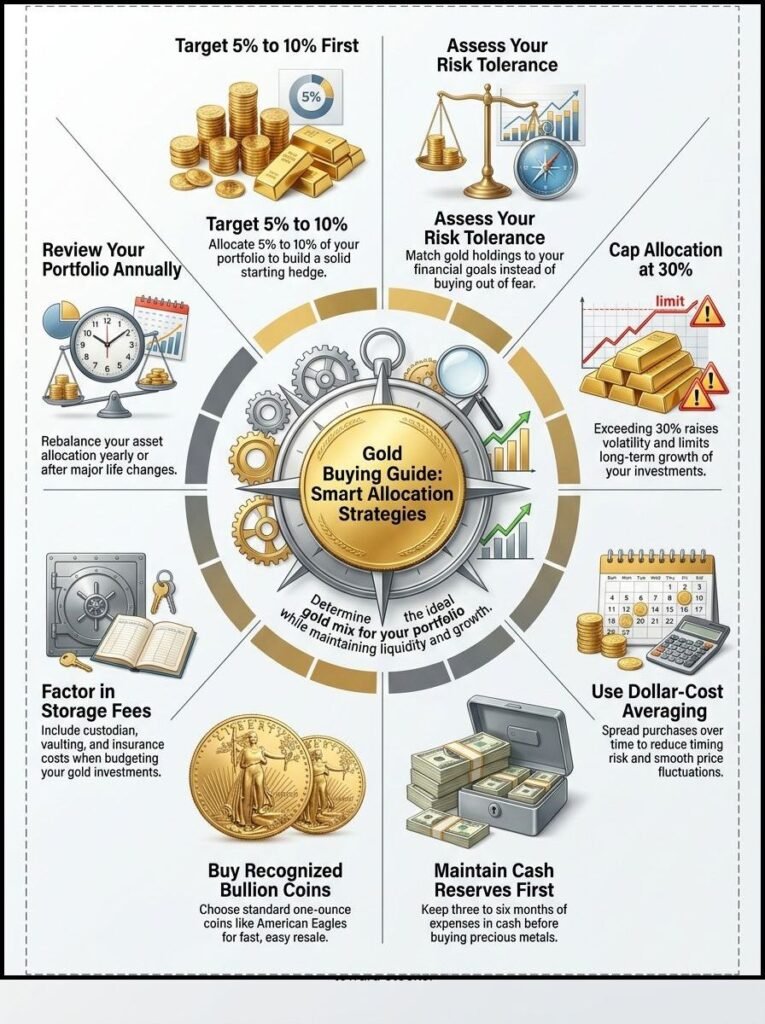
Calculate a target by multiplying the value of your investment portfolio by the percentage you are considering. For example, 5% of a $100,000 portfolio is $5,000, while 10% is $10,000. These are calculations, not recommendations.
Use the same portfolio definition consistently. If you have $100,000 in one IRA and $150,000 in another investment account, a $10,000 gold holding represents 4% of the combined $250,000 portfolio, rather than 10% of your overall investments.
Next, subtract the current value of existing gold exposure from your target. If your target is $10,000 and you already hold $7,000 in gold, the initial gap is $3,000, before allowing for fees and market changes.
For physical bullion, distinguish your cash outlay from the metal’s value. Money spent on a premium or setup fee is not necessarily recoverable when you sell. Our guide to gold coin premiums] explains this difference.
Use a consistent valuation method when reviewing your position. For physical gold, a realistic resale estimate is more useful for planning than assuming you can recover the full retail purchase price.
Choose an Ownership Method That Fits the Allocation
How you own gold affects expenses, access, and administrative work. It does not remove the underlying price risk.
Direct bullion ownership requires a storage and resale plan. Physically backed gold exchange-traded products can offer brokerage access without personal storage, but their expenses and structures still need review.
A Gold IRA is an account arrangement for holding eligible physical metal. It should not be confused with a separate asset that performs differently from gold itself. Mining stocks are also different: their returns reflect company operations and other business risks as well as the gold price.
Our comparison of physical gold, gold ETFs, and Gold IRAs covers the ownership decision in more detail. If you are considering physical metal within a retirement account, examine Gold IRA fees before deciding whether that structure is economical for your intended position.
For direct bullion purchases, widely traded coins and bars can make pricing and resale comparisons easier. Smaller products offer flexibility but may cost more per ounce. See our comparison of one-ounce and fractional gold coins if purchase size is an important part of your decision.
Arrange storage before buying. Our guide to storing gold securely explains practical considerations for personally owned bullion.
Build Your Position With a Defined Plan
Once you have chosen a target, decide how to approach it. Buying at once establishes exposure immediately. Spreading purchases over time reduces reliance on a single purchase date but may leave you with less exposure if prices rise while you are waiting.
Neither approach guarantees a better result. Repeated small bullion purchases can also increase the significance of shipping charges or product premiums.
Choose a method that fits your available funds and transaction costs, without allowing each purchase to become an excuse to raise the target. Our guide to buying gold all at once or over time compares the tradeoffs.
Review and Rebalance Your Gold Allocation
An allocation changes when gold moves, when other investments move, and when you add or withdraw money. A position can grow as a percentage even without another gold purchase.
For example, $5,000 of gold in a $100,000 portfolio represents 5%. If the gold rises to $7,000 while the other holdings remain at $95,000, it becomes approximately 6.9% of the new $102,000 total.
Set a review schedule and consider checking after major financial changes, including retirement or a change in withdrawal needs. A review does not always require a trade.
If your allocation has drifted substantially, consider whether new contributions or planned withdrawals can move it toward your target. Selling and buying may also be appropriate, but include taxes, spreads, and other costs in the decision.
Rebalancing manages exposure; it does not guarantee higher returns. A decline in gold should prompt a review of whether your original rationale and financial circumstances still hold, rather than an automatic purchase.
Common Gold Allocation Mistakes
Treating More Gold as More Protection
Gold can diversify some risks while adding others. A higher allocation magnifies its influence on your finances and can reduce income-producing or growth-oriented holdings.
Evaluate the result for your whole portfolio. Avoid measuring protection solely by the quantity of metal you own.
Letting Headlines Set the Percentage
Inflation reports, market losses, and geopolitical events can make an urgent purchase feel necessary. They do not establish how much gold fits your finances or whether its current price offers a favorable outcome.
Use your objectives and spending needs to guide allocation decisions. Be wary of sales claims that pressure you into a large purchase based on fear. Our guide to gold investment scams explains warning signs to watch for.
Overlooking Combined Exposure
Several gold holdings across different accounts still create exposure to the same underlying metal. Changing the ownership method does not necessarily add diversification.
Review the combined amount, including holdings acquired before your current allocation plan, and distinguish bullion exposure from mining-company investments.
Assuming You Can Sell Without Friction
The quoted market price is not necessarily the amount you will receive for a coin or bar. Dealer spreads, shipping, verification, and account procedures can affect proceeds and timing.
Understand the selling process before committing funds, particularly if withdrawals may depend on those proceeds.
Final Thoughts
The right gold allocation begins with a purpose, a budget, and a realistic understanding of risk. Percentage examples can help you compare exposure, but they cannot determine suitability on their own.
Consider what gold would replace, how it affects spending and income, and whether the costs fit the position you want to hold. If you choose gold, set a target and review it as your finances change. If you decide against it, make sure the rest of your plan still addresses diversification and purchasing power.
The goal is an allocation you can afford, understand, and maintain through unfavorable markets.
Frequently Asked Questions
How much gold should a beginner buy?
There is no required starting amount. First establish whether gold fits your finances and investment goals. If it does, choose a manageable position after accounting for existing investments, spending reserves, and purchase costs. You do not need to begin at 5% or increase your allocation as you gain experience.
Is 5% to 10% of a portfolio enough gold?
It is one range to evaluate, but there is no minimum amount needed for a sound portfolio. The effect depends on what else you own, what gold replaces, and market conditions. A smaller allocation or no gold may fit your needs better.
How much gold should a retiree own?
The answer depends on dependable income, withdrawal needs, other holdings, and tolerance for losses. Gold produces no income, so a retiree who relies heavily on portfolio withdrawals should carefully assess how it affects the spending plan. There is no percentage that every retiree should own.
Should I buy more gold when inflation rises?
Higher inflation does not automatically justify a larger allocation. Gold can lag consumer prices, and market prices may already reflect inflation concerns. Review your overall inflation strategy before changing your target.
Should gold replace stocks or bonds?
Adding gold to an existing portfolio usually means reducing another holding or directing new funds toward it. The important question is what function that money previously served. Gold does not provide the same income characteristics as bonds or the same connection to business growth as stocks.
Should I buy gold every month?
Monthly purchases are optional. They may help you spread purchases across dates, but they do not guarantee better returns and can increase transaction costs. Stop and review once you reach your chosen allocation rather than continuing indefinitely.
Can I own too much gold?
Yes. A position can be too large if it compromises liquidity, creates more price risk than you can tolerate, or reduces the resources available for other goals. Whether an allocation is excessive depends on your financial circumstances, not a single universal cutoff.