
Inflation can make a comfortable retirement budget feel tighter, even when your account balance looks healthy. Groceries, insurance, and other expenses rise, and the money you set aside must cover more expensive years ahead.
Gold is often promoted as protection against that problem. But preserving wealth over time and reliably covering rising retirement expenses are different jobs. Gold may help with the first, while offering much less certainty about the second.
Understanding that distinction can help you decide whether gold belongs in your retirement portfolio and what you should expect from it.
Quick Answer
Gold can help protect purchasing power in some market conditions, but it is not a dependable inflation hedge over the years when retirees need to fund withdrawals. Its price does not automatically rise with the Consumer Price Index, and it pays no interest or dividends. Gold is better considered a potential diversifier within a retirement plan that also addresses income, growth, and inflation directly.
Key Takeaways
Gold’s reputation as a store of value does not guarantee that it will keep pace with your retirement expenses. Your purchase price, holding period, and ownership costs all affect the outcome.
Gold may benefit from currency concerns, financial uncertainty, or falling real interest rates. These influences can also outweigh inflation itself, so rising consumer prices do not guarantee rising gold prices.
Treasury Inflation-Protected Securities, or TIPS, have a direct inflation adjustment. Stocks and real estate may provide growth or rising income, but neither offers guaranteed inflation protection.
A gold allocation should fit your withdrawal needs and tolerance for losses. There is no percentage that every retiree needs to own, and a retirement portfolio can address inflation without including gold.
What Does Inflation Protection Mean in Retirement?
An inflation hedge helps preserve what your money can buy as prices rise. For retirees, the practical question is whether your savings and income can keep covering expenses throughout retirement.
Consider a simple hypothetical example. If annual expenses are $40,000 and rise by 3% each year, the same spending would cost about $53,800 after ten years. That is an illustration, not an inflation forecast, but it shows why a fixed dollar income can gradually fall behind.
Your personal spending may also increase at a different rate from the Consumer Price Index. Someone facing substantial healthcare or insurance increases may feel more pressure than the headline inflation figure suggests.
This makes the timing of investment returns important. An asset might eventually recover its purchasing power yet still disappoint during the years you need to sell it. Selling investments after a decline to cover rising expenses can leave fewer assets available for a recovery.
Gold therefore needs to be evaluated against your spending timeline, rather than its reputation alone.
Why Gold Has a Reputation as an Inflation Hedge
Gold is a tangible asset with a long history as a form of wealth. Its supply cannot be expanded through monetary policy in the way a currency’s supply can, which helps explain its appeal when investors worry about the value of money.
Physical bullion also does not depend on a company’s earnings or a borrower’s promise to repay. However, that does not remove price risk, theft risk, or risks associated with storage and intermediaries.
Investors sometimes turn to gold when confidence in currencies or financial markets weakens. That demand can support its price during certain inflationary or stressful periods.
The important limitation is that scarcity does not create an automatic connection to consumer prices. Gold is bought and sold in a market, and its price reflects changing demand and expectations. Its history as a store of value is a reason to examine it, rather than proof that it will protect a particular retirement budget.
Does Gold Actually Keep Up With Inflation?
Gold can outperform inflation over some periods and fall behind over others. Extending the holding period does not guarantee a positive return after inflation, especially once ownership costs are included.
In their research paper The Golden Dilemma, Claude Erb and Campbell Harvey examined gold’s inflation-hedging reputation. They found that its very long historical relationship with purchasing power does not make it a reliable inflation hedge over practical investment horizons.
That distinction matters for retirement planning. A historical argument spanning centuries cannot tell you whether gold will cover higher living costs over the next five, ten, or twenty years.
Why Gold Can Fall When Inflation Rises
Inflation is only one influence on gold. Interest rates, currency movements, investor demand, and expectations about future economic conditions also affect its price.
Real interest rates describe interest rates after accounting for inflation. Higher real yields can make interest-bearing investments more attractive relative to gold, which produces no income. Falling real yields can reduce that opportunity cost. These are influences, rather than dependable trading signals.
A stronger U.S. dollar can also put pressure on dollar-denominated gold prices. Meanwhile, investors may have bought gold in anticipation of inflation before the higher consumer-price figures appear.
As a result, inflation can remain elevated while gold declines. Gold can also rise when inflation is easing. Neither outcome is inconsistent with a market responding to several forces at once.
Purchasing Power Depends on More Than the Gold Price
An increase in gold’s quoted price does not necessarily mean your investment has preserved purchasing power. You need to account for inflation, purchase premiums, selling spreads, and any ongoing expenses.
For example, if gold rises by 5% while consumer prices rise by 6%, it has lost purchasing power over that period before costs. If you also paid a substantial premium when buying, your own result could be weaker than the change in the market price suggests.
This is why gold’s performance should be judged by what the proceeds can buy after costs, rather than the dollar price alone.
Where Gold Can Help a Retirement Portfolio
Gold’s most useful role may be diversification. It has different price drivers from stocks and bonds, so it can sometimes perform well when other holdings struggle.
If gold rises during a difficult market period, it may provide an asset you can sell or rebalance while avoiding some sales of depressed holdings. However, that benefit depends on how the assets actually perform. Gold can fall alongside other investments, and diversification does not eliminate losses.
Some investors also value physical ownership as a way to hold part of their wealth outside conventional securities. That preference can be reasonable when it fits their finances and they understand the storage and resale responsibilities.
The useful question is whether gold adds something your existing portfolio needs. Buying it simply because inflation feels worrying is less helpful than identifying a clear role and deciding how much risk that role justifies.
Where Gold Falls Short for Retirees
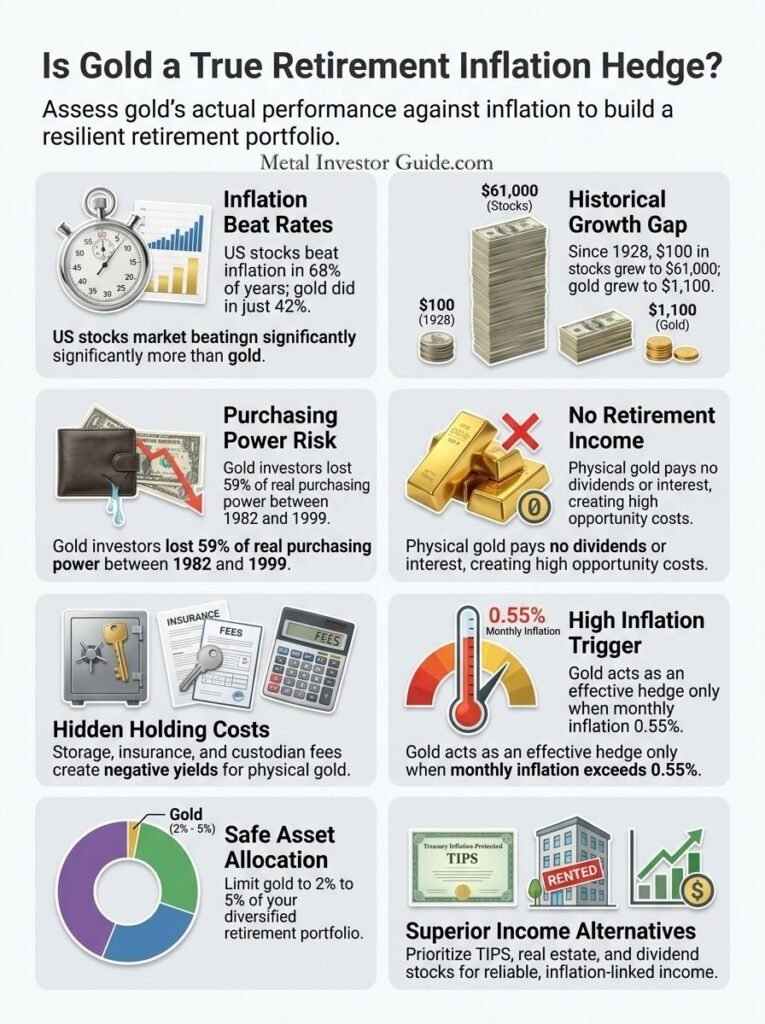
Gold pays no interest or dividends. To use it for living expenses, you generally need to sell some of it, and the price available when you sell may be disappointing.
Selling assets is a normal part of many retirement plans. The difficulty is relying heavily on a volatile holding that offers no cash flow while you wait for a recovery. A large gold position can also reduce the money available for investments that support income or long-term growth.
Physical gold introduces additional costs. Dealer premiums and selling spreads can make short holding periods expensive, while storage and insurance can reduce returns over time. Our guide to gold coin premiums explains why the amount you pay can differ from the quoted gold price.
Finally, gold has no promise to return your purchase price on a particular date. A long history of value does not protect an individual buyer from an unfavorable entry price or a prolonged decline.
How Gold Compares With Other Inflation Defenses
A retirement plan can use several approaches to inflation because each addresses a different need. Gold offers possible diversification, while other investments may provide more direct inflation adjustments, income, or growth.
TIPS Offer a Direct Inflation Adjustment
TIPS are U.S. Treasury securities whose principal adjusts with a specified Consumer Price Index measure. They pay interest every six months on the adjusted principal. At maturity, Treasury pays the inflation-adjusted principal or the original principal, whichever is greater, as explained by TreasuryDirect.
That makes individual TIPS a more direct tool for planning around inflation-linked spending than gold. Their protection still has limits: prices can fall if you sell before maturity, taxes can affect returns, and the index may not match your personal expenses. If you pay above the original principal when purchasing, the maturity floor does not guarantee recovery of your full purchase price.
A TIPS fund also differs from an individual bond held to maturity. Its share price fluctuates, and you do not receive an individual bond’s maturity payment simply by holding the fund.
Stocks Can Support Long-Term Spending Growth
Businesses may raise prices, grow earnings, and increase dividends over time. A diversified stock allocation can therefore help support spending across a long retirement.
That potential comes with market risk. Inflation can squeeze profit margins, dividends can be cut, and stock prices can decline sharply. Dividend-paying stocks are not automatically safer or better inflation hedges than other stocks.
The value of equities in a retirement plan is their potential contribution to growth and total return, rather than a promise to track inflation each year.
Bonds, Cash, and Real Estate Serve Different Needs
High-quality bonds and cash can support near-term spending and reduce the need to sell volatile holdings during a downturn. However, fixed payments and cash balances can lose purchasing power when inflation outpaces their returns.
Real estate may benefit from rising rents or property values, but financing, maintenance, vacancy, and local conditions affect the result. Real estate investment trusts also face market and interest-rate risk.
These tradeoffs explain why an inflation plan usually needs more than one tool. An investment can be useful for retirement without being a reliable inflation hedge by itself.
How Much Gold Should a Retiree Consider?
There is no universal gold allocation for retirees. The appropriate amount, including no gold at all, depends on your income sources, withdrawal needs, other holdings, ownership costs, and ability to tolerate losses.
Someone whose essential expenses are largely covered by dependable income may have different flexibility from someone who relies heavily on portfolio withdrawals. Even then, a large gold position introduces concentration risk and reduces exposure to other sources of return.
For retirees who choose gold, a modest supporting allocation is generally easier to integrate into a diversified plan than a position expected to fund most retirement spending. The exact percentage requires a broader assessment than this inflation question alone. Our guide to how much gold you should buy discusses allocation considerations in more detail.
Set a target and a review process before buying. Rebalancing can help prevent a price surge from turning a small holding into a dominant one, but transaction costs and taxes should influence how you implement it. A price decline should also prompt a review of your plan, rather than an automatic decision to buy more.
Does the Way You Own Gold Change Its Inflation Protection?
The ownership method changes costs, convenience, and account rules. It does not make the underlying metal a more dependable inflation hedge.
Directly owned bullion offers tangible possession but requires arrangements for storage, insurance, and resale. Physically backed gold exchange-traded products can provide convenient brokerage access, although they charge expenses and have their own structures and risks.
Mining stocks are a different investment. Their returns depend on business factors such as operating costs, debt, and management, as well as gold prices. They should not be treated as interchangeable with bullion.
A Gold IRA is an account arrangement for holding eligible physical metals, rather than a separate asset with better inflation performance. The IRS explains that qualifying bullion must meet fineness requirements and remain in the physical possession of a bank or approved nonbank trustee. Buying metal for an IRA should not be confused with buying bullion for personal home storage.
For the broader ownership decision, see our comparison of physical gold, gold ETFs, and Gold IRAs. If you are considering physical metal inside an IRA, review Gold IRA fees before deciding whether the added costs fit your intended allocation.
Final Thoughts
Gold can contribute to a retirement portfolio, but its reputation as an inflation hedge deserves careful qualification. It may preserve purchasing power over some periods or provide diversification during uncertainty. It can also lag inflation, fall in price, and create ownership costs while producing no income.
Start with the expenses your retirement plan must cover, the income available to cover them, and the investments needed for future growth. Then consider whether gold improves that plan at a size and cost you can manage.
You do not need to own gold to address inflation. If you choose to include it, give it a defined supporting role and realistic expectations.
Frequently Asked Questions
Does gold always go up when inflation rises?
No. Gold responds to interest rates, currency movements, investor demand, and economic expectations as well as inflation. It can decline even while consumer prices continue to rise.
Is gold better than TIPS for retirement inflation protection?
TIPS offer a direct inflation adjustment, making them more closely suited to planning for CPI-linked expenses. Gold may offer diversification, but it has no contractual inflation adjustment or income payment. The two serve different purposes.
Can gold protect against inflation over a long retirement?
It may help, but a long holding period does not guarantee inflation-beating returns. Your purchase price, the period you hold it, ownership costs, and the timing of sales all matter.
Is a Gold IRA safer than other ways of owning gold?
A Gold IRA does not remove gold’s market risk or guarantee inflation protection. It changes how eligible metal is held within a retirement account and adds custody requirements and expenses. Its suitability depends on your account needs and the total cost.
Should retirees move their savings into gold when inflation rises?
A major shift based on inflation headlines can create concentration risk and disrupt a withdrawal plan. Review your overall inflation exposure, income needs, and diversification first. If gold has a role, decide on that role and its size before buying.