
Not all gold coins are created equal. While many contain the same amount of gold, they can differ significantly in liquidity, resale value, dealer premiums, security features, and long-term investment appeal. Choosing the right coin from the beginning can save you money, make your investment easier to sell, and help you avoid costly mistakes that many first-time buyers don’t realize until it’s too late.
One of the biggest surprises for new investors is that experienced gold buyers don’t spend much time debating dozens of different coins. Instead, they tend to build their portfolios around a relatively small group of widely recognized bullion coins that have earned a reputation for strong market acceptance, competitive pricing, and reliable resale. Knowing which coins have earned that reputation, and why, can make your buying decisions much simpler.
Of course, selecting the best gold coin isn’t just about popularity. The right choice depends on several practical factors, including premiums over the spot price, purity, durability, global recognition, Gold IRA eligibility, and how easily the coin can be sold when the time comes. Understanding these differences helps you buy with confidence instead of relying solely on dealer recommendations or marketing claims.
In this guide, we’ll compare the world’s leading investment-grade gold coins, explain what makes each one stand out, and help you determine which coins best match your investing goals and budget. By the end, you’ll know which gold coins experienced investors buy repeatedly, which features matter most, and how to choose a coin you can feel confident owning for years to come.
Quick Answer: What Are the Best Gold Coins for Investors?
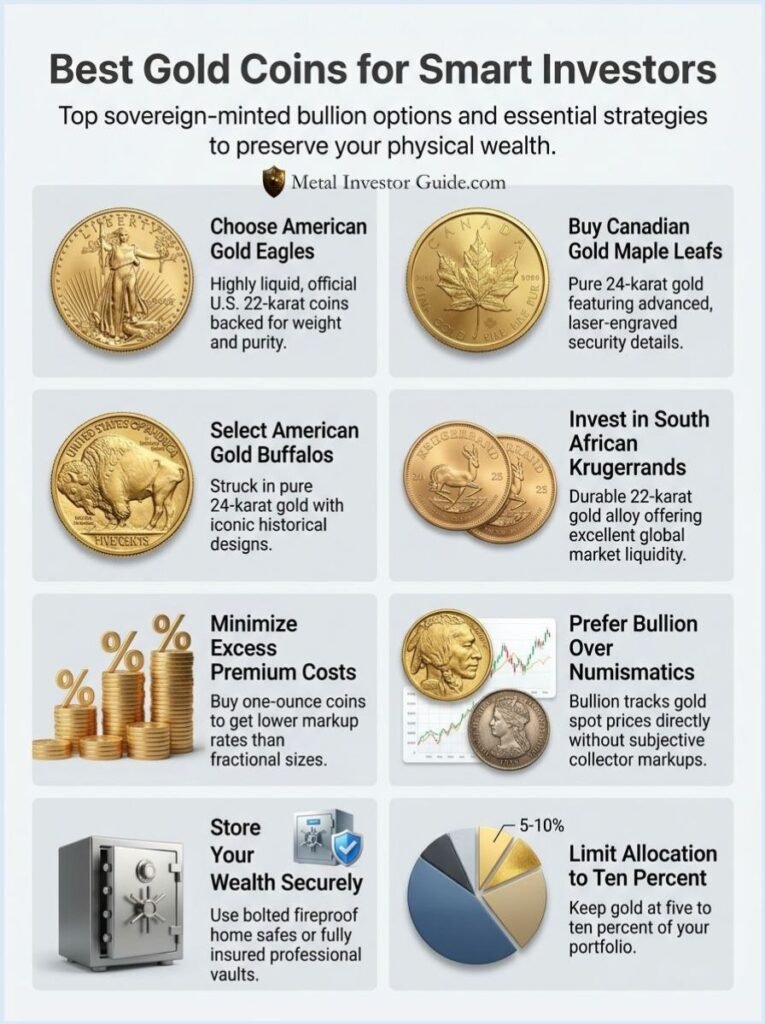
For most investors, the best gold coins are widely recognized government-issued bullion coins with strong liquidity, competitive premiums, and an established resale market. If you’re looking for coins that are easy to buy, easy to verify, and easy to sell, four consistently stand above the rest: the American Gold Eagle, American Gold Buffalo, Canadian Gold Maple Leaf, and South African Krugerrand.
These coins have earned the trust of investors around the world because they combine sovereign mint backing with decades of market acceptance. They are actively traded by precious metals dealers, widely recognized by buyers, and have proven track records as long-term investment vehicles.
- American Gold Eagle: The best all-around choice for most U.S. investors thanks to exceptional liquidity, widespread dealer acceptance, and strong resale value. Available in 1 oz, 1/2 oz, 1/4 oz, and 1/10 oz sizes.
- American Gold Buffalo: An excellent option for investors who prefer .9999 fine (24-karat) gold while still benefiting from the recognition and confidence that comes with a U.S. Mint bullion coin.
- Canadian Gold Maple Leaf: One of the world’s purest bullion coins, prized for its .9999 gold content, advanced anti-counterfeit features, and strong international recognition.
- South African Krugerrand: A globally respected bullion coin known for its long history, competitive pricing, and broad acceptance in precious metals markets around the world.
If you’re unsure where to begin, the American Gold Eagle is often the safest starting point for U.S. investors because it offers an outstanding combination of liquidity, durability, and market recognition. However, each of these coins has unique strengths, and the best choice ultimately depends on your priorities, whether that’s maximum purity, lower premiums, Gold IRA eligibility, or international resale.
The sections below compare each coin in detail and explain the factors that matter most, including liquidity, premiums, purity, security features, and long-term investment value, so you can choose the gold coin that best fits your goals.
Quick Recommendations
If you’re looking for a fast recommendation, this table summarizes which gold coins are generally the best fit for different investment priorities.
| If your priority is… | Recommended Coin |
|---|---|
| Best overall for most U.S. investors | American Gold Eagle |
| Highest gold purity | American Gold Buffalo |
| Best combination of purity and security | Canadian Gold Maple Leaf |
| Historically competitive pricing | South African Krugerrand |
The remainder of this guide explains why each of these coins stands out, along with the differences in liquidity, premiums, purity, security features, and long-term investment value so you can choose the option that best fits your goals.
Key Takeaways
Choosing the right gold coin is about more than buying gold. The best investment coins combine strong market recognition, reasonable premiums, and reliable resale value, making them easier to buy, hold, and sell with confidence.
- Choose liquidity over novelty: Widely recognized government-issued bullion coins are generally easier to buy, verify, and resell than obscure or collectible coins.
- The American Gold Eagle is the benchmark for many U.S. investors: Its exceptional liquidity, broad dealer acceptance, and long history make it one of the safest choices for building a gold portfolio.
- One-ounce bullion coins usually provide the best value: They typically carry lower premiums per ounce than fractional coins while remaining highly liquid.
- Compare the total cost of ownership, not just the purchase price: Dealer premiums, buyback policies, and resale spreads can have a meaningful impact on your long-term return.
- Choose the coin that fits your goals: Whether you prioritize maximum purity, Gold IRA eligibility, lower premiums, or global recognition, understanding the strengths of each coin will help you make a more confident investment decision.
Why Gold Coins Are a Popular Investment
While investors can gain exposure to gold in many different ways, including bars, exchange-traded funds (ETFs), mining stocks, and collectible coins, experienced investors often return to the same choice: widely recognized government-issued bullion coins. They offer an ideal balance of liquidity, security, market acceptance, and long-term investment value, making them one of the most practical ways to own physical gold.
Unlike collectible coins, which derive much of their value from rarity and condition, bullion coins are valued primarily for their gold content. That makes pricing more transparent and resale much more straightforward. Coins from respected government mints also follow standardized specifications for weight, purity, and dimensions, giving both buyers and dealers greater confidence during transactions.
Why Investors Prefer Government-Issued Bullion Coins
Government-issued bullion coins have earned their reputation over decades of active trading. Because they are produced by sovereign mints with consistent quality standards, they are widely recognized by dealers, investors, and financial institutions around the world. That recognition often translates into faster authentication, stronger demand, and more competitive resale prices.
For investors, these advantages matter far more than an attractive design or limited mintage. When the time comes to sell, choosing a coin that buyers already know and trust can make the process quicker, easier, and potentially more profitable.
The primary advantages of government-issued bullion coins include:
- Excellent liquidity: Popular bullion coins are actively traded and widely accepted by precious metals dealers.
- Consistent specifications: Standardized weight, purity, and dimensions make verification straightforward.
- Strong market recognition: Well-known coins typically attract more buyers and tighter buyback spreads.
- Modern security features: Many leading mints incorporate advanced anti-counterfeiting technology to help protect investors.
- Long-established investor confidence: Decades of market acceptance provide reassurance for both new and experienced buyers.
Gold Coins vs Other Forms of Physical Gold
Although gold coins are an excellent choice for many investors, they are not the only way to own physical gold. Gold bars can offer lower premiums for larger purchases, while collectible coins appeal to numismatists who value rarity more than bullion content.
For most investors, however, bullion coins provide the best balance of convenience and flexibility. They are widely available, easy to authenticate, and generally easier to sell than collectible coins. That combination has made them the preferred choice for individuals looking to build or preserve wealth through physical gold.
Understanding why bullion coins have become the market standard makes it much easier to evaluate the individual coins themselves. The next section explains the specific characteristics that separate a good investment coin from an average one.
Bullion Coins vs Gold Bars and Collectible Coins
Although investors can own physical gold in several forms, bullion coins remain the preferred choice for many individuals because they offer an excellent balance of liquidity, security, and ease of resale. While gold bars and collectible coins each have their advantages, widely recognized bullion coins are often the most practical option for investors focused on preserving wealth over the long term.
| Investment Type | Best For | Considerations |
|---|---|---|
| Bullion Gold Coins | Most investors | Easy to buy, widely recognized, simple to verify, and typically the easiest physical gold products to resell. Available in multiple sizes to suit different budgets. |
| Gold Bars | Larger investments | Often carry lower premiums per ounce, especially in larger sizes, but can be less convenient to sell in small portions and may require additional verification. |
| Collectible (Numismatic) Coins | Experienced collectors | Value depends on rarity, condition, and collector demand rather than gold content alone. They typically carry higher premiums and are generally not the best choice for investors seeking straightforward exposure to gold. |
For most investors, government-issued bullion coins provide the best combination of transparency, flexibility, and long-term market acceptance. Their standardized weight, purity, and worldwide recognition make them easier to authenticate and easier to sell than many alternative forms of physical gold.
Now that we’ve established why bullion coins are the preferred choice for many investors, let’s look at the characteristics that separate an excellent investment coin from an average one.
What Makes a Gold Coin Good for Investing?
The best investment coins all share a few important characteristics. They are easy to verify, widely recognized by dealers, competitively priced, and straightforward to sell when the time comes. Those qualities matter far more than an attractive design or a limited mintage.
Before comparing specific coins, it’s helpful to understand the factors experienced investors consistently consider when evaluating physical gold investments.
- Liquidity: The best investment coins are actively traded and widely recognized, making them easier to sell quickly and often at more competitive prices.
- Reasonable premiums: Paying less over the spot price helps maximize the value of your investment. Comparing premiums before you buy can significantly improve your long-term results.
- Gold purity and composition: Understanding a coin’s purity and alloy helps you compare products and choose the option that best matches your investment goals.
- Global recognition: Coins produced by respected government mints typically enjoy stronger demand and greater acceptance around the world.
- Reliable security features: Modern anti-counterfeiting technology makes leading bullion coins easier to authenticate and helps protect buyers from counterfeit products.
Liquidity and Ease of Resale
Liquidity is one of the most important characteristics of a successful investment coin. The easier a coin is to recognize and verify, the easier it is for dealers to quote competitive buyback prices.
That’s one reason the American Gold Eagle, Canadian Gold Maple Leaf, American Gold Buffalo, and South African Krugerrand consistently rank among the most popular investment coins. Their long histories, broad dealer acceptance, and worldwide recognition help create active resale markets.
If you’re buying multiple coins over time, consider building your collection around one or two widely recognized bullion coins. A consistent collection can simplify future resale and make it easier to compare dealer buyback offers.
Premiums Over the Spot Price
Premiums are an important part of the total cost of investing in physical gold. Even when two coins contain the same amount of gold, differences in dealer premiums can affect your overall return when you eventually sell.
In general, one-ounce bullion coins tend to offer the best value because they usually carry lower premiums per ounce than fractional coins. Before making a purchase, compare both the premium and the dealer’s buyback policy to understand your true round-trip cost.
For a more detailed explanation of how premiums work and how to evaluate them, see our guide to Gold Coin Premiums Explained.
Gold Purity and Coin Composition
Gold purity is an important consideration, but it isn’t the only factor that affects an investment coin’s value. Composition also influences durability, handling, and investor preference.
- 24-karat (.9999 fine) gold: Coins such as the American Gold Buffalo and Canadian Gold Maple Leaf offer maximum gold purity and are popular with investors seeking nearly pure gold.
- 22-karat (91.67% gold): Coins such as the American Gold Eagle and South African Krugerrand contain the same stated amount of gold but include copper and silver alloys that improve durability.
Neither option is inherently better. The right choice depends on your priorities, whether that’s maximum purity, long-term durability, or compatibility with your overall investment strategy.
Recognition and Global Acceptance
One of the greatest advantages of buying well-known bullion coins is that they are recognized by dealers and investors throughout the world. That recognition often results in quicker authentication, stronger demand, and more competitive resale prices.
For most investors, sticking with established government-issued bullion coins reduces uncertainty and helps make future transactions simpler. Coins such as the American Gold Eagle, Canadian Gold Maple Leaf, American Gold Buffalo, and South African Krugerrand have earned their reputations through decades of active trading and broad market acceptance.
Security Features and Counterfeit Protection
Counterfeit protection is another important consideration when buying physical gold. Fortunately, many of the world’s leading government mints incorporate sophisticated security features that make their bullion coins easier to authenticate.
Examples include radial lines, micro-engraved security marks, laser-engraved details, and other anti-counterfeiting technologies designed to help verify authenticity.
Regardless of which coin you choose, always purchase from reputable dealers and verify multiple characteristics, including weight, dimensions, and visible security features. Taking a few extra minutes to confirm authenticity can provide valuable peace of mind and help protect your investment.
The Best Gold Coins for Investors
The coins below have earned their reputations through decades of active trading, strong dealer recognition, and broad acceptance among investors around the world. While each has its own strengths, all are excellent choices for investors seeking physical gold with reliable long-term liquidity.
As you compare them, think about what matters most to you. Some investors prioritize maximum purity, while others value lower premiums, stronger U.S. resale markets, or advanced security features. The best gold coin is the one that best aligns with your investment goals.
American Gold Eagle
The American Gold Eagle has been the benchmark for U.S. bullion investing since its introduction in 1986. Produced by the United States Mint, it is available in 1 oz, 1/2 oz, 1/4 oz, and 1/10 oz sizes, making it suitable for investors with a wide range of budgets.
Although it is a 22-karat coin (91.67% gold), each coin still contains its full stated weight of pure gold. The addition of copper and silver alloys makes it more durable than many 24-karat alternatives while maintaining exceptional market acceptance.
- Best for: Most U.S. investors seeking outstanding liquidity, broad dealer recognition, and excellent resale value.
- Why investors choose it: Widely accepted by dealers, available in multiple sizes, highly liquid, and commonly used for Gold IRA investments.
- Things to consider: Investors who prefer maximum gold purity may favor a .9999 fine coin such as the American Gold Buffalo or Canadian Gold Maple Leaf.
Canadian Gold Maple Leaf
First issued in 1979 by the Royal Canadian Mint, the Canadian Gold Maple Leaf is one of the world’s best-known .9999 fine gold bullion coins. It has earned an outstanding reputation for purity and incorporates some of the most advanced anti-counterfeiting technology available on modern bullion coins.
- Best for: Investors who prioritize maximum purity and industry-leading security features.
- Why investors choose it: .9999 fine gold, excellent international recognition, advanced anti-counterfeit technology, and strong global liquidity.
- Things to consider: Premiums may occasionally be slightly higher than those of comparable bullion coins because of its popularity and advanced security features.
American Gold Buffalo
Introduced in 2006, the American Gold Buffalo was the first .9999 fine gold bullion coin issued by the United States Mint. It combines exceptional purity with the confidence that comes from U.S. Mint production.
- Best for: Investors who want .9999 fine gold backed by the U.S. Mint.
- Why investors choose it: Exceptional purity, strong dealer recognition, excellent resale potential, and familiar U.S. Mint backing.
- Things to consider: Bullion versions are produced only in the one-ounce size, making them less flexible for investors with smaller budgets.
South African Krugerrand
Since its introduction in 1967, the South African Krugerrand has become one of the world’s most recognizable bullion coins. Its durable 22-karat alloy and long history have made it a favorite among precious metals investors for decades.
- Best for: Investors seeking worldwide recognition and historically competitive pricing.
- Why investors choose it: Strong international liquidity, durable alloy, long track record, and competitive premiums.
- Things to consider: If you’re purchasing gold for a Gold IRA, confirm that the specific coin meets current IRS eligibility requirements before buying.
Austrian Gold Philharmonic
Introduced in 1989, the Austrian Gold Philharmonic is Europe’s best-known bullion coin and enjoys strong recognition throughout international precious metals markets. Its .9999 gold purity and elegant design have made it a popular choice for investors around the world.
- Best for: Investors seeking a highly respected European bullion coin.
- Why investors choose it: High purity, broad international recognition, and active trading in both European and U.S. markets.
- Things to consider: While widely recognized, it may not be stocked as consistently as American Gold Eagles by some smaller U.S. dealers.
British Britannia
The British Britannia has become one of the Royal Mint’s flagship bullion products. Modern issues combine .9999 fine gold with several sophisticated security features designed to help deter counterfeiting while maintaining excellent global recognition.
- Best for: Investors looking for a highly secure bullion coin backed by one of the world’s oldest mints.
- Why investors choose it: Advanced security features, .9999 purity, strong international reputation, and reliable liquidity.
- Things to consider: Availability may vary slightly depending on local dealer inventory compared with more common North American bullion coins.
Australian Gold Kangaroo
Produced by the Perth Mint, the Australian Gold Kangaroo combines .9999 fine gold with changing annual designs and modern authentication features. It has become a respected choice for investors seeking both purity and sovereign mint backing.
- Best for: Investors who value high purity and modern anti-counterfeiting technology.
- Why investors choose it: Perth Mint reputation, .9999 gold purity, micro-laser security feature, and strong international demand.
- Things to consider: Annual design changes can sometimes result in slightly higher premiums than more standardized bullion coins.
Chinese Gold Panda
Issued under the authority of the People’s Bank of China, the Chinese Gold Panda is known for its annually changing panda designs and strong collector appeal while remaining an investment-grade bullion coin.
- Best for: Investors who appreciate both bullion value and collectible appeal.
- Why investors choose it: Beautiful annual designs, strong international recognition, and high gold purity.
- Things to consider: Modern bullion Pandas are measured in grams rather than troy ounces, so comparing prices requires a little extra attention.
Gold Coin Comparison Table
Choosing the right gold coin isn’t just about buying the purest gold or finding the lowest premium. The best choice depends on your investment goals. Some investors prioritize liquidity and resale value, while others focus on maximum purity, lower premiums, or international recognition.
The tables below provide two ways to compare the leading bullion coins. The first helps you identify the best coin based on your investing priorities, while the second compares the key characteristics of each coin side by side.
Which Gold Coin Is Best for Your Investment Goals?
| If your priority is… | Recommended Coin | Why It Stands Out |
|---|---|---|
| Best overall for most U.S. investors | American Gold Eagle | Outstanding liquidity, broad dealer acceptance, and multiple size options. |
| Highest gold purity | American Gold Buffalo | .9999 fine gold backed by the United States Mint. |
| Best combination of purity and security | Canadian Gold Maple Leaf | .9999 fine gold with advanced anti-counterfeiting features. |
| Historically competitive pricing | South African Krugerrand | Strong global recognition with consistently competitive premiums. |
| Best European bullion coin | Austrian Gold Philharmonic | Highly respected throughout Europe with excellent international liquidity. |
| Best modern security features | British Britannia | Multiple anti-counterfeiting technologies introduced by the Royal Mint. |
| Strong sovereign backing with innovative security | Australian Gold Kangaroo | Perth Mint quality combined with micro-laser authentication. |
| Bullion coin with added collector appeal | Chinese Gold Panda | Annual design changes while maintaining investment-grade bullion status. |
Compare the Leading Gold Bullion Coins
| Coin | Purity | Typical Premium | U.S. Liquidity | Best For |
|---|---|---|---|---|
| American Gold Eagle | 22 karat (91.67% gold) | Low to Moderate | Very High | Most U.S. investors seeking outstanding liquidity and resale value. |
| Canadian Gold Maple Leaf | .9999 fine gold | Moderate | Very High | Investors who prioritize purity and advanced security features. |
| American Gold Buffalo | .9999 fine gold | Moderate | High | Investors seeking maximum purity with U.S. Mint backing. |
| South African Krugerrand | 22 karat (91.67% gold) | Low to Moderate | High | Investors looking for competitive pricing and worldwide recognition. |
| Austrian Gold Philharmonic | .9999 fine gold | Moderate | High | Investors seeking a respected European bullion coin. |
| British Britannia | .9999 fine gold | Moderate | High | Investors who value modern security features and Royal Mint quality. |
| Australian Gold Kangaroo | .9999 fine gold | Moderate | Moderate to High | Investors seeking Perth Mint quality and innovative security features. |
| Chinese Gold Panda | Commonly .999 fine gold | Moderate to High | Moderate | Investors who appreciate both bullion value and collectible appeal. |
No matter which coin you choose, sticking with well-established government-issued bullion coins is usually the safest approach. These coins have earned decades of trust among investors because they combine recognized purity standards, strong dealer acceptance, and dependable resale markets. For most investors, those qualities matter far more than owning the newest design or the rarest coin.
Should You Buy One-Ounce or Fractional Gold Coins?
For most investors, one-ounce gold coins offer the best combination of lower premiums, strong liquidity, and long-term value. They are the industry standard, making them easier to compare, buy, and sell than smaller denominations.
That doesn’t mean fractional coins are a poor choice. They can be an excellent option for investors with smaller budgets, those building a position over time, or anyone who values the flexibility of selling smaller portions of their holdings. The right choice ultimately depends on your budget, investing strategy, and long-term goals.
| Feature | One-Ounce Coins | Fractional Coins |
|---|---|---|
| Premium per ounce | Generally lower | Generally higher |
| Initial investment | Higher | Lower |
| Liquidity | Excellent | Excellent, but with higher premiums |
| Best suited for | Long-term investors seeking maximum value | Investors building positions gradually or seeking greater flexibility |
Advantages of One-Ounce Gold Coins
One-ounce coins are the benchmark for physical gold investing. They are actively traded around the world and typically provide the best value because their premiums, measured as a percentage of the gold’s value, are usually lower than those of fractional coins.
Benefits include:
- Lower premiums: One-ounce coins generally cost less per ounce than smaller denominations.
- Excellent liquidity: Dealers buy and sell one-ounce bullion coins every day, making them easy to resell.
- Simple pricing: Comparing premiums and dealer buyback offers is straightforward because the one-ounce coin is the market standard.
- Efficient long-term investing: Investors focused on accumulating gold over many years often build their core holdings with one-ounce coins.
When Fractional Gold Coins Make Sense
Fractional gold coins can be an excellent choice when flexibility is more important than minimizing premiums. Although they cost more per ounce, they make physical gold ownership accessible to a wider range of investors.
Fractional coins may be the better choice if you:
- Have a smaller budget: You can begin investing without waiting until you can afford a full ounce.
- Plan to buy regularly: Purchasing smaller coins over time can be an effective way to build a long-term position.
- Want greater selling flexibility: Selling a single fractional coin may be easier than selling an entire one-ounce coin when you only need a portion of your investment.
Many experienced investors eventually own both. They build the core of their portfolio with one-ounce bullion coins while keeping a few fractional coins for additional flexibility if they ever need to liquidate part of their holdings.
Understanding the Premium Difference
The primary tradeoff with fractional coins is cost. Manufacturing, handling, and distribution expenses are spread across less gold, so smaller coins typically carry higher premiums per ounce than one-ounce coins.
That doesn’t necessarily make them a poor investment. The additional flexibility can easily justify the higher premium for many buyers, especially those investing gradually or working within a fixed budget.
For a more detailed explanation of how premiums affect your total investment cost and long-term returns, see our guide to Gold Coin Premiums Explained.
Bullion Coins vs Numismatic Coins
One of the most common mistakes new gold investors make is paying collectible prices for coins they intend to hold as investments. Before you buy, it’s important to understand the difference between bullion coins and numismatic coins, because they serve very different purposes.
For most investors, bullion coins are the better choice. They offer transparent pricing, excellent liquidity, and are valued primarily for their gold content rather than collector demand. Numismatic coins, on the other hand, can appreciate in value, but they require specialized knowledge and carry additional risks that many beginning investors don’t fully appreciate.
| Feature | Bullion Coins | Numismatic Coins |
|---|---|---|
| Primary value | Gold content plus a modest premium | Rarity, condition, age, and collector demand |
| Pricing | Closely follows the spot price of gold | Determined largely by the collector market |
| Premiums | Generally lower and more predictable | Often significantly higher |
| Liquidity | Excellent for widely recognized bullion coins | Varies depending on collector demand |
| Best suited for | Investors building long-term wealth | Experienced collectors and numismatic enthusiasts |
What Is a Bullion Coin?
Bullion coins are investment-grade coins valued primarily for their gold content. Their prices closely follow the market value of gold, plus a dealer premium, making them straightforward to understand and compare.
Popular bullion coins include the American Gold Eagle, Canadian Gold Maple Leaf, American Gold Buffalo, South African Krugerrand, Austrian Gold Philharmonic, British Britannia, Australian Gold Kangaroo, and Chinese Gold Panda. These coins are widely recognized by dealers around the world, making them relatively easy to buy, verify, and resell.
What Is a Numismatic Coin?
Numismatic coins derive much of their value from factors beyond their gold content, including rarity, historical significance, condition, and collector demand. Two coins containing the same amount of gold can have dramatically different values if one is considered scarce or highly collectible.
While numismatic coins can appreciate significantly under the right circumstances, they also require greater expertise. Buyers need to understand grading standards, market demand, authenticity, and collector trends, all of which introduce additional uncertainty.
Which Type Is Better for Most Investors?
If your goal is building long-term wealth through physical gold, bullion coins are usually the better choice. They provide transparent pricing, broad dealer acceptance, and a predictable resale market, making them well suited for investors who want straightforward exposure to gold.
Numismatic coins can certainly have a place in a collection, but they should generally be viewed as a separate category of investment. Most experienced precious metals investors build the foundation of their portfolio with widely recognized bullion coins and only explore collectible coins if they have a specific interest in numismatics and understand the additional risks involved.
How Much Gold Should You Buy?
Choosing the right gold coin is only part of building a successful precious metals portfolio. You also need to decide how much gold makes sense for your financial goals, risk tolerance, and overall investment strategy.
There is no single “correct” amount to own. Some investors begin with a single bullion coin and gradually add to their holdings over time, while others make larger purchases as part of a broader diversification plan. The most important step is to invest an amount that fits comfortably within your long-term financial objectives.
Once you’ve determined your investment budget, focus on building your portfolio with widely recognized bullion coins such as the American Gold Eagle, Canadian Gold Maple Leaf, American Gold Buffalo, or South African Krugerrand. Their strong liquidity and broad market acceptance make them practical choices for investors at almost any investment level.
If you’re unsure how much of your portfolio should be allocated to gold, read our complete guide to How Much Gold Should You Buy? There, we discuss portfolio allocation strategies, diversification, risk tolerance, and practical approaches for building a long-term precious metals portfolio.
Where to Buy Gold Coins Safely
Choosing the right dealer is almost as important as choosing the right gold coin. Even a high-quality bullion coin can become a poor investment if you overpay, purchase from an unreliable seller, or work with a dealer that has weak buyback policies.
When comparing precious metals dealers, focus on three key factors:
- Transparent pricing: Reputable dealers clearly disclose premiums, shipping costs, payment options, and any additional fees before you complete your purchase.
- Strong reputation: Look for established dealers with positive customer reviews, a long operating history, and a proven record of serving precious metals investors.
- Fair buyback policies: Before you buy, understand how the dealer handles buybacks, including pricing, payout timelines, and any applicable fees. A straightforward buyback program can make selling your coins much easier in the future.
It’s equally important to know what to avoid. Be cautious of high-pressure sales tactics, unrealistic promises of guaranteed profits, or dealers who steer you toward expensive collectible coins when your goal is simply to own investment-grade bullion. Trusted dealers educate their customers, answer questions openly, and allow you to make informed decisions without unnecessary pressure.
If you’d like more detailed guidance, we recommend reading our articles on Gold Investment Scams, Noble Gold Investments Review, and Augusta Precious Metals Review. If you’re planning to invest through a retirement account, our Best Gold IRA Companies guide can help you compare some of the industry’s leading Gold IRA providers.
Once you’ve selected a reputable dealer, the final step is protecting your investment with a secure storage plan that matches the size of your holdings and your long-term investment goals.
How to Store Gold Coins Securely
Choosing the right gold coin is only part of protecting your investment. Once you’ve made your purchase, you’ll need a storage strategy that safeguards your coins against theft, loss, and damage while giving you the level of access you’re comfortable with.
Most investors choose one of three storage options: a high-quality home safe, a bank safe deposit box, or a professional insured vault. Each approach has its own advantages, and the best choice depends on the size of your investment, your security preferences, and how frequently you expect to access your gold.
If you’re unsure which storage solution is right for you, read our complete guide to How to Store Gold Coins Securely. It compares the advantages and disadvantages of each storage option, explains important insurance and documentation considerations, and provides practical tips to help you protect your precious metals for years to come.
Common Mistakes to Avoid When Buying Gold Coins
Most investors don’t lose money because they choose the “wrong” gold coin. They lose money by paying unnecessary premiums, buying from unreliable sellers, overlooking storage considerations, or making emotional decisions instead of following a long-term investment plan. Fortunately, these are all mistakes you can avoid with a little preparation.
Paying Excessive Premiums
Paying too much over the spot price is one of the easiest ways to reduce your long-term return. While premiums vary by coin, dealer, and market conditions, comparing prices before you buy can help you avoid unnecessary costs.
Before making a purchase:
- Compare premiums for the same coin across several reputable dealers.
- Consider whether a one-ounce coin offers better value than a fractional alternative.
- Review the dealer’s buyback policy so you understand your total round-trip cost.
For a deeper look at how premiums affect your investment, read our guide to Gold Coin Premiums Explained.
Buying Collectible Coins Instead of Bullion
Many first-time buyers are persuaded to purchase collectible or numismatic coins when their real goal is simply to invest in gold. While collectible coins can appreciate in value, their prices depend heavily on rarity, condition, and collector demand rather than gold content alone.
If your objective is straightforward precious metals investing, widely recognized government-issued bullion coins are usually the better choice. They offer more transparent pricing, stronger liquidity, and a more predictable resale market.
Purchasing from Unverified Sellers
Even the best gold coin can become a poor investment if it comes from an unreliable source.
Protect yourself by:
- Buying from established precious metals dealers with strong reputations.
- Verifying coin specifications when your purchase arrives.
- Keeping invoices and purchase records for insurance and future resale.
If you’d like additional guidance on identifying trustworthy dealers and avoiding fraudulent offers, see our Gold Investment Scams article.
Ignoring Storage and Insurance
Protecting your investment doesn’t end once your coins arrive. Proper storage and appropriate insurance help safeguard your precious metals against theft, loss, and damage.
Whether you choose a home safe, a bank safe deposit box, or professional vault storage depends on your personal circumstances. For a complete comparison of these options, see our guide to How to Store Gold Securely.
Failing to Compare Dealer Prices
The lowest advertised premium doesn’t always represent the best overall value. Before making a purchase, compare the complete buying experience, including:
- Coin premiums
- Shipping and insurance costs
- Available payment discounts
- Dealer buyback policies
- Overall company reputation and customer service
Taking a little extra time to compare dealers can often save money today while making your eventual resale experience much smoother.
By avoiding these common mistakes and focusing on widely recognized bullion coins from reputable dealers, you’ll be well positioned to build a gold portfolio that is both secure and easy to manage for years to come.
Frequently Asked Questions
What is the best gold coin for beginners?
For most U.S. investors, the American Gold Eagle is an excellent place to start. It offers exceptional liquidity, broad dealer recognition, and comes in multiple sizes to fit different budgets. If you prefer .9999 fine gold, the American Gold Buffalo and Canadian Gold Maple Leaf are also outstanding beginner-friendly choices.
Should I buy 22-karat or 24-karat gold coins?
Both are excellent investment options. Twenty-two-karat coins, such as the American Gold Eagle and South African Krugerrand, contain their full stated weight of gold but include alloy metals that improve durability. Twenty-four-karat coins, such as the American Gold Buffalo and Canadian Gold Maple Leaf, offer maximum gold purity. For most investors, the choice comes down to personal preference rather than investment performance.
Which gold coin has the lowest premiums?
Premiums change with market conditions, but one-ounce bullion coins generally offer the best value per ounce. Among the most popular investment coins, the South African Krugerrand and American Gold Eagle are often competitively priced, although premiums vary by dealer and market demand. Comparing several reputable dealers before you buy is one of the best ways to minimize costs.
Are one-ounce gold coins a better investment than fractional coins?
For most investors, yes. One-ounce coins typically carry lower premiums per ounce and are the industry standard for pricing and liquidity. Fractional coins remain an excellent choice for investors with smaller budgets or those who want greater flexibility when buying or selling portions of their holdings.
Are gold coins better than gold bars?
Neither is inherently better, but they serve different needs. Gold coins generally offer greater flexibility, stronger recognition, and easier resale for individual investors. Gold bars often have lower premiums on larger purchases, making them attractive for investors making substantial allocations to physical gold.
Which gold coin is the easiest to sell?
The American Gold Eagle is generally considered the easiest bullion coin to sell in the United States because it is widely recognized and actively traded by precious metals dealers. Other highly liquid options include the Canadian Gold Maple Leaf, American Gold Buffalo, and South African Krugerrand.
Can I hold gold coins in a Gold IRA?
Yes, but only certain coins qualify. The IRS permits specific bullion coins and coins that meet defined purity requirements, with the American Gold Eagle being one of the best-known exceptions to the general fineness rules. For more information, see our guide to Gold IRA Rules and IRS Requirements.
Should I buy gold coins online or from a local dealer?
Both can be good options when you work with reputable sellers. Online dealers often provide wider selection and competitive pricing, while local dealers allow you to inspect coins in person and complete transactions face to face. Regardless of where you buy, compare premiums, review buyback policies, and choose a dealer with a strong reputation for transparency and customer service.
Final Thoughts
Choosing the best gold coin isn’t about finding a single “perfect” investment. It’s about selecting a widely recognized bullion coin that aligns with your goals, budget, and long-term investment strategy. For most investors, coins such as the American Gold Eagle, Canadian Gold Maple Leaf, American Gold Buffalo, and South African Krugerrand offer an outstanding combination of liquidity, market recognition, and long-term value.
As you make your decision, focus on the factors that matter most: strong dealer acceptance, reasonable premiums, reliable security features, and a clear resale market. Buying from a reputable dealer and storing your investment securely are equally important steps in protecting your long-term investment.
Successful gold investing is rarely about finding the perfect time to buy or chasing the newest or rarest coin. It’s about making informed decisions, building your portfolio gradually if necessary, and choosing investment-grade bullion that you can own with confidence for years to come.
Whether you’re purchasing your very first gold coin or adding to an existing precious metals portfolio, following these principles will help you avoid many of the common mistakes new investors make. By focusing on quality, liquidity, and long-term value instead of short-term market noise, you’ll be well positioned to build a precious metals portfolio that supports your financial goals for years to come.