
Gold & Precious Metal Investment Scams (2026 Guide)
Imagine rolling over $250,000 from your 401(k) into a Gold IRA – only to discover months later that the “exclusive coins” you were sold carried a 35–50% markup, and your retirement account is already deep in the red.
It happens more often than most investors realize.
Gold and silver are often marketed as protection – against inflation, banking instability, reckless monetary policy, and geopolitical chaos. And historically, they have played that role well. But the same urgency that pushes investors toward precious metals can also be exploited by aggressive sales teams, inflated commission structures, and outright fraud.
If you’re considering buying physical gold or silver – especially inside a retirement account – you need to understand how these scams actually work. Because once you see the patterns, they become much easier to stop.
The patterns are predictable. The red flags are visible. And with a simple verification process, you can protect both your money and your retirement.
Key Takeaways
- Most precious metal scams follow repeatable patterns: inflated semi-numismatic coins, “discount to spot” bait, fake storage arrangements, advance-fee “Swiss procedure” deals, and high-pressure IRA rollovers.
- The biggest losses often happen inside retirement accounts, where markups of 30–50% can quietly erase years of growth before you even notice.
- “Guaranteed returns,” urgency, secrecy, or pressure to use irreversible payment methods (wire, Zelle, crypto) are immediate red flags.
- Always verify three things before sending money: the dealer’s credentials, the exact product specifications (weight, fineness, brand), and proof of allocated custody.
- Ask the most important question in writing: “What would you pay me for this tomorrow?”
- If you feel rushed, isolated from outside advice, or discouraged from verifying information — stop the transaction.
Common Types of Precious Metal Scams (Gold and Other Metals)
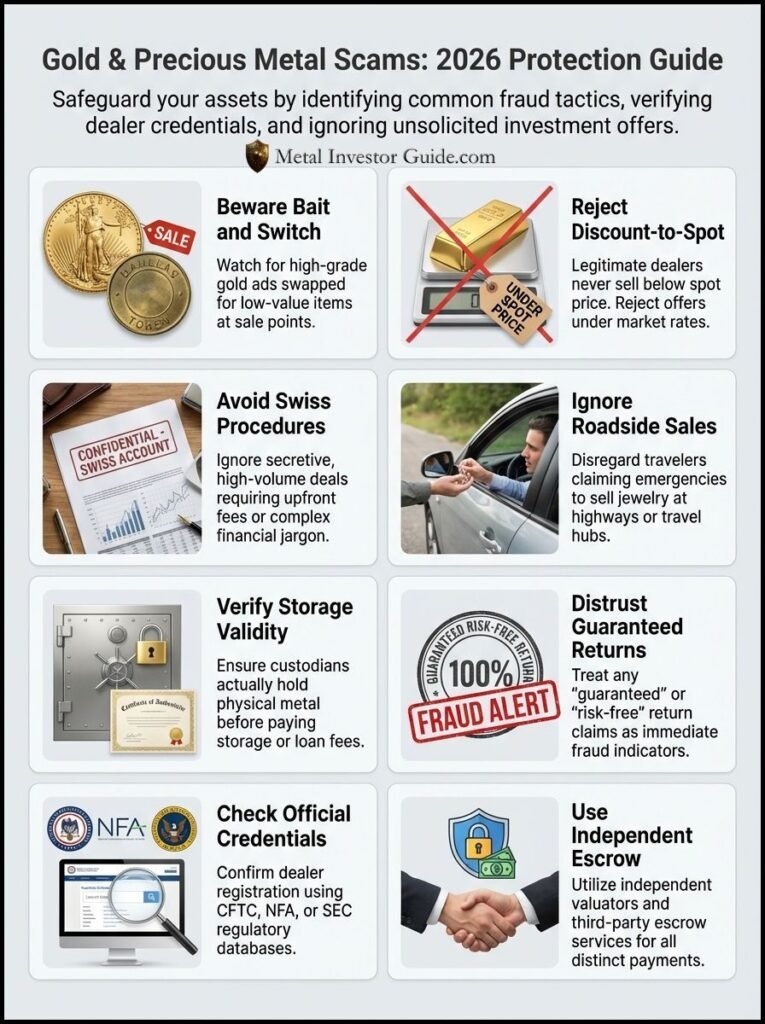
Most precious metal scams are not “mystery schemes.” They are sales scripts built around three moves: get you excited, get you isolated from second opinions, then get you to pay in a way that is difficult to recover.
The CFTC has warned that some dealers take customer funds and never buy metal at all, or they tack on phony interest and storage fees while the “vaulted” gold never exists.
| Scam pattern | What it looks like | Your fastest defense |
|---|---|---|
| Product swap | You request a known coin or bar, and receive a lower-grade or different item | Get the exact product details in writing, then verify before funds clear |
| Price trap | “Discount to spot” pricing, plus surprise fees, spreads, or “insurance” add-ons | Calculate spot value vs. retail price and ask for a next-day buyback quote |
| Storage fiction | Statements and vault photos, but no independent proof the metal is held for you | Use a depository statement that comes directly from the storage provider |
| Advance-fee fantasy | “Swiss procedure,” release payments, or access to massive hidden reserves | Refuse upfront fees and treat secrecy as the warning label |
Bait and Switch
In a bait-and-switch, the ad is the “clean” part. The swap happens once you are committed and moving fast, like when the salesperson pushes you from a widely recognized coin into a “better” semi-numismatic option with a bigger commission.
A practical way to block this is to insist on an invoice that lists the exact item you are buying: mint or refiner name, weight, stated fineness, year (for coins), and any grade or packaging details. If the seller will not lock the specifics in writing, treat it as a stop sign.
For coins, many buyers lean on third-party grading and authentication from services like PCGS and NGC. That does not remove all risk, but it makes “mystery inventory” harder to push through at the point of sale.
- Do a product match: compare weight, dimensions, and markings to the published specs for that coin or bar.
- Demand chain-of-custody clarity: ask where the item ships from and whether you can take delivery (or have it sent to a depository in your name).
- Watch the payment pivot: if the seller suddenly pushes wire, Zelle, or cryptocurrency trading rails “because it’s faster,” slow down.
- Confirm the story with regulators: if someone claims they are regulated, verify their registration and disciplinary history before you pay.
Discount to Spot
The spot price is a wholesale benchmark for metal, not a guaranteed retail price you can actually buy at. Legitimate dealers still have to cover sourcing, hedging, shipping, insurance, and business overhead, which is why retail prices typically sit above spot.
That is what makes “10 to 20% below spot” so effective as a hook. It is designed to short-circuit your skepticism and keep you focused on the deal, not the details.
A CFTC and FINRA investor bulletin notes that some fraudulent dealers have charged spreads above 300%, while other dealers may charge far less. If you do one check before you buy, do this one: ask what the dealer would pay you tomorrow for the same item, in writing.
- Calculate the math yourself: metal value (weight times spot) plus a reasonable premium should not turn into unexplained add-ons.
- Ask for the “out-the-door” number: include shipping, insurance, storage, admin fees, and any “special handling” fees.
- Compare at least three quotes: if one offer is dramatically cheaper, assume the catch is in authenticity, delivery, or fees.
Swiss Procedure
“Swiss procedure” pitches are usually advance-fee fraud with a luxury accent. They throw around bank-like language, promise exclusive access, and use gigantic numbers like “5,000 metric tonnes” to make you feel small, lucky, and late to the party.
Real bullion transactions do not require secret release payments, mystery intermediaries, or a chain of fees just to “unlock” the deal. If the seller insists you cannot verify details until you pay, the goal is not to sell you gold, it is to sell you the fee.
An FBI Internet Crime Complaint Center alert reported that, from May to December 2023, scammers used couriers to collect cash and precious metals from victims, with aggregated losses over $55 million. When a pitch includes secrecy plus a handoff of metal or money to a stranger, treat it as a high-risk scenario, even if they name-drop regulators.
No legitimate gold transaction involves secretive, high-volume “Swiss procedure” arrangements.
- Never pay “release,” “clearance,” or “verification” fees: those are classic advance-fee triggers.
- Refuse to share personal data: especially your social security number, account logins, or images of your ID.
- Report the outreach: unusual bulk-gold solicitations are worth reporting even if you did not lose money.
Autobahn Gold
This is the parking-lot version of investment fraud. Someone approaches you at a highway stop, gas station, or busy lot with a “family emergency” story and offers “gold” jewelry cheap because they need fast cash.
In the U.S., local police and pawn shops often describe this as “gas station gold,” fake jewelry stamped as 14k or 18k that turns out to be base metal. A common detail in public warnings is that the pieces are frequently magnetic and have a brassy hue, even when the stamp looks convincing.
- Use one quick filter: if a stranger is selling precious metal in a parking lot, walk away.
- If you want to help, help safely: offer to call roadside assistance or buy a small amount of gas directly instead of buying jewelry.
- Do not “test it later”: scammers count on you leaving before you can authenticate.
The Empty Safe
The empty safe scam is what it sounds like: you pay, you get paperwork, and the metal either never gets purchased or never gets stored as promised. Later, withdrawals are delayed, “audits” never finish, and your money is gone.
This is where storage language matters. “Allocated” means metal is held for you, not as a general pool the company can treat like its own inventory. One example of a depository that clearly explains this is Delaware Depository, which states it stores bullion on behalf of customers, does not lend or lease metal, and treats bullion as fully allocated.
If you are investing through a Gold IRA, custody rules are even more important. IRS regulations require approved custodians and qualified depositories — but not all IRA providers operate with the same level of transparency. Before opening any precious metals IRA, review fee schedules carefully and confirm exactly how your metals are stored and audited.
Also pay attention to the financing angle. The CFTC has warned that some frauds charge storage and insurance for metal that never existed, and that leveraged or financed precious metals pitches can hide margin-call risk and other traps.
- Get the storage statement from the vault: not from the salesperson, and not as a screenshot.
- Ask which storage type you are buying: segregated (kept separate by customer) vs. non-segregated (commingled by product type), then decide based on your need for exact-bar return.
- Test the exit: ask for the exact process and timeline to sell or take delivery, before you pay.
- Be skeptical of “we handle everything” IRA pitches: convenience is often used to hide fees and weak controls.
Warning Signs of Investment Scams
The fastest way to spot an investment scam is to ignore the story and audit the mechanics: how they price it, how they get paid, how you can exit, and how you can verify ownership.
If they mix gold with pump and dump language from cryptocurrencies, or they throw in blockchain buzzwords and non-fungible tokens (NFTs) to sound modern, keep your focus on the basics: proof, custody, and and total costs.
Promises of ‘Guaranteed’ Returns
“Guaranteed” returns do not belong in metals investing. Gold and silver prices move, spreads exist, and fees can be large enough to erase gains even when the price of gold rises.
The CFTC’s precious metals fraud advisory warns about pitches that promise easy profits from public news and then use that narrative to justify urgency. If the return is certain, the salesperson will usually try to make your decision feel like a formality.
- Ask one question: “What is the dealer’s spread, and what would you pay me for this tomorrow?”
- Reject certainty: anyone who cannot discuss downside risk is selling a script.
- Watch for bonus traps: “free” metal, waived fees, or limited-time perks can be a way to bury a massive markup.
High-Pressure Sales Tactics
High-pressure sales works because it steals your verification window. The goal is to get your money moving before you check records, compare pricing, or ask a third party what you are actually buying.
In a joint investor bulletin, the CFTC and FINRA recommend you do not respond to cold calls or unsolicited outreach for precious metals offers. If the first contact is a cold call, treat everything that follows as high risk until proven otherwise.
- Slow the process on purpose: take 24 hours, then re-check pricing and credentials with a fresh head.
- Do not accept “handoffs” to a closer: “lead trader” and “senior specialist” transfers are common boiler-room patterns.
- Refuse secrecy: “Don’t tell your advisor” is a direct signal they expect your deal to fail scrutiny.
Lack of Regulation or Transparency
Precious metal dealers and salespeople can sit in a gray zone, which is why scammers love this niche. A key red flag is a seller who argues that “gold is different” so normal verification does not apply.
Use a simple transparency test: you should be able to verify who you are dealing with, what you are buying, what you will pay in total fees, where the metal will be held, and how you can sell or withdraw.
- No written fees: treat it as a stop sign.
- No physical address: treat it as a stop sign.
- No proof of custody: treat it as a stop sign.
- Confusing exit rules: treat it as a stop sign.
How to Protect Yourself from Scams
Good protection is not about becoming a metals expert overnight. It is about building a repeatable checklist that forces proof at each step, before you move money.
Focus on three controls: verify the person, verify the product, then verify custody.
Verify Dealer Credentials
Start with identity and registration. If the pitch involves commodity futures, derivatives, pooled vehicles, or anything that sounds like managed trading, verify whether the person or firm is registered with the CFTC and whether they appear in NFA’s BASIC system.
If someone claims they are an investment adviser or broker for stocks, ETFs, or other securities products, use the SEC’s and FINRA’s public lookup tools (IAPD and BrokerCheck) to confirm registration status and review disclosures.
For retirement accounts, verify both the metals dealer and the IRA custodian. They are often separate entities, and fees can exist at multiple layers — dealer markup, custodial fees, storage fees, and transaction spreads. Make sure you understand who is being paid, how much, and for what service.
- Match the legal name: compare the company name, DBA names, and the salesperson’s name across documents.
- Check for disciplinary history: do not stop at “active” status.
- Confirm who holds your money: be clear on whether you are paying a dealer, a custodian, or a depository.
Research Investment Opportunities Thoroughly
Do not let a clean-looking website substitute for due diligence. You want independent evidence: complaint history, state enforcement actions, and contract terms that make economic sense.
Use the “spread reality check” from the CFTC and FINRA bulletin: multiply the metal weight by spot, then compare it to the all-in retail price. Also ask what you would receive if you had to sell back immediately. If you cannot get straight answers in writing, that is your answer.
| What to verify | What “good” looks like | What “walk away” looks like |
|---|---|---|
| Total fees and commissions | Itemized, written, signed before payment | “We’ll explain after you fund it” |
| Product details | Specific coin or bar, weight, fineness, brand, serial when applicable | Vague descriptions or substitutions |
| Custody and storage | Allocated storage with statements from the depository | Photos of a vault, no direct proof |
Avoid Unsolicited Offers
Unsolicited outreach is the front door for most precious metal scams. Cold call, random text, social message, or a “chance” in-person offer all belong in the same bucket.
Payment method pressure is another tell. Zelle’s own consumer guidance says you should not use Zelle to pay someone you do not know, and it notes there is no purchase protection for these transactions. That is exactly why scammers like it.
- Do not send money first: not by wire, not by Zelle, not by gift card, not by crypto assets.
- Keep your personal data tight: do not share your social security number, full bank details, or copies of your ID with a cold-contact seller.
- Use a clean communication lane: a separate email and a call-back number can limit identity theft fallout if the pitch is a trap.
Conclusion
Precious metal scams succeed when the seller controls the timeline and the paperwork. You can take that control back.
Use the same discipline you would use for any serious investment: verify credentials, compare pricing to the price of gold plus a realistic premium, demand proof of allocated custody, and avoid any pressure to rush.
If you are considering a Gold IRA rollover, take your time comparing providers, fee structures, and buyback policies. A reputable firm should welcome scrutiny, provide written documentation, and allow you to verify storage independently. Retirement investing should never feel rushed.
If your social security number or banking details were shared, the FTC’s consumer guidance recommends placing a credit freeze and notes that an initial fraud alert lasts one year, while an extended fraud alert can last seven years for identity theft victims.
Report investment fraud to the CFTC and the FTC, and consider the CFTC whistleblower program if you have actionable information. The safer move is still the simplest one: do not engage with unsolicited offers, even when the story sounds convincing.
FAQs
1. What are common gold and precious metal investment scams in this 2026 guide?
Scammers use fake dealers, phony guarantees, and false certificates to lure buyers. They push quick sales, promise guaranteed returns, or hide big fees, and some use slick ads or fake reviews to seem real.
2. How can I spot a scam before I invest in gold or other precious metals?
Check that the dealer is registered with a regulator, read real reviews, and ask for written terms. Insist on clear fees, request physical delivery or verified storage, and get an independent appraisal when needed.
3. What should I do if I suspect a precious metals fraud?
Stop payments, save all records and emails, and contact your bank or card issuer right away. File a complaint with the regulator and local police, and tell consumer protection groups, they can guide next steps.
4. Can I recover money lost to a gold investment scam?
Sometimes you can, but act fast, and expect work. You may get a chargeback, file complaints with regulators, or hire a lawyer, however watch out for recovery firms that turn out to be scams themselves.