
You know how every new wave of digital finance promises to replace the old guard, yet the same old risks keep showing up: inflation, market volatility, and financial crisis headlines.
That is why physical gold still matters, even if you also hold digital gold, crypto assets, stocks, and bonds.
Below, we’ll lay out where gold has historically helped as an inflation hedge, why central banks still treat it as financial security infrastructure, and how you can use a few practical rules to diversify your portfolio without drifting into speculation.
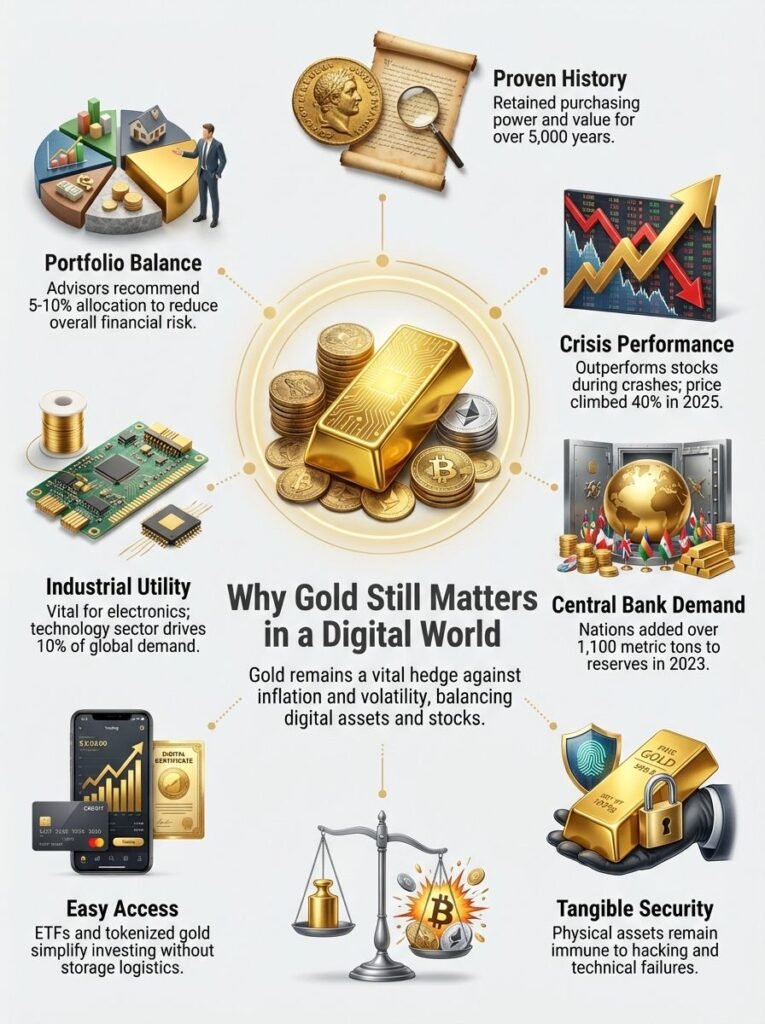
Key Takeaways
- Gold has preserved value for ~5,000 years. After the Bretton Woods system ended in 1971, gold became a free-trading inflation hedge, rising from about $35/oz in 1971 to roughly $850/oz by January 1980 (about a 24× move). In the 2008 financial crisis, the S&P 500’s annual total return was −37.00%.
- Central bank demand has stayed historically elevated: World Gold Council data shows net buying of about 1,037t in 2023, 1,045t in 2024, and 863t in 2025 (still well above the 2010–2021 average often cited in gold research). China’s reported gold reserves reached about 2,303.5t in 2025, while the United States remains the largest reported holder at about 8,133.5t.
- Gold demand has been setting records. World Gold Council reporting shows total gold demand in 2025 (including OTC) exceeded 5,000t for the first time, with investment demand rising to about 2,175t and global gold ETF holdings reaching about 4,025t.
- Allocation guidance varies by goals, but World Gold Council portfolio analysis often lands on a modest 2%–10% range for many diversified portfolios. Gold can reduce portfolio drawdowns, but you still have to plan around storage costs, trading spreads, and the fact that gold has no yield.
Gold as a Safe Haven Asset (Why Physical Gold Still Has a Job)
Gold stopped being a formal monetary anchor for the US dollar in the early 1970s, but it did not stop acting like a crisis barometer.
In practical terms, a “safe haven” is not a magic shield. It is an asset that can hold up, or even rise, when other financial markets are under stress.
That pattern shows up repeatedly in modern price milestones: gold crossed $1,000 in March 2008, $2,000 in August 2020, and moved above $5,000 in January 2026 as safe-haven demand surged during another spike in economic uncertainty.
What gold can realistically do for you
Gold tends to help most when your portfolio needs shock absorbers, not when you are chasing maximum growth.
- Reduce drawdowns: World Gold Council portfolio research (through December 31, 2024) shows that adding 5% gold reduced maximum drawdown in a hypothetical portfolio over a 20-year period.
- Hedge policy and rate uncertainty: Gold often responds to falling real interest rates and to confidence shocks in fiat currencies.
- Stay outside the credit system: Physical bullion is a tangible asset with no issuer risk, which is a different kind of protection than bonds or bank deposits.
If you want gold for “sleep at night” stability, treat it like insurance. Size it like insurance, too.
The Role of Gold in Central Bank Reserves
Central banks do not buy gold because it is trendy. They buy it because it is an internationally recognized reserve asset that does not depend on another country’s promise to pay.
In the latest updates from the World Gold Council, central bank net purchases were about 1,037 tonnes in 2023, 1,045 tonnes in 2024, and 863 tonnes in 2025, with Poland reported as the largest buyer in 2025 (102 tonnes).
Why reserve managers still prioritize bullion
- Diversification away from single-currency risk: Gold can reduce reliance on the US dollar and other fiat currencies when geopolitics and sanctions risk rise.
- Liquidity in stress: Gold trades globally and can serve as collateral in ways that are familiar to financial markets.
- No counterparty risk: A gold bar is not someone else’s liability, which matters during a financial crisis.
- Operational resilience: Central banks can hold physical gold while they test central bank digital currencies and new payment rails.
The Bretton Woods system of 1944 fixed exchange rates around a US dollar gold peg at $35 per ounce. That era ended, but the lesson remains: countries still keep bullion for credibility, optionality, and financial security.
Physical gold is a silent anchor in volatile times, valuable precisely because it does not need a network connection or an issuer.
For individual investors, the “so what” is simple. If central banks treat gold as strategic infrastructure, it can make sense for you to treat it as strategic ballast, not a trade.
Gold vs. Digital Currencies
Gold and digital currencies solve different problems. Gold is built for durability and wealth preservation. Digital assets are built for speed, programmability, and new payment and investment vehicles.
| Asset type | What it’s best at | Main risk to plan around |
|---|---|---|
| Physical gold | Tangible store of value, crisis hedge, no issuer | Storage costs, insurance, liquidity spreads |
| Digital gold (tokenized gold) | Fast transfer, smaller minimums, easier trading | Issuer, custody, smart contract, redemption limits |
| Crypto assets (like Bitcoin) | Scarcity narrative, global transferability, decentralization themes | High volatility, regulatory swings, operational self-custody risk |
| Fiat currencies | Day-to-day medium of exchange, taxes, wages | Inflationary pressures, policy shifts, money supply growth |
Stability and Tangibility
Gold is physically stable, it does not rust, and it is easy to divide into coins or bars.
From a market structure standpoint, the London Bullion Market Association’s Good Delivery rules define a standard gold bar as holding between 350 and 430 fine troy ounces, which is one reason large bullion markets stay interoperable across banks, vaults, and refiners.
Supply is also slow-moving. World Gold Council data shows mine production of about 3,644 tonnes in 2023, which is small relative to the estimated above-ground stock of gold (often cited at 216,265 tonnes as of year-end 2024). That means price is usually more demand-driven than “new supply” driven.
A practical checklist for buying physical gold in the US
- Decide on form: coins for easier resale and recognition, bars for lower premiums per ounce in larger sizes.
- Confirm purity: common investment-grade bars are .995 fine or higher, which aligns with standard deliverable grades used in regulated futures markets.
- Plan storage upfront: home safe, bank safe deposit box, or professional vault, each has different security and access tradeoffs.
- Document everything: invoices, serial numbers (for bars), and photos help with insurance and resale.
Hedging Against Volatility
Gold often responds less to headline inflation and more to confidence in monetary policy, real interest rates, and currency credibility.
In the US, one clear stress-test year is 2008: the S&P 500’s annual total return was −37.00%, while gold held up far better as investors searched for a safe haven.
Crypto assets can also rise during periods of distrust in traditional finance, but they tend to swing harder. Bitcoin peaked near $69,000 in 2021 and later fell sharply during the 2022 drawdown, a very different volatility profile than gold.
If you want a decision rule you can actually use, watch these drivers and adjust your hedges before panic hits:
- Real interest rates: falling real yields often support gold prices.
- US dollar strength: a weakening US dollar can amplify gold’s appeal globally.
- Credit markets: widening credit spreads and recession fears often lift safe-haven demand.
- ETF flows: large inflows can push prices, and large outflows can pressure prices.
For investors using digital assets, note that the SEC approved 11 spot Bitcoin exchange-traded products on January 10, 2024, which made crypto exposure easier inside standard brokerage workflows, even though market volatility remained high.
The Emergence of Gold-Backed Digital Assets
Gold-backed digital assets try to combine two ideas: the long-term value story of bullion and the transfer speed of blockchain technology.
The quality difference is not the word “tokenized.” It is the structure behind it: who holds the metal, how audits work, and what redemption actually allows.
How tokenized gold works in the real world
Paxos states that each PAXG token equals one fine troy ounce of London Good Delivery gold held on a segregated basis, but physical bar redemption requires a minimum of 430 PAXG (plus fees), aligning with the upper end of the LBMA Good Delivery bar range.
- So what: tokenized gold can be great for smaller sizes and faster transfers, but “I can redeem anytime” is not the same as “I can redeem one ounce for a coin.”
- Action: before you buy, read the redemption minimums, delivery geography limits, and identity verification requirements.
Quick comparison: common ways to get gold exposure
| Approach | What you own | Best use case | Key tradeoff |
|---|---|---|---|
| Physical gold | Coins or bars you can hold | Systemic-risk hedge, tangible assets, long-term value | Storage costs and resale spread |
| Gold ETFs (physically backed) | Shares tracking gold, held in a brokerage | Liquidity and simplicity for many portfolios | Ongoing expense ratio, no personal delivery for typical investors |
| Tokenized gold | Digital claim linked to vaulted gold | Smaller minimums, transferability, DeFi use cases | Issuer and redemption constraints |
| Gold futures/options | Derivative exposure | Short-term hedges, professional risk management | Leverage risk and margin calls |
Digital gold can support financial inclusion by lowering minimum buy sizes, but it also adds a new layer of operational risk. Make sure the convenience is worth it for your goals.
Sustainability and Ethical Sourcing of Gold
Gold’s store-of-value role works better when buyers trust the supply chain. That is why ethical sourcing has become part of what “investment-grade” means.
The World Gold Council launched the Responsible Gold Mining Principles in 2019, a framework of 51 principles that requires public disclosure and external assurance for companies claiming conformance.
How to apply ESG standards as a buyer
- Ask what “responsible” means: look for third-party assurance, not marketing language.
- Prefer established supply chains: bullion tied to recognized Good Delivery and large-scale custody systems is easier to verify and resell.
- Watch for common pitfalls: vague provenance claims and missing documentation raise both ethical and resale risks.
- Match sourcing to use: if you are buying jewelry, ask for traceability. If you are buying bullion, ask for recognized refiner and chain-of-custody handling.
Clean energy upgrades at mines, including renewable energy and solar panels, can reduce emissions and operating expenses, but you still want proof through reporting and assurance, not promises.
Gold’s Industrial and Technological Applications
Gold is not just a financial asset. It is also a high-performance material: conductive, corrosion-resistant, and reliable in tiny contacts.
That said, industry is not what sets the price most of the time. World Gold Council reporting shows that technology-related gold demand fell below 300 tonnes in 2023, a small share relative to total demand above 4,000 tonnes.
Where gold shows up in technology
- Electronics: connectors, bonding wire, and high-reliability contacts.
- Aerospace and satellites: corrosion resistance and stable performance in harsh environments.
- Medical devices: select components that need conductivity and biocompatibility.
- Semiconductors: specialized uses where reliability matters more than raw cost.
For investors, the takeaway is straightforward. Industrial demand helps diversify demand sources, but safe-haven flows, interest rates, and macroeconomic uncertainty usually drive the bigger price moves.
Balancing Tangible and Digital Investments
Most people do best with a balanced approach: enough gold to hedge, not so much that it overwhelms your long-term growth assets.
World Gold Council research often supports a 2%–10% allocation range as a reasonable starting point for many diversified portfolios, adjusted based on your risk, time horizon, and exposure to inflationary pressures.
A simple allocation framework you can use
- Start small: pick a target percent, then rebalance once or twice a year instead of chasing headlines.
- Choose the right wrapper: physical gold for tangibility, exchange-traded funds for liquidity, tokenized gold for transferability, and crypto assets only if you can tolerate large drawdowns.
- Separate hedge from speculation: if you are using leverage, options, or short-term trading, label that clearly as speculation and size it accordingly.
Costs and tax rules that change real-world results
| Option | Typical ongoing cost example | What to watch |
|---|---|---|
| SPDR Gold Shares (GLD) | 0.40% annual expense ratio | High liquidity, but ongoing fee drag |
| SPDR Gold MiniShares Trust (GLDM) | 0.10% annual expense ratio | Lower fee structure, still tracks physical gold |
| iShares Gold Trust (IAU) | 0.25% annual expense ratio | Lower cost than some large funds |
| Physical gold | Varies by storage and insurance setup | Premiums, verification, and storage planning |
Two US-specific points matter for planning. First, physically backed gold ETFs and physical precious metals are often treated as collectibles for federal tax purposes in taxable accounts, meaning a maximum 28% long-term capital gains rate can apply (as described in multiple fund tax disclosures and mainstream tax guides).
Second, if you buy gold inside a self-directed IRA, treat custody rules as non-negotiable. A 2021 U.S. Tax Court case (McNulty) is a clear warning that storing IRA metals at home can be treated as a taxable distribution.
If you want gold inside retirement accounts, use a qualified custodian and approved storage, and do not mix personal possession with IRA ownership.
Conclusion
Gold keeps its place as an inflation hedge and a store of value because it is liquid, durable, and not dependent on any single issuer.
Central banks still accumulate bullion to strengthen reserves and reduce single-currency exposure, even as digital currencies and central bank digital currencies evolve.
For most investors, the best use of physical gold is simple: a measured allocation that supports wealth preservation, limits regret in a financial crisis, and complements, rather than replaces, your long-term plan.
FAQs
1. What makes gold an inflation hedge in times of economic uncertainty?
Gold acts as an inflation hedge because it keeps long-term value when fiat currencies fall in price. As a tangible asset and one of the precious metals, gold supports wealth preservation and serves as gold as a store of value for financial security.
2. How do physical gold and digital gold compare to other digital assets?
Physical gold is a tangible asset with storage costs, while digital gold and digital assets sit on blockchains or in digital wallets. Digital currencies and decentralized finance offer new access, but they do not change gold’s basic long-term value.
3. Will gold help during market volatility, oil shocks, or macroeconomic stress?
Yes, gold often moves opposite market volatility and can hedge against oil shocks and rising government debt. It can limit losses when bonds yields fall or when deflationary spirals threaten growth.
4. How do central banks and the World Gold Council shape gold’s role in finance?
Central banks hold gold to back reserve currency plans and to add stability to the financial markets. The World Gold Council tracks demand and helps explain how past rules like the Bretton Woods system, fixed rate regimes, gold peg links, and currencies pegged to gold once worked.
5. Is investing in gold sensible for emerging markets, ASEAN region, and market economies?
Investing in gold can protect savings in emerging markets and in ASEAN countries where local currencies can be unstable. Good investment advice targets your goals, and gold often fits a plan for a secure financial future.
6. How should I use gold with new finance options and portfolio choices?
Treat gold as part of a balanced plan, alongside options, bonds, and digital assets, to support economic growth and reduce risk. Think about storage costs, medium of exchange limits, and how gold helped during the great depression, then adjust your mix for long-term value.