
Where to Buy Silver Safely (Avoid Scams and Overpaying)
Buying silver sounds simple until the moment something goes wrong.
A deal looks great, the price seems lower than everywhere else, and you click “buy” thinking you just saved money. Then the doubts start creeping in. Is it real? Did I overpay? Will I even be able to sell this later?
That uncertainty is more common than most people admit. The silver market is filled with legitimate opportunities, but it is also filled with small traps that are easy to miss if you are not paying close attention.
And the problem is not always obvious.
Sometimes it is a counterfeit coin that looks nearly identical to the real thing. Sometimes it is a premium that is quietly inflated just enough to eat into your future profit. Other times, it is a seller who disappears the moment something goes wrong.
None of these mistakes feel significant at the time of purchase. But they tend to show up later, when you try to verify what you bought or when you attempt to sell it and realize the market does not value it the way you expected.
That is why buying silver safely is not about chasing the lowest price.
It is about controlling risk at every step of the process.
When you buy from the right source, choose the right products, and understand how pricing actually works, you put yourself in a position where your silver holds its value and remains easy to sell.
When you do not, even a small mistake can turn a solid investment into a frustrating experience.
The good news is that safe silver buying follows a simple, repeatable process once you know what to look for.
In this guide, I will show you:
- Where to buy silver safely
- Where not to buy (and why those places are risky)
- How to verify a dealer before you trust them
- How to understand pricing so you do not overpay
- Which types of silver are easiest to resell
If you follow the framework in this guide, you will avoid the most common mistakes that cost buyers money and confidence.
And more importantly, you will be able to make purchases knowing exactly what you are getting and why it holds value.
Because in the end, the difference between a good silver investment and a bad one usually comes down to a few simple decisions made at the beginning.
And those decisions start with understanding why buying silver safely matters more than most people realize.
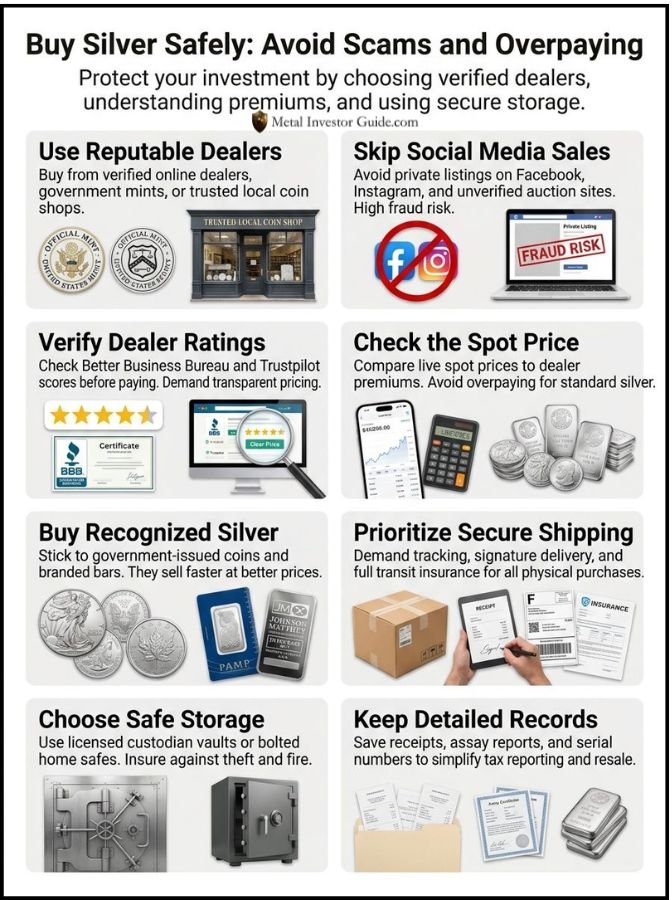
Why Buying Silver Safely Matters More Than You Think
Most silver buying mistakes do not feel like mistakes at the time.
They feel like smart decisions.
The price looks competitive. The product looks legitimate. The seller seems convincing enough. And in that moment, everything checks out.
The problem only shows up later.
It might happen when you try to verify the item and realize something is off. It might happen when you attempt to sell and the buyer hesitates or offers less than expected. Or it might happen when you discover that what looked like a good deal was actually an inflated premium hidden in the pricing.
Buying silver safely protects you from these delayed problems.
It protects you from counterfeits that pass casual inspection. It protects you from hidden fees that reduce your long-term return. And it protects your ability to resell without friction when you decide to exit your position.
Even experienced buyers make mistakes in this market. One questionable purchase can create unnecessary stress, reduce confidence, and in some cases, turn a solid investment into a loss.
If you want a simple rule to follow, it is this:
Buy products that are easy to verify, from sellers that are easy to hold accountable.
That single principle solves most of the risks that affect silver buyers.
The Risks of Buying From the Wrong Source
Most problems in the silver market start with the source.
When a deal looks significantly better than everything else, there is usually a reason. In many cases, that reason is risk.
Small or unknown sellers can ship plated items, reuse stock photos, delay delivery, or disappear entirely after payment. Auction-style platforms and private listings increase that risk because you are often dealing with individuals instead of established operations.
The most common risks include:
- Counterfeit risk: Popular products like American Silver Eagles and Canadian Maple Leaf coins are frequently copied because they are widely recognized.
- Payment risk: Sellers who insist on wire transfers or “friends and family” payments remove your ability to dispute the transaction.
- Resale risk: If you cannot clearly prove what you bought and where it came from, buyers will often discount your silver or refuse it entirely.
- Delivery risk: A shipping label does not guarantee delivery. Without proper tracking and insurance, your order can disappear with little recourse.
Reputable dealers reduce these risks by providing clear policies, consistent product standards, and a support structure that holds them accountable.
How Safety Impacts Pricing, Authenticity, and Resale
One of the biggest misconceptions about silver investing is that the lowest price is always the best deal.
In reality, safer purchases often come with slightly higher premiums, and that is not necessarily a disadvantage.
You are not just paying for the metal. You are paying for recognizability, verification, and liquidity.
Well-known products from trusted mints are easier to authenticate and easier to sell. Buyers recognize them quickly, which reduces hesitation and improves your resale outcome.
That “boring” choice is often the smartest one.
When you prioritize safety:
- You reduce the chance of buying counterfeit or questionable products
- You improve your ability to sell quickly and at a fair price
- You avoid unnecessary stress during both the buying and selling process
When you ignore safety:
- You increase the risk of hidden losses
- You create friction when trying to exit your position
- You may be forced to accept a lower price just to move the asset
In other words, safety is not an extra feature of buying silver.
It is a core part of protecting your investment from the moment you buy it to the moment you sell it.
The Safest Places to Buy Silver Bullion
Once you understand the risks, the next step becomes much simpler.
Safe silver buying is not about finding a hidden source or a secret deal. It is about choosing environments where risk is already controlled.
The safest places to buy silver all share a few important traits:
- Pricing is transparent
- Products are standardized and easy to verify
- Policies are clearly defined
- The seller can be held accountable if something goes wrong
If a source does not meet those criteria, it should not be your starting point.
For most buyers, the safest path is straightforward:
Start with a recognized product. Buy from a seller with a proven track record. Keep your documentation from the beginning.
From there, you can expand into other options as your confidence grows.
Reputable Online Silver Dealers
For most people, reputable online dealers are the best place to start.
They offer a combination of selection, transparency, and structured processes that significantly reduce risk.
Established dealers such as APMEX, JM Bullion, and BGASC operate at scale. That scale matters because it forces consistency. Listings are standardized, pricing is visible, and shipping procedures are defined before you ever place an order.
That does not mean every deal is perfect. But it does mean you are operating inside a system designed to reduce mistakes.
If you are buying online, focus on these fundamentals:
- Choose dealers with a long track record and strong review history
- Confirm the company has a real business presence, not just a website
- Review pricing carefully, including premiums, shipping, and payment fees
- Stick to widely recognized products if resale matters to you
A simple way to reduce risk even further is to place a small test order first. This allows you to evaluate packaging, communication, and delivery before committing more capital.
Local Coin Shops and Bullion Stores
Local coin shops offer a different type of advantage: direct verification.
When you buy in person, you can inspect the product before paying. You can ask questions, compare items side by side, and get a better sense of what is actually liquid in your local market.
This can be especially valuable if you plan to sell locally in the future.
However, not all shops price the same way.
Two stores in the same city can have very different premiums, which is why comparison still matters.
If you are buying locally:
- Visit more than one shop before making a decision
- Ask both the buy price and the sell price to understand the spread
- Observe how the shop verifies authenticity
- Take your time inspecting the product before paying
Local shops reduce certain risks, but they still require you to be an informed buyer.
Precious Metals IRA Providers
Precious metals IRA providers serve a specific purpose.
They are designed for investors who want silver inside a retirement account, with storage handled through a custodian and approved depository.
This structure can reduce personal storage risk, but it introduces a different type of complexity.
You are no longer just buying metal. You are entering a system with rules, fees, and long-term implications.
Because of that, verification becomes even more important.
Before moving forward with any IRA provider:
- Confirm exactly who the custodian is and where the metal is stored
- Request a complete breakdown of all fees, including setup, annual, and storage costs
- Verify which products are eligible within the account
- Understand how liquidation works before you ever need it
If anything feels unclear or rushed, slow down. This is not a decision that benefits from urgency.
Government Mints and Authorized Dealers
Government-issued silver products are among the easiest to verify and resell.
Coins from recognized mints carry built-in trust because their specifications are widely known and consistently produced.
However, most government mints do not sell bullion directly to the public. Instead, distribution happens through authorized dealers.
That means your focus should not be on buying directly from a mint, but on ensuring that the dealer you choose is sourcing legitimate products.
Well-known silver coins such as American Silver Eagles, Canadian Maple Leafs, and British Britannias are widely accepted in the market. That recognition reduces friction when it is time to sell.
If your goal is safety and liquidity, these products are often the most practical starting point.
If you want a quick starting point, focus on established online dealers with transparent pricing and recognized products. That combination alone eliminates most of the risk new buyers face.
Where NOT to Buy Silver (High-Risk Sources to Avoid)
Most bad silver purchases do not start with bad intentions.
They start with something that looks like a good opportunity.
A lower price. A limited-time offer. A seller who seems helpful or urgent. On the surface, everything feels reasonable.
The risk is not always obvious until you know what to look for.
High-risk sources tend to share the same pattern. They remove one or more of the protections that make a transaction safe. That might be pricing transparency, payment protection, product verification, or accountability after the sale.
Once those protections are gone, the burden shifts entirely to you.
And that is where most problems begin.
Unknown Online Sellers With No Track Record
Unknown sellers create the most dangerous combination: limited verification and limited recourse.
At first glance, the listing may look identical to what you would see from a reputable dealer. The product description is similar. The images look convincing. The price might even be slightly better.
But what you cannot see is what matters most.
There is no established reputation. No consistent track record. No reliable way to resolve a problem if something goes wrong.
This is where many buyers make a critical mistake. They assume that because the product looks legitimate, the transaction is safe.
It is not.
If you choose to deal with a new or unfamiliar seller:
- Use payment methods that allow disputes and chargebacks
- Avoid any request for irreversible payment
- Demand clear product images and written terms
- Start with a small test purchase, not a large order
If those conditions are not met, the safest decision is to walk away.
Auction Sites Without Verification Experience
Auction platforms can be legitimate, but they are not beginner-friendly environments.
They reward experience.
If you already know how to verify silver, evaluate sellers, and recognize inconsistencies, you can navigate these platforms safely.
If you do not, you are exposed.
The biggest risk is that you can pay a fair price for something that is not what it appears to be.
Popular products like American Silver Eagles are frequent targets because they are widely recognized and easy to replicate visually. A listing may look completely legitimate until you inspect the item in person.
By that point, your options may be limited.
If you use auction platforms:
- Review return policies before placing a bid
- Avoid listings with unclear photos or vague descriptions
- Verify the item immediately upon arrival
- Never let a return window expire without inspection
If you want a safer alternative with similar convenience, reputable online dealers provide a more controlled environment.
Private Sellers and Social Media Listings
Private sellers and social media listings carry the highest level of risk.
These transactions often combine urgency, informality, and limited protection, which is exactly what scammers rely on.
The pattern is usually the same.
The price appears unusually attractive. The seller creates pressure to act quickly. And the payment method removes your ability to reverse the transaction.
At that point, the outcome is largely out of your control.
If you consider buying from a private seller:
- Refuse any payment method that cannot be reversed
- Avoid deals that rely on urgency or pressure
- Meet in a location where verification is possible, ideally a coin shop
- Bring basic tools to check weight and dimensions
Most importantly, be willing to walk away.
A legitimate seller will not pressure you to skip verification.
An illegitimate one will.
If a deal requires you to ignore normal verification steps, you already have your answer.
How to Verify a Silver Dealer Is Legitimate
Verifying a silver dealer is not a one-time check.
It is a process.
The goal is not to find a single signal that tells you a seller is safe. The goal is to stack multiple signals until the risk becomes manageable.
When several things line up, reputation, pricing, policies, and communication, you are likely dealing with a legitimate operation.
When even one of those elements feels unclear, that is your signal to slow down.
Think of verification as a simple checklist you run every time before you buy.
Check Third-Party Ratings and Reviews
Start with reputation, but read it carefully.
A high rating alone does not tell the full story. What matters is consistency over time.
Look for patterns in feedback rather than isolated complaints. Every business will have some negative reviews, but repeated issues around shipping delays, product quality, or customer service are meaningful.
Focus on:
- Recent reviews, not just overall rating
- Specific complaints that appear more than once
- How the company responds to problems
A dealer that responds clearly and professionally is usually operating with real systems behind the scenes.
Be cautious of review profiles that feel unnatural. A sudden wave of short, generic praise can sometimes indicate manipulated feedback.
Look for Transparent Pricing and Fees
Legitimate dealers make it easy to understand your total cost before you pay.
That includes:
- The premium over spot
- Shipping and insurance
- Payment method fees
- Any minimum order requirements
If you cannot calculate your full cost clearly, you are taking on unnecessary risk.
Transparency is one of the strongest signals of a reputable dealer.
When pricing is clear, it becomes much harder for hidden costs to affect your investment.
Confirm Secure Shipping, Insurance, and Policies
Shipping is one of the most overlooked parts of buying silver safely.
But it is also one of the easiest places for problems to occur.
Before placing an order, confirm:
- Tracking is provided and updated
- The shipment is insured
- Delivery timelines are clearly stated
- Signature confirmation is required for higher-value orders
You should also understand the return policy.
Know how long you have to report an issue, whether any fees apply, and what steps are required if something arrives damaged or incorrect.
If these details are vague or difficult to find, treat that as a warning sign.
Watch for High-Pressure Sales Tactics
Legitimate dealers do not need to rush you.
Pressure is often used to bypass your verification process.
You may hear phrases like:
- “This pricing is only available right now”
- “You need to lock this in before the market moves”
- “This opportunity won’t be available later”
These tactics are designed to create urgency and reduce careful thinking.
Instead of reacting, slow the process down.
Ask for everything in writing. Confirm the exact product you will receive. Compare the offer with other dealers.
A reputable seller will give you space to verify.
A questionable one will try to prevent it.
If you follow this process consistently, you will eliminate most of the risk that causes buyers to lose money in the silver market.
Understanding Silver Pricing So You Don’t Overpay
Most silver buyers do not lose money because they chose the wrong metal.
They lose money because they paid the wrong price.
And in many cases, they do not realize it until much later.
Overpaying rarely feels obvious at the time of purchase. The price looks reasonable. The product looks legitimate. And without a clear reference point, it is difficult to know what a “fair” deal actually looks like.
That is why understanding pricing is one of the most important parts of buying silver safely.
Once you understand how pricing works, bad deals become much easier to spot.
What Is the Spot Price of Silver
The spot price is the starting point for all silver pricing.
It represents the current market value of silver in large-volume transactions. This is the baseline price before any retail costs are added.
However, spot price is not what you pay.
Retail pricing builds on top of spot.
To understand pricing clearly, keep these three terms in mind:
- Spot price: the market benchmark
- Bid price: what buyers are willing to pay
- Ask price: what sellers are charging
When you buy silver, you are paying above spot. The key question is how much above spot, and whether that difference is reasonable.
How Premiums Work on Coins and Bars
The premium is the amount you pay above the spot price.
This is where most overpayment happens.
Premiums cover manufacturing, distribution, dealer margins, and market demand. But they can also vary widely depending on the product and the seller.
If you do not understand premiums, it becomes easy to compare the wrong numbers.
For example, one product may look cheaper at first glance, but actually carry a higher premium once you calculate the total cost.
As a general rule:
- Government-issued coins tend to carry higher premiums due to recognizability and liquidity
- Silver rounds usually offer lower premiums while still remaining fairly liquid
- Larger bars reduce premium per ounce but require more confidence in verification and storage
The goal is not to avoid premiums.
The goal is to pay a fair premium for a product that holds its value when you sell.
Typical Premium Ranges for Common Silver Products
Premiums change frequently, but understanding general ranges helps you identify outliers quickly.
If a premium falls significantly outside expected ranges, there is usually a reason.
That reason may be:
- Increased demand
- Limited supply
- Or increased risk
Use typical ranges as a reference point, not a guarantee.
They allow you to quickly recognize when something does not align with the broader market.
| Product | Typical Premium Range (over spot) | Notes and Examples |
|---|---|---|
| 1 oz Government-Issued Silver Coins (e.g., American Silver Eagles, Canadian Maple Leaf) | Often $4 to $10+ per coin | High recognition and strong liquidity. Premiums can spike during supply shortages or surges in demand. |
| 1 oz Recognized Silver Rounds | Often $2 to $5 per round | Good balance of price and liquidity. Focus on recognizable mints and consistent markings. |
| 1 oz Branded Silver Bars (reputable mints) | Often $2 to $5 per bar | Look for clear hallmarks, standard weights, and assay packaging where applicable. |
| 10 oz Silver Bars | Often $2 to $4 per ounce over spot | Lower premium per ounce than 1 oz products in many markets. Storage and verification matter more. |
| 100 oz Silver Bars | Often $1 to $3 per ounce over spot | Strong “metal for the dollar” value, but harder to move quickly, and you must trust your verification process. |
| Junk Silver (90% U.S. coins) | Highly variable | Pricing depends on availability, condition, and local demand. Great for small-denomination silver exposure. |
| Numismatic and Proof Coins | 20% to many times spot | These are silver collectibles, not simple bullion exposure. Use third-party grading (NGC or PCGS) if you are paying for rarity. |
| Dealer Fees: Shipping, Insurance, and Storage | Variable | Always calculate the all-in total, including shipping, signature service, and any storage or IRA custodian fees. |
The Mistake Most Buyers Make: Ignoring the All-In Price
One of the most common and costly mistakes is focusing only on the listed price.
The listed price is rarely the final price.
Your true cost includes:
- Premium over spot
- Shipping and insurance
- Payment method fees
- Taxes (depending on your location)
A deal that looks cheaper upfront can become more expensive once all costs are included.
At the same time, an offer that appears slightly higher may actually be more competitive once everything is factored in.
Always calculate the full, all-in cost before comparing options.
That single habit can prevent a surprising number of pricing mistakes.
Pricing Is a Signal, Not Just a Number
Pricing does more than tell you what you will pay.
It often tells you something about the level of risk.
If a price is significantly lower than the rest of the market, it is rarely a coincidence.
It may indicate:
- A questionable product
- A seller with no accountability
- Or hidden costs that are not immediately visible
This does not mean every low price is a problem.
But it does mean every unusually low price deserves closer inspection.
A fair, transparent price from a reputable seller is usually a safer long-term decision than a “deal” that introduces uncertainty.
Physical Silver vs Silver IRAs (Which Is Safer?)
There is no single “safest” way to own silver.
There is only the option that best controls the type of risk you care about most.
Some investors want direct control. Others want structured storage and fewer personal responsibilities. Both approaches can be valid, but they solve different problems.
The key is understanding what each option protects you from, and what it does not.
Direct Ownership and Home Storage Risks
Owning physical silver directly gives you full control.
You can access it at any time. There are no custodians, no ongoing account fees, and no third-party involvement in your ownership.
That simplicity is one of its biggest advantages.
But it also comes with responsibility.
When you store silver at home, you take on the risks yourself:
- Theft
- Fire or water damage
- Loss or misplacement
- Insurance gaps
These risks are often underestimated because they do not show up immediately. But over time, they can become significant, especially as your holdings grow.
If you choose direct ownership, your focus should shift to protection:
- Use a properly rated safe that is anchored and secured
- Confirm that your insurance policy explicitly covers precious metals
- Keep purchase records and photos stored separately from the metal
Control is valuable, but only if it is supported by strong security and documentation.
Vault Storage and Custodian Protection
Vault storage shifts the responsibility away from you and onto a professional system.
Your silver is stored in a secured facility with monitored access, insurance coverage, and documented handling procedures.
This setup reduces many of the physical risks associated with home storage.
However, it introduces a different type of dependency.
You are relying on a third party to store, protect, and return your assets when needed.
Because of that, verification becomes critical.
Before using any vault or storage provider:
- Confirm how your holdings are stored (segregated vs commingled)
- Understand the insurance coverage and limits
- Ask how often the facility is audited
- Clarify how withdrawals or shipments are handled
You are trading direct control for structured security. The system works well, but only if you understand how it operates.
Precious Metals IRA (Custodied Silver)
A precious metals IRA adds another layer.
It combines professional storage with a tax-advantaged retirement structure.
This can be appealing for long-term investors, but it also introduces rules, restrictions, and ongoing costs.
You are no longer just buying silver.
You are participating in a regulated account system that includes:
- A custodian
- An approved depository
- Specific product eligibility requirements
Because of this structure, mistakes can be more difficult to unwind.
Before committing to a precious metals IRA:
- Verify the custodian and depository independently
- Request a complete breakdown of all fees
- Confirm which products are eligible within the account
- Understand how liquidation and distributions work
If any part of the process feels rushed or unclear, slow down.
This is a long-term decision that benefits from careful verification.
Which Option Fits Your Investment Goals
The best choice depends on what you are trying to protect.
If your priority is control and immediate access, direct ownership may be the better fit.
If your priority is security and reduced personal responsibility, vault storage or an IRA structure may make more sense.
Each option involves trade-offs.
- Direct ownership offers flexibility but requires strong personal security
- Vault storage offers protection but requires trust in a third party
- IRAs offer structure and tax advantages but come with rules and fees
There is no perfect option.
There is only the option that aligns with your goals, your risk tolerance, and your willingness to manage the details.
The right choice is not the one that sounds safest on paper. It is the one you understand well enough to manage with confidence.
Best Types of Silver to Buy for Safety and Liquidity
Once you understand where to buy and how pricing works, the next decision becomes much easier.
What you buy matters just as much as where you buy it.
The safest silver products all share one key trait:
They are easy for the next buyer to recognize and trust.
That single factor determines how easily you can verify your purchase, and how easily you can sell it later.
If a product creates hesitation during resale, it reduces your flexibility and often your return.
If it is immediately recognized, the transaction becomes much simpler.
For most buyers, this leads to a clear starting point.
Government-Issued Silver Coins
Government-issued silver coins are one of the safest and most practical choices for most investors.
They are widely recognized, consistently produced, and easy to verify.
That combination makes them highly liquid.
Coins such as American Silver Eagles, Canadian Maple Leafs, and British Britannias are known throughout the market. Buyers understand their specifications, trust their origin, and are generally comfortable purchasing them without hesitation.
This reduces friction when it is time to sell.
These coins often carry higher premiums than other forms of silver, but that premium serves a purpose.
You are paying for:
- Recognizability
- Consistency
- Ease of resale
For buyers who prioritize safety and liquidity, this is often the best place to start.
Recognized Silver Bars From Reputable Mints
Silver bars offer a different advantage: more metal for your money.
As you move into larger sizes, such as 10 oz or 100 oz bars, the premium per ounce typically decreases.
However, this comes with a trade-off.
Bars require more attention to verification and storage.
Because they are less standardized than government coins, buyers may take more time to confirm authenticity, especially for larger pieces.
To reduce risk when buying bars:
- Choose well-known mints with strong reputations
- Look for clear markings, including weight, purity, and mint name
- Prefer common sizes that are easy to price and resell
- Keep any assay packaging or documentation
When chosen carefully, silver bars can be an efficient way to accumulate ounces while still maintaining reasonable liquidity.
Why Recognizability Matters More Than “Uniqueness”
One of the most common mistakes new buyers make is choosing products based on appearance instead of market demand.
Limited designs, themed rounds, or “exclusive” releases can seem appealing. But they often introduce uncertainty when it is time to sell.
The problem is not the silver content.
The problem is recognition.
If a buyer has to stop and evaluate what something is, they are more likely to hesitate, negotiate, or offer less.
In contrast, widely recognized products move quickly because they remove that uncertainty.
As a general rule:
- High recognizability leads to faster, easier resale
- Low recognizability often leads to pricing friction
If your goal is to keep things simple and liquid, familiarity is an advantage, not a limitation.
A Simple Starting Strategy
If you want to eliminate most of the guesswork, start with a simple approach:
- Choose one or two widely recognized coin types
- Buy from a reputable dealer
- Keep your products consistent rather than scattered
This creates a foundation that is easy to manage, easy to verify, and easy to sell.
As your experience grows, you can expand into other products with more confidence.
But in the beginning, simplicity is one of the most effective forms of risk control.
If your goal is safety and flexibility, choosing recognizable products will solve more problems than trying to optimize for the lowest possible price.
Step-by-Step Guide to Buying Silver Safely
Buying silver safely is not about making the perfect decision.
It is about following a consistent process that prevents avoidable mistakes.
When you use the same approach every time, you reduce uncertainty and eliminate most of the risks that affect new buyers.
Think of this as a simple system you can repeat for every purchase.
Step 1: Define Your Goal and Budget
Start with clarity.
Before you look at products or prices, decide why you are buying silver.
Your goal determines everything that follows.
- If your priority is liquidity, focus on widely recognized coins
- If your priority is maximizing ounces, consider larger bars
- If your interest is collecting, expect pricing to behave differently
Once your goal is clear, set a total budget and define what you consider an acceptable premium range.
This prevents impulse decisions and keeps your purchases consistent.
Step 2: Compare Reputable Dealers
Do not buy from the first seller you find.
Comparison is one of the simplest ways to reduce both cost and risk.
Choose three to five reputable dealers and compare the exact same product across each one.
Focus on the full cost, not just the listed price.
That includes:
- Premium over spot
- Shipping and insurance
- Payment-related fees
- Taxes, if applicable
If one offer looks significantly better than the others, pause and investigate.
There is usually a reason.
Step 3: Select Recognizable Products
Keep your product selection simple.
Recognizable silver is easier to verify and easier to sell.
Start with widely known options such as government-issued coins or common bar sizes from reputable mints.
Avoid overcomplicating your first purchases with niche or collectible items.
You can always expand later.
At this stage, simplicity is a form of protection.
Step 4: Verify the Dealer Before You Buy
Before placing an order, run a quick verification check.
- Review recent customer feedback
- Confirm pricing transparency
- Check shipping, insurance, and return policies
- Make sure the dealer provides clear communication
If anything feels unclear, stop and reassess.
A legitimate dealer will not create friction when you ask basic questions.
Step 5: Choose Secure Delivery or Storage
Once you are ready to buy, think about what happens after the purchase.
For delivery:
- Use insured shipping with tracking
- Require signature confirmation for higher-value orders
For storage:
- Use a secure, anchored safe if storing at home
- Consider a vault or custodian if your holdings become significant
Do not treat storage as an afterthought.
Protection begins the moment your order is placed.
Step 6: Keep Records From Day One
Documentation is part of your investment.
Without it, selling becomes more difficult and less predictable.
Make it a habit to:
- Save invoices and order confirmations
- Take photos of your items upon arrival
- Keep packaging and assay cards when applicable
- Store records separately from your silver
Good records protect your cost basis and make future transactions smoother.
A Simple Rule to Remember
If you want to simplify the entire process, remember this:
Follow the same steps every time, even when a deal looks obvious.
Most mistakes happen when buyers skip part of their process because something feels like a “sure thing.”
Consistency is what protects you.
The goal is not to find the perfect deal, but to make sound decisions consistently.
Common Mistakes to Avoid When Buying Silver
Most silver buying mistakes do not happen because someone is careless.
They happen because something looks reasonable in the moment.
A price seems fair. A product looks legitimate. A seller appears trustworthy.
And without a clear process, those small assumptions can lead to bigger problems later.
The goal is not to eliminate every possible risk.
It is to recognize the patterns that lead to mistakes and avoid them before they happen.
Overpaying for Collectible or Numismatic Coins
One of the most common mistakes is paying collectible prices when the goal is simple silver ownership.
At first glance, a coin may look like a great opportunity. It may have a unique design, limited mintage, or special packaging.
But the pricing is often driven by collector demand, not just silver content.
This creates a disconnect.
If your goal is exposure to silver, paying far above melt value can reduce your flexibility and make resale more complicated.
If your goal is collecting, that is a different strategy entirely.
The key is not to mix the two.
Keep your bullion purchases focused on value and liquidity, and treat collectibles as a separate category with different expectations.
Buying Based on Fear or Market Hype
Another common mistake is rushing into a purchase because of urgency.
You may hear that prices are about to rise. That supply is disappearing. That you need to act immediately.
In that moment, it can feel like waiting means missing out.
But urgency often leads to poor decisions.
Higher premiums, less verification, and rushed comparisons are all common outcomes when buyers feel pressured.
The better approach is to slow down.
Follow your process. Compare options. Verify the seller and the product.
A solid purchase should still make sense after a careful review.
Ignoring Storage and Security Considerations
Storage is easy to overlook, especially when starting out.
A small purchase does not seem like it requires much planning. But over time, those purchases add up.
Without proper storage, you introduce risks that have nothing to do with the silver itself.
Loss, theft, and damage become real concerns as your holdings grow.
The mistake is not buying silver.
The mistake is assuming you can figure out storage later.
Security should scale with your investment.
Failing to Compare Multiple Dealers
Many buyers lose money simply by not comparing options.
The first listing they find looks reasonable, so they move forward without checking alternatives.
But pricing can vary more than expected, even for identical products.
Without comparison, it is difficult to know whether you are paying a fair premium or accepting unnecessary risk.
Taking a few extra minutes to compare dealers can prevent both overpayment and exposure to questionable sellers.
It is one of the simplest habits that produces consistent results.
Skipping Verification Because “It Looks Legitimate”
This is one of the most subtle mistakes, and one of the most common.
A product looks real. The seller seems credible. Everything appears to check out.
So the buyer skips part of the verification process.
This is exactly when mistakes happen.
Legitimacy is not something you assume. It is something you confirm.
Even when a deal looks straightforward, the safest approach is to follow your process.
Consistency is what prevents small oversights from turning into larger problems.
Most mistakes are not complicated. They come from skipping a step or rushing a decision. The process you follow matters more than any single purchase.
Who Buying Silver Is Right For (and Who Should Avoid It)
Silver can be a useful investment.
But it is not the right fit for everyone.
The difference usually comes down to expectations and behavior, not just financial goals.
If you approach silver with the right mindset, it can serve a clear purpose in your portfolio.
If you approach it with the wrong expectations, it can become frustrating or inefficient.
Understanding that difference upfront can save you time, money, and unnecessary complexity.
Investors Seeking Diversification and Inflation Protection
Silver tends to work best for investors who value diversification and are comfortable thinking long term.
It behaves differently than traditional assets like stocks and bonds, and it can act as a hedge during certain economic conditions.
It also has industrial demand, which creates its own cycles within the market.
For investors who are patient and willing to follow a disciplined process, silver can play a supporting role in a broader strategy.
This type of investor typically:
- Understands that prices can be volatile
- Is not relying on short-term gains
- Is willing to compare prices and verify purchases carefully
- Values liquidity and documentation for future resale
In this context, silver is not a standalone solution.
It is one component of a larger plan.
Investors Who May Be Better Served by Other Assets
Silver may not be the best fit for investors who want simplicity or immediate results.
It comes with friction.
There are premiums to consider, storage decisions to make, and resale factors that do not exist with more traditional assets.
If your priority is:
- Short-term trading
- Generating income
- Minimal effort or oversight
Then other investments may be more suitable.
Silver rewards discipline and patience, not speed.
It also requires attention to detail.
If you prefer a “set it and forget it” approach, the added steps involved in buying, storing, and eventually selling silver may feel unnecessary.
A Simple Way to Think About It
If you are willing to follow a process, verify your decisions, and think long term, silver can be a practical addition to your strategy.
If you are looking for convenience, speed, or simplicity above all else, it may not be the right fit.
There is no advantage in forcing an investment that does not match your approach.
The goal is not to buy silver.
The goal is to make decisions that align with how you invest.
The right investment is not the one that sounds the most appealing. It is the one that fits how you actually make decisions.
Should You Buy Silver Now or Wait
This is one of the most common questions, and one of the hardest to answer with certainty.
Because no one can consistently time the silver market.
Prices move quickly. Premiums expand and contract. And what looks like a good entry point today can look different tomorrow.
Waiting for the “perfect” moment often leads to hesitation rather than better decisions.
In many cases, it leads to missed opportunities or rushed purchases when the market starts moving.
Why Timing the Market Is Difficult
Silver is naturally volatile.
That volatility shows up not only in the spot price, but also in premiums, especially during periods of increased demand.
When prices rise quickly, buyers tend to react emotionally. When prices fall, uncertainty increases and buyers hesitate.
Both situations can lead to poor decisions.
Trying to predict short-term price movements adds another layer of complexity that most investors do not need.
The result is often overthinking rather than clarity.
A Better Approach: Focus on Process Instead of Timing
Instead of trying to predict the market, focus on controlling what you can.
That means:
- Buying from reputable sources
- Choosing recognizable products
- Paying fair, transparent premiums
- Following a consistent verification process
These factors have a greater impact on your long-term outcome than trying to buy at the exact lowest price.
A well-executed purchase at a reasonable price is usually more effective than waiting indefinitely for a perfect entry point.
A Practical Strategy to Reduce Regret
If timing still feels uncertain, there is a simple way to reduce that pressure.
Buy gradually.
Instead of making one large purchase, spread your purchases over time.
This approach:
- Reduces the impact of short-term price swings
- Removes the need to “get it exactly right”
- Allows you to build confidence with each transaction
It also aligns naturally with the process-driven approach outlined throughout this guide.
What Matters Most
In the long run, your results will be shaped more by how you buy than when you buy.
Consistent, well-verified purchases tend to outperform rushed or poorly evaluated decisions, regardless of short-term market timing.
The goal is not to predict the market perfectly.
The goal is to make decisions that still make sense after careful review.
Waiting for perfect timing often creates more risk than it removes.
FAQs
1. Where is the safest place to buy silver?
The safest place to buy silver is from established dealers with transparent pricing, clear policies, and a strong track record. For most buyers, that means reputable online dealers or well-reviewed local coin shops where products are standardized and easy to verify.
2. How do I avoid getting scammed when buying silver?
Follow a simple process every time: verify the dealer, compare pricing, use payment methods with protection, and avoid any situation that creates urgency or limits your ability to check details. Most scams rely on rushing the buyer or removing normal safeguards.
3. How can I tell if I’m overpaying for silver?
Compare the premium over spot across multiple dealers and calculate the full, all-in price including shipping and fees. If one offer is significantly lower or higher than others for the same product, it deserves closer inspection.
4. Is it better to buy silver online or in person?
Both can be safe if done correctly. Online dealers usually offer better pricing and selection, while local shops allow you to inspect items before purchase. The safer option depends on your ability to verify the product and the reliability of the seller.
5. What type of silver is easiest to resell?
Widely recognized products such as American Silver Eagles, Canadian Maple Leafs, and common bar sizes from reputable mints are typically the easiest to resell. Recognition reduces hesitation and simplifies the transaction.
6. Should I buy a large amount of silver at once?
For most buyers, it is better to start small and build gradually. This reduces risk, allows you to verify your process, and removes the pressure of trying to time the market perfectly.
Final Thoughts on Buying Silver Safely
Buying silver safely does not require perfect timing or expert-level knowledge.
It requires consistency.
When you follow a clear process, verify each step, and focus on recognizable products, you remove most of the risks that cause problems for new buyers.
The difference between a smooth experience and a frustrating one usually comes down to a few early decisions.
Where you buy.
What you buy.
And whether you take the time to verify both.
If you get those right, everything else becomes much easier.
That is why the safest approach is also the simplest:
Start small.
Follow your process.
Build confidence with each purchase.
Over time, those small, consistent decisions add up to a stronger and more flexible position.
Your Next Step: Start With a Trusted Dealer
If you are ready to move forward, the easiest way to reduce risk is to start with a reputable dealer that offers:
- Transparent pricing
- Recognizable products
- Insured shipping and clear policies
- A track record you can verify
You do not need to overcomplicate your first purchase.
Choose a well-known product. Place a small order. Evaluate the experience.
That single step will teach you more than hours of research alone.
Compare Trusted Silver Dealers
Not all dealers operate the same way.
Some prioritize transparency and customer experience. Others compete primarily on price. The key is finding the balance between cost, reliability, and ease of transaction.
When comparing dealers, focus on what actually affects your outcome:
- All-in pricing: including premiums, shipping, and fees
- Product clarity: clear listings with consistent specifications
- Reputation: recent reviews and how issues are handled
- Delivery process: tracking, insurance, and signature requirements
- Buyback policies: how easy it is to sell when the time comes
A slightly higher price from a well-structured dealer is often a better long-term decision than a lower price that introduces uncertainty.
Below are reputable dealers that consistently meet the criteria outlined in this guide.
- APMEX (Large selection, strong reputation)
- JM Bullion (Competitive pricing, fast shipping)
- BGASC (Good balance of pricing and service)
A Simple Way to Get Started
If you want a straightforward starting point:
- Choose one or two established dealers
- Select a widely recognized coin or bar
- Place a small test order
- Verify the product when it arrives
- Store it securely and keep your records
From there, you can build with confidence.
You are no longer guessing.
You are following a process that protects your investment from the beginning.
If you follow the process outlined in this guide, you will avoid the most common mistakes and make more confident buying decisions from the start.