
Most people who start stacking silver think the hard part is choosing what to buy.
It isn’t.
The hard part is avoiding the quiet mistakes that slowly destroy your long-term returns: overpaying huge premiums, buying silver that’s hard to resell, storing it poorly, panic-buying during price spikes, or building a stack with no real strategy behind it.
That’s why experienced stackers rarely focus only on silver prices. They focus on systems.
A smart silver stacking strategy helps you:
- build ounces consistently
- control premiums
- avoid emotional buying decisions
- improve long-term flexibility
- create a stack that is actually easy to liquidate later
This guide breaks down the most effective silver stacking strategies for beginners and experienced investors alike, including dollar cost averaging, junk silver accumulation, barbell stacking, storage planning, and how to build a silver position you can realistically maintain for years.
In This Guide, You’ll Learn:
- The best silver products for stacking
- How to reduce premiums over time
- The safest ways to store silver
- Which stacking strategies work best for beginners
- How experienced stackers manage volatility
- Common silver stacking mistakes to avoid
What Is Silver Stacking?
Silver stacking means buying physical silver in a steady, intentional way with the goal of building long term precious metals ownership over time.
Unlike short term traders who focus on daily price swings, silver stackers usually think in ounces, consistency, and long term accumulation. The goal is not to chase perfect timing. The goal is to steadily build a position that you can hold, verify, store, and eventually liquidate if needed.
Own weight, not art; stack for metal, not myth.
Experienced silver stackers rarely obsess over spot price alone.
They also pay attention to:
- premiums
- liquidity
- authenticity
- storage
- resale flexibility
- and how consistently they can continue adding ounces over time
That is because successful stacking is not just about buying silver cheaply. It is about building a position you can realistically maintain through volatility without making emotional decisions.
If you want silver stacking to feel disciplined instead of stressful, treat each purchase as part of a long term system, not a short term bet.
Most stackers build their position slowly using dollar cost averaging. They buy recognizable silver products, monitor premiums carefully, verify authenticity, and focus on creating a stack that remains practical to store and easy to sell later.
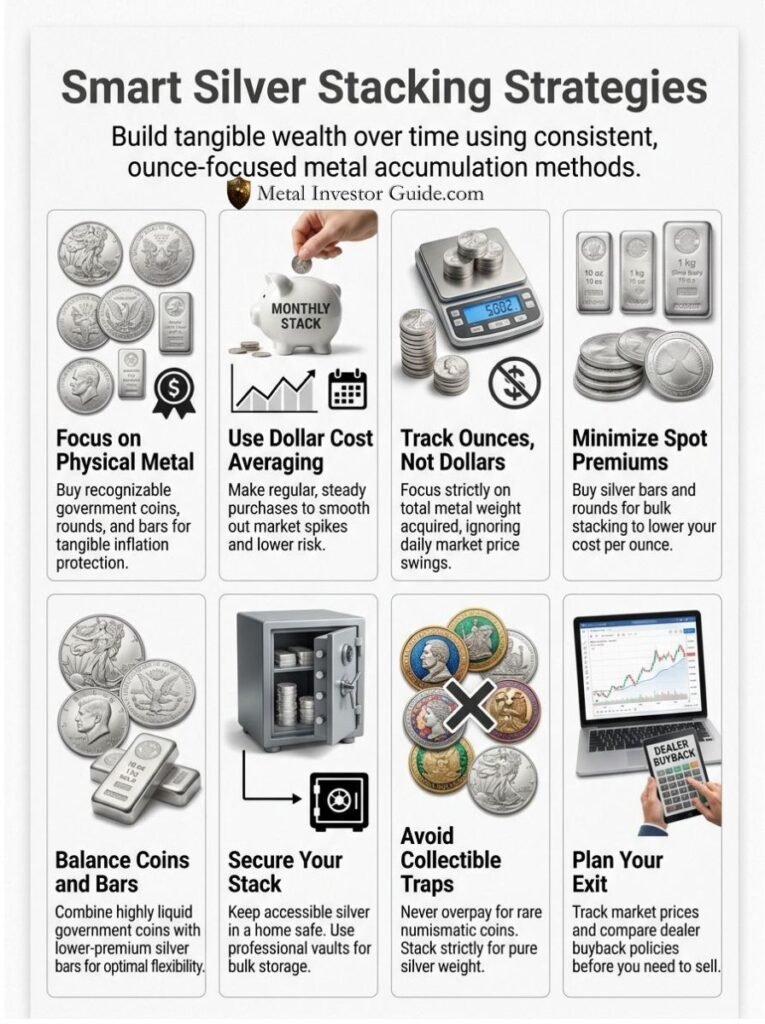
Simple Definition of Silver Stacking
At its simplest, silver stacking means buying silver primarily for its metal content rather than for rarity or collectible value.
Most stackers focus on bullion products where the value closely follows the silver market itself. That usually includes:
- bullion coins
- silver rounds
- silver bars
- and junk silver
One important detail beginners should understand early is that bullion is measured in troy ounces. One troy ounce equals 31.1035 grams, and that is the standard unit used throughout the precious metals market.
If you are trying to determine the best silver to stack, start with products that clearly list both purity and weight, such as:
- 1 troy ounce
- .999 fine silver
- .9999 fine silver
Then build outward based on your budget, storage setup, and long term goals.
- Coins: highly recognizable and easy to resell, though premiums are often higher.
- Rounds: lower premium silver that still stores and stacks efficiently.
- Bars: excellent for bulk accumulation and lower cost per ounce in larger sizes.
- Junk silver: smaller divisible units valued primarily for silver content rather than collector appeal.
Stacking vs Investing vs Trading
Silver stacking is different from both investing and trading because the primary focus is physical ownership.
Stackers usually think first about ounces accumulated, average cost, storage security, and long term flexibility.
Investors may still buy physical silver, but they typically think more in terms of portfolio allocation, diversification, and after tax returns.
Traders focus primarily on short term price movement and frequent buying and selling opportunities.
| Approach | Main Goal | What You Track | Common Mistake |
|---|---|---|---|
| Silver stacking | Build long term physical ounces | Total ounces and average cost | Overpaying for high premium collectibles |
| Investing | Diversification and wealth preservation | Portfolio allocation and taxes | Ignoring storage and liquidity |
| Trading | Profit from short term volatility | Price movement and timing | Emotional overtrading |
A practical point for US investors is that physical precious metals are commonly treated as collectibles for federal tax purposes. That can affect your after tax results if you eventually sell for a gain.
Why Investors Choose Physical Silver
People choose physical silver for different reasons, but most stackers are drawn to the same core ideas:
- diversification
- inflation protection
- tangible ownership
- and long term wealth preservation
Many investors also like the fact that silver has both monetary history and real industrial demand. It is used in areas like electronics, solar technology, and manufacturing, which adds another layer of long term interest.
Silver can also move dramatically during periods of economic uncertainty or speculative excitement. That volatility is one reason experienced stackers focus so heavily on discipline and consistency rather than emotion.
A strong stacking strategy helps you avoid:
- panic buying during price spikes
- overpaying extreme premiums
- chasing hype
- and building a stack that becomes difficult to resell later
The most successful stackers are usually the most consistent ones.
They build slowly, buy intelligently, keep good records, and focus on long term ownership instead of short term excitement.
Why Strategy Matters When Buying Silver
A weak silver stacking strategy quietly creates expensive problems.
Many beginners think the biggest risk is silver prices falling. In reality, most stacking mistakes happen long before the market moves against you.
They happen when investors:
- overpay huge premiums
- buy silver products that are difficult to resell
- panic-buy during price spikes
- ignore storage planning
- or build a stack with no long term structure behind it
The difference between a disciplined stacker and an emotional buyer often comes down to having a repeatable system.
A strong silver stacking strategy helps you:
- control premiums
- reduce emotional decisions
- improve liquidity
- build ounces consistently
- and create a stack you can realistically hold through volatility
Experienced stackers understand that buying silver is easy. Building a smart long term silver position takes planning.
A good strategy defines:
- what you buy
- how often you buy
- how much you pay over spot
- where you store it
- and eventually how you may sell it
How Poor Strategy Leads to Overpaying
Most silver stacking mistakes do not feel like mistakes when you make them.
They feel exciting.
A flashy collectible coin, a sudden market spike, or a “limited inventory” warning can push buyers into emotional decisions that quietly damage long term results.
The easiest way to lose money in physical silver is often not a market crash. It is consistently overpaying through high premiums, poor product selection, and impulsive buying decisions.
That is why experienced stackers focus heavily on premium control.
Start with one simple calculation: premium per ounce.
- Premium (dollars) = your all-in price per ounce minus spot price per ounce
- Premium (percent) = premium dollars divided by spot price
Once you start tracking premiums consistently, buying decisions become much clearer.
For example, if two products contain the same silver weight but one carries a dramatically higher premium, you should understand exactly what benefit you are receiving in return. Sometimes higher premiums are justified through liquidity, recognition, or security features. Other times, they are simply marketing.
Thinking ahead to resale also matters.
Generic bullion products are usually easier to liquidate quickly through local coin shops and dealer buyback programs. High premium collectibles often require a more specialized buyer.
The Role of Consistency vs Market Timing
Experienced stackers know that consistency matters more than perfect timing.
The people who build strong long term silver positions are usually not the ones making dramatic market predictions. They are the ones quietly adding ounces year after year while controlling premiums and avoiding emotional decisions.
Small, steady buys often beat rare, risky market bets.
Dollar cost averaging helps remove emotion from the process. Instead of trying to predict short term silver prices, you build steadily across different market environments.
A schedule also improves discipline because it forces you to compare premiums consistently instead of reacting emotionally to headlines.
- Monthly plan: buy a fixed amount or fixed weight every month
- Quarterly plan: make larger scheduled purchases while reviewing storage and insurance regularly
- Hybrid plan: maintain small recurring purchases while reserving extra cash for unusually favorable buying opportunities
The goal is not to buy perfectly. The goal is to build consistently without creating unnecessary stress.
Understanding Volatility Before You Start
Silver can stay quiet for months, then suddenly move fast enough to trigger emotional buying and panic selling.
That volatility is one reason experienced stackers rely on rules instead of headlines.
If you want a silver stacking strategy you can realistically follow long term, plan for volatility before emotions enter the picture.
A few simple rules can make a major difference:
- define a minimum holding period for your core stack
- separate long term stacking from short term speculation
- focus on products that match your liquidity and storage goals
- avoid making major buying decisions during highly emotional market moves
Different silver products also serve different purposes.
- Government coins: strong recognition and liquidity
- Rounds and bars: lower premium ounces and efficient accumulation
- Junk silver: small divisible units with flexibility during resale
If market volatility starts making you feel pressured or emotional, that is usually a signal to simplify your strategy rather than become more aggressive.
Once you understand why strategy matters, the next step is learning the core principles that experienced stackers use to build and protect their silver position over time.
The Core Principles of Smart Silver Stacking
Smart silver stacking is not complicated, but it is disciplined.
The most successful stackers usually follow the same core habits:
- they buy recognizable products
- control premiums carefully
- stay consistent during volatility
- verify what they buy
- and track their stack methodically over time
That may sound simple, but these habits separate disciplined long term stackers from emotional buyers who constantly chase hype, overpay during market excitement, or build stacks that become difficult to manage later.
Experienced stackers understand that building a silver position is not about making one perfect purchase. It is about creating a repeatable system that works year after year.
Focus on Recognizable and Liquid Silver Products
Experienced stackers prioritize recognizable silver products because liquidity matters just as much as accumulation.
The easier a product is to recognize and authenticate, the easier it usually is to resell later through dealers, local coin shops, or private buyers.
Two of the most widely recognized silver bullion coins are:
- American Silver Eagle: 1 troy ounce of .999 fine silver with a $1 face value
- Canadian Silver Maple Leaf: 1 troy ounce of .9999 fine silver produced by the Royal Canadian Mint
These coins are popular not only because of their silver content, but because buyers immediately recognize them and trust their authenticity.
Experienced stackers also pay attention to basic dimensions and specifications because counterfeit silver products have become more common over time.
For example:
- American Silver Eagle: approximately 40.6 mm diameter and 2.98 mm thickness
- Canadian Silver Maple Leaf: approximately 38 mm diameter and 3.29 mm thickness
A basic scale and calipers can help you verify many common bullion products before you even use more advanced authentication tools.
The goal is not just to own silver. The goal is to own silver that remains practical to verify, store, and eventually liquidate if needed.
Minimize Premiums Over Spot Price
New stackers sometimes become so focused on buying silver that they overlook how much premiums affect long term results.
Premiums are not automatically bad. Higher premiums can sometimes provide meaningful benefits such as:
- stronger recognition
- easier resale
- higher liquidity
- or advanced anti-counterfeit features
The key is understanding when a higher premium actually improves your stack and when it simply adds unnecessary cost.
| Type | Why Stackers Buy It | What to Watch |
|---|---|---|
| Government coins | Recognition and liquidity | Premium spikes during periods of high demand |
| Rounds | Lower cost ounces | Stick to well-known private mints |
| Bars | Efficient bulk accumulation | Prefer serialized bars or assay packaging when possible |
Experienced stackers compare all-in cost, not just sticker price.
That means factoring in:
- shipping
- insurance
- payment method fees
- and possible sales tax depending on your state
A lower advertised price does not always mean a better deal once all costs are included.
Prioritize Consistency Over Timing the Market
Most successful stackers are surprisingly boring.
They follow a schedule, compare premiums carefully, avoid emotional buying decisions, and continue building ounces during both strong markets and weak ones.
That consistency becomes a major advantage over time.
Small, steady purchases often outperform emotional market timing decisions.
Dollar cost averaging works well because it reduces pressure to predict short term silver prices. Instead of trying to buy at the perfect moment, you build gradually across different market conditions.
Consistency also improves discipline because it forces you to evaluate purchases logically instead of emotionally.
- Weekly or monthly purchases: steady accumulation and cleaner budgeting
- Quarterly purchases: larger buys with more time for comparison shopping
- Hybrid approach: smaller recurring purchases combined with occasional bulk buys during favorable premium environments
The goal is not to outsmart the market every month.
The goal is to build a silver position you can realistically maintain for years.
Measure Progress in Ounces, Not Just Dollars
Experienced stackers often think in ounces first and dollar value second.
That mindset helps reduce emotional reactions during price swings because you focus on what you can control:
- how much silver you accumulate
- what premiums you pay
- and how efficiently you build your stack over time
You cannot control daily silver prices, but you can control your buying discipline.
A simple inventory spreadsheet is one of the most useful tools a stacker can have.
Track:
- purchase date
- product type
- purity and weight
- all-in cost per ounce
- storage location
- serial numbers or assay information
This creates cleaner recordkeeping, simplifies insurance documentation, and helps with future capital gains reporting if you eventually sell.
For junk silver, experienced stackers rely heavily on one important conversion number:
- approximately 0.715 troy ounces of silver per $1 face value for worn 90% US silver coinage
Understanding that conversion makes it much easier to compare junk silver pricing against standard bullion products.
Over time, disciplined tracking helps remove emotion from stacking and turns the process into a structured long term accumulation strategy.
The Most Effective Silver Stacking Strategies
No single silver stacking strategy works for everyone.
The best approach depends on:
- your budget
- your storage setup
- your risk tolerance
- your personality
- and how actively you want to manage your stack over time
Experienced stackers often combine multiple strategies instead of relying on just one method. Some prioritize consistency and simplicity. Others focus heavily on premium control, liquidity, or bulk accumulation.
The key is building a strategy you can realistically maintain through both calm markets and volatile ones.
The most successful stackers are usually not the most aggressive. They are the most disciplined.
Dollar Cost Averaging Strategy for Beginners
This is one of the most popular silver stacking strategies because it removes much of the emotion from the process.
Instead of trying to predict silver prices, you build steadily over time using scheduled purchases.
This strategy works especially well for:
- beginners
- long term investors
- and anyone who wants silver stacking to feel manageable instead of stressful
Experienced stackers often prefer dollar cost averaging because consistency usually matters more than perfect timing.
Small, steady accumulation often beats emotional buying during market excitement.
A simple approach works best:
- choose a fixed schedule
- choose a fixed dollar amount or ounce target
- and stick to recognizable silver products
Many stackers keep a short approved list of products to simplify decision-making and improve premium comparisons over time.
- Start small: even 1 to 5 ounces per month builds discipline and long term momentum
- Keep products consistent: this makes premium tracking easier
- Verify purchases routinely: weight, dimensions, and authentication checks help reduce risk
This strategy may not feel exciting, but that is part of why it works so well long term.
Bulk Buying During Price Dips
Bulk buying is usually best for disciplined stackers who already have:
- emergency savings
- secure storage
- and a stable long term accumulation plan
The goal is not to panic-buy during every silver dip. The goal is to take advantage of favorable pricing opportunities without disrupting your overall financial stability.
Experienced stackers often use bulk buying selectively after they already have a steady stacking routine in place.
Bulk buying commonly involves:
- larger silver bars
- sealed tubes of coins
- or monster boxes containing large quantities of bullion
Larger purchases can sometimes reduce premiums per ounce and improve storage efficiency.
For example:
- larger bars often provide lower cost per ounce
- sealed tubes simplify organization and inventory
- monster boxes can streamline long term storage and counting
However, some stackers become so focused on lowering premiums that they accidentally create storage and security problems at home.
Saving a little on premiums is not worth compromising safety or peace of mind.
Bulk accumulation only makes sense if your storage setup can support it properly.
The Core Plus Flex Strategy
This strategy is popular because it balances discipline with enjoyment.
Many stackers eventually realize they want two things at the same time:
- a strong core bullion position
- and some flexibility to buy specialty pieces they personally enjoy
The core plus flex strategy solves that problem cleanly.
The idea is simple:
- build a core stack focused on liquidity, recognition, and lower premiums
- then reserve a smaller portion of your budget for higher premium or collectible pieces
This approach works well for stackers who enjoy the hobby side of silver but still want to protect long term accumulation goals.
- Core stack: silver bars, rounds, and widely recognized bullion coins
- Flex stack: limited designs, specialty rounds, collectible themes, or higher premium items
Experienced stackers usually protect the core from emotional spending.
If you choose to buy higher premium collectible silver, keeping that portion limited by ounces instead of dollars can help maintain balance during premium spikes.
Junk Silver Accumulation Strategy
Junk silver remains popular because it offers small, divisible units with strong historical familiarity in the United States.
This strategy works especially well for stackers who value:
- flexibility
- smaller transaction sizes
- and highly recognizable US coinage
Most junk silver refers to pre-1965 US dimes, quarters, and half dollars minted with 90% silver content.
Experienced stackers often like junk silver because it combines:
- divisibility
- recognizability
- and practical barter-sized units
Pricing is usually based on face value rather than individual coin counts.
One of the most important numbers to learn is:
- approximately 0.715 troy ounces of silver per $1 face value for worn 90% silver coinage
Understanding that conversion makes it much easier to compare junk silver pricing against standard bullion products.
- Buy by face value: dealers commonly sell junk silver in face-value lots
- Keep coins organized: separate 90% silver from 40% half dollars
- Store clearly: labeled tubes or bags simplify inventory tracking
Junk silver may not look as polished as modern bullion, but many experienced stackers appreciate its practicality and flexibility.
The Barbell Strategy Using Coins and Bars
Many experienced stackers eventually gravitate toward a barbell strategy because it balances two competing goals:
- liquidity
- and premium efficiency
Government bullion coins provide easier resale and stronger recognition, while bars help maximize total ounces accumulated over time.
This strategy works well for stackers who want:
- recognizable products for liquidity
- lower premium bulk accumulation
- and flexibility during future selling
The “coin side” of the strategy often includes:
- American Silver Eagles
- Canadian Silver Maple Leafs
- Austrian Silver Philharmonics
The “bar side” focuses more heavily on:
- serialized silver bars
- larger ounce formats
- and efficient long term storage
Experienced stackers often adjust the balance depending on their goals.
For example:
- investors prioritizing liquidity may lean more heavily toward coins
- long term accumulators focused on ounces may emphasize bars more heavily
The barbell strategy works because it avoids becoming too concentrated in a single type of silver product.
It creates a stack that remains practical, flexible, and easier to manage over time.
What Types of Silver Should You Stack?
There is no single “perfect” type of silver for every stacker.
Experienced stackers usually own a mix of silver products because different formats solve different problems:
- government coins improve liquidity and recognition
- rounds help lower premiums
- bars improve ounce efficiency
- junk silver adds flexibility and divisibility
The right combination depends on:
- your budget
- your storage setup
- your long term goals
- and how you may eventually want to sell your silver
Smart stacking is not just about accumulating ounces. It is also about building a stack that remains practical to verify, store, organize, and liquidate over time.
Government Minted Coins and Their Advantages
Experienced stackers often prioritize government minted bullion coins because liquidity matters during both buying and selling.
Recognizable bullion coins are easier to authenticate, easier to price, and usually easier to resell quickly if needed.
The most widely recognized example in the United States is the American Silver Eagle. It contains one troy ounce of .999 fine silver and carries a $1 face value, although the silver value itself is what matters most to stackers.
Other globally recognized government bullion coins include:
- Canadian Silver Maple Leaf
- Austrian Silver Philharmonic
- British Silver Britannia
Government coins are especially popular with stackers who value:
- strong resale markets
- easy authentication
- broad dealer recognition
- and long term liquidity
- Best for: liquidity, recognition, gifting, and easier resale
- Trade-off: premiums are often higher than rounds or bars
Many experienced stackers are willing to pay slightly higher premiums for government bullion because the stronger recognition can simplify future resale.
Government bullion can also matter for precious metals IRAs because eligibility rules typically focus on approved products and minimum fineness standards.
Silver Rounds and Lower Premium Options
Many stackers turn to silver rounds once they become more focused on maximizing ounces instead of collecting government bullion.
Silver rounds look similar to coins, but private mints produce them and they do not carry legal tender status.
Their biggest advantage is usually lower premiums.
That makes rounds attractive for stackers who want:
- efficient long term accumulation
- lower cost per ounce
- and simple storage without sacrificing recognizability entirely
Experienced stackers often prefer rounds from well-known private mints because recognizable products tend to resell more smoothly.
Rounds also stack and store efficiently because they commonly use standard sizes and tube formats.
- Best for: routine accumulation and premium control
- Trade-off: some lesser-known rounds can be harder to resell quickly
For many long term stackers, rounds become a practical middle ground between high-premium government coins and larger silver bars.
Silver Bars for Bulk Accumulation
Experienced stackers often gravitate toward silver bars once storage efficiency and premium control become larger priorities.
Bars are built for accumulation.
They maximize ounce density, simplify storage, and often reduce premium costs compared to individual bullion coins.
That makes bars especially attractive for stackers focused on:
- bulk silver ownership
- long term holding
- and efficient storage
Silver bars come in many sizes ranging from small 1 ounce bars to much larger formats designed for serious accumulation.
Many stackers prefer bars that include:
- serial numbers
- assay cards
- or tamper-evident packaging
These features can improve buyer confidence during resale and reduce authentication concerns.
- Best for: bulk accumulation, vault storage, and long term stacking
- Trade-off: very large bars can be less flexible during partial sales
Experienced stackers usually balance premium savings against future liquidity. Saving money on premiums is valuable, but flexibility still matters.
Junk Silver for Divisibility and Flexibility
Junk silver remains popular because it offers small, practical units with strong historical familiarity in the United States.
Most junk silver consists of pre-1965 US dimes, quarters, and half dollars minted with 90% silver content.
Many experienced stackers appreciate junk silver because it combines:
- divisibility
- recognizability
- flexibility
- and lower denomination silver ownership
Unlike modern bullion products, junk silver is commonly bought and sold based on face value rather than individual coin counts.
One of the most useful numbers stackers learn is:
- approximately 0.715 troy ounces of silver per $1 face value for worn 90% silver coinage
Understanding that conversion makes it much easier to compare junk silver pricing against traditional bullion products.
Junk silver also appeals to stackers who prefer smaller transaction sizes and more flexibility during future resale.
- Best for: divisibility, smaller transactions, and flexible liquidity
- Trade-off: coin condition varies and sorting may require more organization
While junk silver may not look as polished as modern bullion, many experienced stackers value its practicality and long history of recognition within the US market.
How Much Silver Should You Stack?
There is no universal “correct” amount of silver to own.
Experienced stackers understand that the right allocation depends on:
- your financial situation
- your long term goals
- your comfort with volatility
- your storage capacity
- and how precious metals fit into your overall financial plan
The best silver allocation is usually the one you can comfortably maintain through volatility without feeling pressured to panic-buy or panic-sell.
A strong silver position should help you feel more financially resilient, not more financially stressed.
For most people, the smartest approach is to start smaller than they think, build consistently over time, and avoid treating silver like an all-or-nothing bet.
Factors That Influence Allocation Decisions
Your reason for stacking silver matters more than chasing a specific percentage.
Some investors primarily want diversification. Others focus more heavily on inflation protection, tangible asset ownership, or long term wealth preservation.
Those goals naturally lead to different allocation sizes.
Experienced stackers also think carefully about sustainability.
A steady monthly stacking plan is usually far more effective than one large emotional purchase that creates financial pressure or regret later.
Several practical factors influence how much silver makes sense for your situation:
- Cash flow: sustainable recurring purchases usually outperform oversized one-time buys
- Storage capacity: larger stacks require more serious security and organization
- Liquidity needs: if you may need quick access to cash later, flexibility matters
- Time horizon: long term stackers often tolerate volatility more comfortably than short term buyers
Many successful stackers begin much smaller than people expect.
Building consistently over several years is usually more important than starting with a massive initial purchase.
Portfolio Balance and Risk Tolerance
Silver can support diversification, but it can also become emotionally demanding during volatile periods.
Experienced stackers build positions sized for long term conviction, not short term excitement.
If silver price swings begin controlling your emotions or influencing unrelated financial decisions, your allocation may be too aggressive for your comfort level.
A well-sized silver position should help you sleep better at night, not create constant stress.
Some investors prefer keeping silver as a smaller diversification layer within a broader portfolio. Others build larger precious metals allocations because they place a higher value on tangible asset ownership and long term wealth preservation.
Many stackers also diversify within precious metals themselves by combining:
- silver
- gold
- platinum
- or palladium
Different metals can serve different purposes depending on:
- storage preferences
- volatility tolerance
- portability
- and long term investment goals
- More conservative approach: smaller allocation with highly liquid products
- More aggressive approach: larger precious metals exposure with greater emphasis on lower premium accumulation
The right balance is the one you can realistically maintain during both strong markets and difficult ones.
Example Allocation Ranges for Different Investors
Allocation ranges are best viewed as flexible guidelines, not rigid rules.
Experienced stackers understand that consistency and emotional sustainability matter more than hitting a perfect percentage target.
| Investor Goal | How Silver Often Fits | What to Prioritize |
|---|---|---|
| Diversification | Smaller allocation | Recognizable bullion and simpler liquidity |
| Wealth preservation | Moderate to larger precious metals allocation | Secure storage and disciplined accumulation |
| Collector-focused stacking | Potentially larger silver exposure | Keep core bullion separate from collectible purchases |
No matter which approach you choose, most experienced stackers focus on the same long term principles:
- consistent accumulation
- premium control
- secure storage
- and avoiding emotional decision-making during volatile markets
Over time, discipline usually matters far more than trying to perfectly predict silver prices.
Where to Buy Silver Safely
Choosing where to buy silver matters almost as much as choosing what to buy.
Experienced stackers usually focus on:
- dealer reputation
- pricing transparency
- authentication standards
- and buyback policies
Both reputable online dealers and trusted local coin shops can work well depending on your goals, preferred products, and storage plans.
If you are new to buying physical silver, it is worth learning how experienced stackers evaluate dealers, compare premiums, and verify authenticity before making larger purchases.
If you are ready to start building your stack, the next step is learning how to evaluate silver dealers, compare premiums, and avoid common buying mistakes. Read our guide on where to buy silver safely.
How to Store Your Silver Securely
Storage is one of the most overlooked parts of silver stacking.
Experienced stackers understand that protecting your silver is just as important as buying it intelligently. A strong storage plan helps reduce:
- theft risk
- moisture damage
- disorganization
- and future resale problems
Some stackers prefer home safes for accessibility and privacy, while others use professional vault storage for larger holdings and additional security.
The right storage setup depends on:
- the size of your stack
- your comfort with home storage
- your need for quick access
- and your long term security goals
No matter which approach you choose, keeping an organized inventory with purchase records, serial numbers, and storage locations is an important part of smart stacking.
If you want to learn how experienced stackers protect, organize, and insure physical silver, read our complete guide on how to store silver securely.
Common Silver Stacking Mistakes to Avoid
Most silver stacking mistakes are not dramatic.
They are usually small decisions repeated over time:
- overpaying premiums
- buying emotionally
- ignoring liquidity
- concentrating too heavily in one type of silver
- or building a stack with no clear long term plan
Many of these mistakes do not feel dangerous in the moment. In fact, they often feel exciting.
Experienced stackers avoid these problems by relying on systems instead of impulse. They focus on discipline, consistency, and long term flexibility rather than reacting emotionally to headlines or market swings.
Avoiding a few common mistakes early can dramatically improve your long term stacking results.
Overpaying for Collectibles Instead of Bullion
One of the easiest traps for new stackers is confusing “interesting” silver with efficient silver accumulation.
High premium collectible pieces can feel exciting in the moment, but many investors later realize they accumulated far fewer ounces than expected for the money spent.
There is nothing wrong with collectible silver if you genuinely enjoy it. The problem happens when collectibles quietly replace the core purpose of your stack.
Experienced stackers usually separate:
- long term bullion accumulation
- from collectible or hobby purchases
That distinction helps protect the core stack from emotional buying decisions.
- Core stack: lower premium bullion focused on ounces and liquidity
- Collector layer: specialty pieces, limited designs, or numismatic items purchased for enjoyment
Many disciplined stackers limit collectible purchases to a small percentage of their total silver holdings.
Ignoring Premiums and Fees
Many stacking mistakes are invisible at first.
Paying slightly too much once may not seem important, but repeatedly overpaying premiums over several years can quietly reduce both the size and flexibility of your stack.
Experienced stackers track their all-in cost carefully because small premium differences add up over time.
That means monitoring:
- spot price
- premium per ounce
- shipping costs
- payment fees
- and possible sales tax
The cheapest advertised price is not always the best overall deal once additional costs are included.
Premium awareness also improves resale flexibility later. Products with extremely high premiums often require very specific buyers to recover those costs.
Disciplined stackers focus on balancing:
- recognizable products
- reasonable premiums
- and long term liquidity
Overconcentrating in One Type of Silver
Building a stack entirely around one type of silver can create problems later.
For example:
- an all-coin stack may carry unnecessarily high average premiums
- an all-bar stack may reduce flexibility during partial sales
- a heavily collectible stack may become harder to liquidate quickly
Experienced stackers usually diversify across multiple silver formats because different products solve different problems.
A balanced stack often includes:
- government bullion coins for liquidity
- rounds or bars for lower premium accumulation
- and smaller divisible silver for flexibility
The goal is not just accumulation. It is building a stack that remains practical to manage and sell over time.
Panic Buying During Price Spikes
Emotional stacking decisions usually happen during periods of excitement, fear, or urgency.
When silver prices move rapidly, many investors suddenly feel pressure to “buy before it is too late.” That is often when premiums spike, inventory tightens, and disciplined decision-making disappears.
Experienced stackers rely on rules during volatile markets because emotions tend to produce expensive decisions.
Panic buying often sounds like:
- “I bought whatever was available”
- “I did not want to miss the move”
- or “everyone else was buying”
Disciplined stackers usually do the opposite.
Instead of reacting emotionally, they:
- compare premiums carefully
- reduce purchase size if necessary
- switch to lower premium products
- and maintain their long term buying plan
The goal is not to chase excitement. The goal is to build a stack you can confidently hold through volatility.
If market conditions start creating emotional pressure, experienced stackers often simplify their decisions rather than becoming more aggressive.
Not Planning an Exit Strategy
Many investors spend years thinking about how to buy silver and almost no time thinking about how they may eventually sell it.
Experienced stackers plan for both accumulation and liquidity from the beginning.
An exit strategy does not mean you expect to sell soon. It simply means you understand:
- what conditions may trigger future sales
- which products are easiest to liquidate
- and how taxes and documentation may affect the process
In the United States, physical precious metals gains may be taxed, and accurate records become important for calculating cost basis.
Experienced stackers usually maintain:
- invoices
- purchase dates
- product details
- serial numbers
- and inventory records
Many also prefer staged selling plans instead of emotional “all at once” decisions.
Possible exit triggers may include:
- reaching a target allocation
- major life events
- retirement needs
- or unusually strong market conditions
Planning ahead helps reduce emotional decision-making later.
And in precious metals investing, emotional decisions are often the most expensive ones.
Who Silver Stacking Is Best For
Silver stacking is not ideal for every investor.
But for people who value long term ownership, financial resilience, and tangible assets, it can become an important part of a broader wealth preservation strategy.
Experienced stackers are usually not looking for quick wins or rapid trading opportunities. They are often more focused on:
- consistency
- discipline
- diversification
- and building assets they can physically verify and control
Silver stacking tends to appeal most to investors who are comfortable thinking in years instead of weeks.
Long Term Investors Seeking Inflation Protection
Many long term stackers are less interested in getting rich quickly and more interested in building financial resilience they can physically hold and verify themselves.
For these investors, silver often represents:
- diversification outside traditional financial assets
- protection against inflation concerns
- and long term tangible ownership
Experienced stackers in this category usually accept that silver prices can be volatile in the short term. Their focus is on gradual accumulation and maintaining purchasing power over time rather than reacting emotionally to daily market movements.
This approach tends to fit investors who:
- prefer long term planning
- value consistency over excitement
- and want a physical asset that exists outside purely digital financial systems
Most successful long term stackers rely on simple habits:
- recurring purchases
- premium control
- secure storage
- and patient accumulation through different market conditions
Investors Who Prefer Tangible Assets
Some investors simply feel more comfortable owning assets they can physically verify, store, and access themselves.
That preference is one of the biggest psychological reasons people become interested in precious metals in the first place.
Unlike purely digital investments, physical silver provides direct ownership. You can:
- hold it
- inspect it
- organize it
- and store it according to your own preferences
For many stackers, that creates a stronger sense of control and financial independence.
Experienced stackers in this category often place high value on:
- authenticity verification
- storage security
- organization
- and long term accessibility
This is also why many disciplined stackers prioritize recognizable bullion products and maintain detailed inventory records. Physical ownership comes with responsibilities, but many investors appreciate the transparency and simplicity that tangible assets can provide.
Investors Building Long Term Diversification
Silver stacking also appeals to investors looking to diversify beyond stocks, bonds, and cash-based assets.
Experienced stackers usually view silver as one part of a broader financial strategy rather than as a standalone solution.
For some investors, silver complements:
- retirement accounts
- traditional investment portfolios
- cash reserves
- and other precious metals holdings
Many stackers also diversify within precious metals themselves by combining:
- silver
- gold
- platinum
- and occasionally palladium
Different metals can serve different purposes depending on:
- storage preferences
- volatility tolerance
- liquidity needs
- and long term goals
Disciplined stackers generally avoid treating silver like an all-or-nothing bet.
Instead, they focus on building balanced positions they can comfortably maintain through changing market conditions without becoming emotionally reactive.
For investors who value patience, tangible ownership, and long term diversification, silver stacking can become a practical and psychologically reassuring part of a broader financial plan.
Final Thoughts on Building a Silver Stacking Strategy
There is no perfect silver stacking strategy.
Experienced stackers understand that long term success usually comes from:
- consistency
- discipline
- premium control
- emotional restraint
- and building a plan you can realistically maintain through different market conditions
The strongest silver stacks are rarely built through excitement or perfect market timing.
They are usually built slowly over time through repeatable habits, thoughtful product selection, and steady accumulation during both strong markets and difficult ones.
Smart stacking is not about chasing headlines or trying to predict every price move.
It is about creating a system that helps you:
- accumulate ounces consistently
- protect purchasing power
- maintain liquidity
- and avoid emotional decision-making during volatility
Most experienced stackers eventually realize that silver stacking works best when it feels sustainable, organized, and calm.
The goal is not to build the biggest stack as quickly as possible.
The goal is to build a stack you can confidently hold, manage, protect, and adjust over time without constantly reacting to fear or excitement.
Continue Building Your Silver Stacking Knowledge
- Where to Buy Silver Safely
- How to Store Silver Securely
- Best Silver Coins for Long Term Stacking
- Silver Bars vs Coins
- Junk Silver Explained
The most successful stackers usually keep things simple: buy consistently, control premiums, stay organized, and think long term.
FAQs
What are silver stacking strategies?
Silver stacking strategies are structured approaches for buying and holding physical silver over time.
Experienced stackers usually focus on:
- consistent accumulation
- premium control
- liquidity
- secure storage
- and long term discipline
The goal is not simply to buy silver randomly. It is to build a stack that remains practical, organized, and sustainable through different market conditions.
How do I build a smart silver position over time?
Most experienced stackers build their silver position gradually rather than trying to perfectly time the market.
A smart long term approach usually includes:
- recurring purchases
- recognizable silver products
- reasonable premiums
- secure storage
- and clear recordkeeping
Many disciplined stackers also separate long term accumulation from emotional or speculative buying decisions.
Consistency usually matters far more than finding the perfect entry price.
Is stacking silver safer than stocks or crypto?
Silver stacking can reduce reliance on purely digital or highly volatile assets, but it still carries risks.
Physical silver prices can fluctuate significantly, and stackers must also manage:
- storage
- security
- insurance
- and resale considerations
Experienced stackers usually view silver as one part of a diversified long term strategy rather than a replacement for every other investment.
The right allocation depends on your goals, risk tolerance, and overall financial situation.
How much silver should I hold and how often should I buy?
There is no universal “correct” amount of silver to own.
Experienced stackers usually build positions gradually and size their allocation based on:
- financial goals
- volatility tolerance
- storage capacity
- and overall portfolio diversification
Many stackers prefer recurring monthly or quarterly purchases because consistency helps reduce emotional decision-making and simplifies budgeting.
For most people, sustainable long term accumulation works better than aggressive short term buying.