
How Does a Precious Metals IRA Work? Rules, Fees, and What Investors Must Know
Most retirement accounts keep you inside the paper system.
Stocks. Bonds. Mutual funds. ETFs.
And for many investors, that’s fine — until inflation rises, markets swing violently, or confidence in the financial system begins to erode.
At some point, a different question emerges:
Can I hold real, physical gold or silver inside my retirement account — without giving up the tax advantages?
The answer is yes.
But not in the way most people assume.
A precious metals IRA is not a “buy gold and store it in your safe” arrangement. It is a regulated structure involving a custodian, a dealer, and a secure depository — all working together to preserve the IRA’s tax status while giving you exposure to physical bullion.
When done correctly, it can strengthen diversification and reduce reliance on paper-only assets.
When done incorrectly, it can trigger taxes, penalties, and compliance issues that are expensive to unwind.
In this guide, you’ll see exactly how a precious metals IRA works in practice — how funding happens, what metals qualify, how storage rules function, how taxes apply, and where investors most often make mistakes.
Let’s break it down clearly.
Key Takeaways
- A precious metals IRA is a self-directed IRA that can hold physical gold, silver, platinum, or palladium – but the metal must meet IRS eligibility standards and remain in the custody of an approved trustee, not in your personal possession.
- Most custodians follow market-standard fineness thresholds: 99.5% gold, 99.9% silver, and 99.95% platinum and palladium, with certain legal exceptions like the American Gold Eagle.
- Funding is typically done through a direct transfer or direct rollover to avoid the 60-day deadline and mandatory withholding risks associated with indirect rollovers.
- Required Minimum Distributions (RMDs) still apply. Physical metal requires planning because you may need to sell inside the IRA or take an in-kind distribution to meet IRS deadlines.
- Fees matter more than most investors realize. In addition to the metal’s spread, you may pay annual custodian fees, storage fees (segregated vs. commingled), and transaction costs.
- Compared to ETFs or mining stocks, a precious metals IRA offers direct physical ownership, but with higher costs and slower liquidity.
What Is a Precious Metals IRA?
A precious metals IRA is simply a self-directed individual retirement account that holds physical bullion instead of paper assets.
The IRS normally classifies metals as “collectibles,” which would make them ineligible for IRA accounts. The exception allows certain coins and qualifying bullion to be held inside an IRA – provided:
- The metal meets fineness standards.
- The assets remain in the physical possession of an approved trustee or depository.
If you want IRA tax benefits, the IRA – not you – must possess the metal.
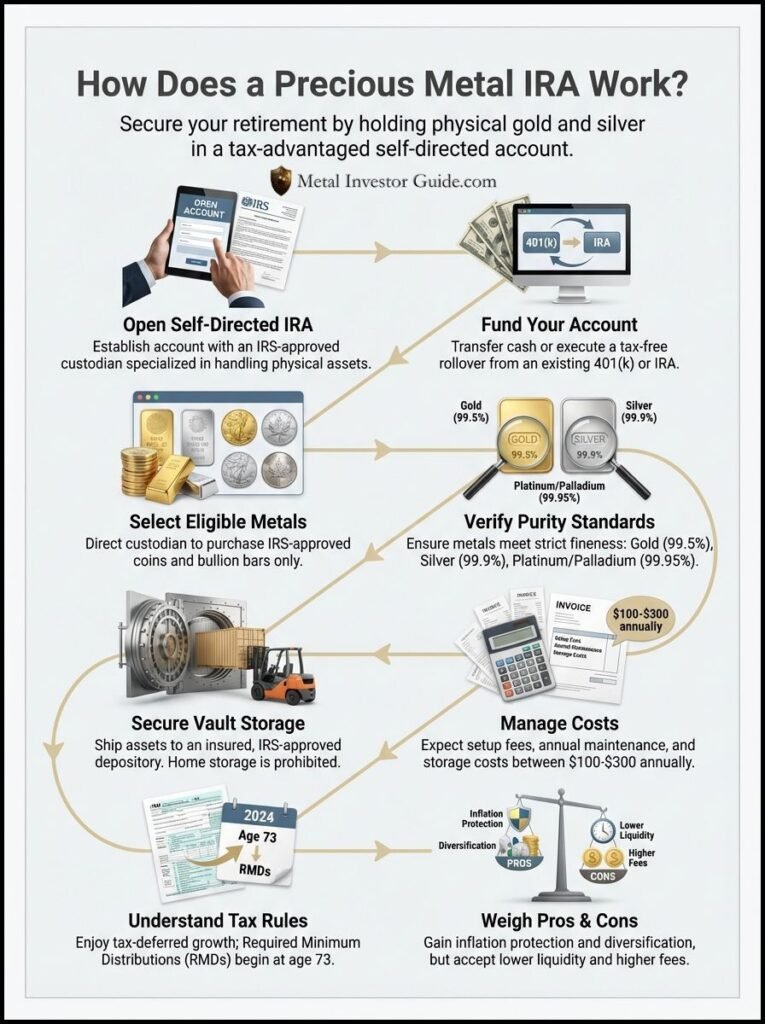
How the Structure Actually Works
Think of the process as a controlled chain of custody:
- Open a self-directed IRA with a custodian that supports metals.
- Fund the account via transfer, rollover, or contribution.
- Select eligible metals that meet IRS and custodian requirements.
- Custodian executes the purchase using IRA funds.
- Metal ships directly to an approved depository.
- You manage the position inside the IRA until sale or distribution.
You direct decisions.
The custodian handles compliance and reporting.
The depository safeguards the metal.
That structure preserves tax status.
Role of the Custodian
Your custodian is the compliance engine of the IRA.
They:
- Open and administer the account
- Execute purchases
- Coordinate approved storage
- Handle IRS reporting (Form 5498, 1099-R, etc.)
- Process distributions
They do not provide investment advice. In a self-directed IRA, you evaluate products, dealers, and pricing.
Fee schedules vary significantly and should be treated as a primary decision factor — not an afterthought.
Funding the Account
There are three funding paths:
Direct Trustee-to-Trustee Transfer (IRA to IRA)
The cleanest option. Funds move directly between custodians. No 60-day rule. No withholding.
Direct Rollover (Employer Plan to IRA)
Funds go directly into the IRA, avoiding mandatory 20% withholding.
Indirect Rollover
Funds are paid to you. You generally have 60 days to redeposit. Employer plans often withhold 20%, which you must replace if rolling over the full balance.
For most investors, direct transfer or direct rollover is the lowest-risk method.
Purchasing Precious Metals
Inside the IRA, purchases must meet three filters:
- Eligibility – Is it allowed under IRS collectible exceptions?
- Fineness – Typically:
- 99.5% gold
- 99.9% silver
- 99.95% platinum and palladium
(American Gold Eagles are a statutory exception.)
- Execution integrity – The metal must move directly into approved custody.
Avoid heavily marked-up collectibles and “rare coin” promotions. Many are disallowed or overpriced.
Always understand:
- The expected bid-ask spread
- Your purchase price
- The dealer’s buyback price
Storage Requirements
IRA-owned metal cannot be stored at home.
Personal possession can be treated as a taxable distribution.
Custodians typically use institutional depositories that provide:
- Allocated or segregated storage
- Insurance coverage
- Reporting and custody controls
Segregated vs. Commingled
Segregated: Your exact items are stored separately and returned to you.
Commingled: Your holdings are allocated but stored with similar assets; you receive equivalent items upon distribution.
Segregated storage costs more but offers item-specific control.
Types of Precious Metals Allowed in an IRA
Gold
- Typically must be 99.5% pure
- American Gold Eagle allowed by statute despite lower fineness
- Mainstream bullion coins improve liquidity and resale spreads
Silver
- Typically 99.9% purity
- More volatile than gold
- Requires more storage space per dollar invested
Platinum & Palladium
- Typically 99.95% purity
- Thinner markets and wider spreads
- Best used as satellite allocations
Eligibility is ultimately determined by your custodian’s acceptance list.
Tax Treatment
A precious metals IRA follows standard IRA tax rules.
Traditional IRA
- Contributions may be deductible
- Distributions taxed as ordinary income
Roth IRA
- Contributions after-tax
- Qualified withdrawals tax-free
Inside an IRA, you do not receive long-term capital gains rates.
Outside an IRA, metals may be taxed as collectibles (up to 28%).
Prohibited transactions — such as personal use or pledging the IRA as collateral — can disqualify the account.
Required Minimum Distributions (RMDs)
RMD rules apply based on current IRS age thresholds.
You can satisfy RMDs by:
- Selling metal inside the IRA and distributing cash
- Taking an in-kind distribution of physical metal
Failure to meet RMD requirements can result in significant excise penalties.
Physical assets require liquidity planning.
Pros and Cons of Precious Metals IRAs
Advantages
- Portfolio diversification
- Direct physical ownership
- IRA tax structure
Disadvantages
- Higher ongoing costs
- Slower liquidity than ETFs
- No yield or passive income
- Compliance complexity
A precious metals IRA is not a default retirement solution. It is a structural choice for investors who value physical ownership enough to accept the added cost and administration.
Conclusion
A precious metals IRA allows you to hold physical bullion inside a self-directed IRA — provided you follow strict custody, eligibility, and tax rules.
It works best when:
- Fees are understood upfront
- Products are mainstream and liquid
- RMD planning is built into the strategy
- Compliance is treated seriously
Used thoughtfully, it can strengthen diversification.
Used carelessly, it can create friction and tax consequences.
Clarity — not emotion — should drive the decision.