
Best Silver Coins for Investment (2026): What Smart Investors Actually Buy
Most people assume investing in silver is straightforward. Buy when the price feels reasonable, hold, and sell later for a profit.
But that’s not how it plays out for many investors.
Two people can buy the same amount of silver at the same time, watch the price rise… and still walk away with very different results when they sell.
The difference usually has nothing to do with timing.
It comes down to what they chose to buy.
Some forms of silver are easy to sell, widely recognized, and consistently in demand. Others require explanation, verification, or a price concession just to move them. That gap shows up at the worst possible moment, when you actually need liquidity.
That’s why experienced investors don’t just think in terms of ounces. They think in terms of resale.
Silver coins, especially sovereign-minted bullion coins, sit at the center of that strategy. You’re not just buying metal. You’re buying recognizability, easier authentication, and access to a much broader pool of buyers.
In this guide, we’ll break down the best silver coins for investment in 2026, how to evaluate premiums properly, and how to build a position that you can sell without unnecessary friction.
Let’s start with why so many investors choose silver coins over bars and rounds in the first place.
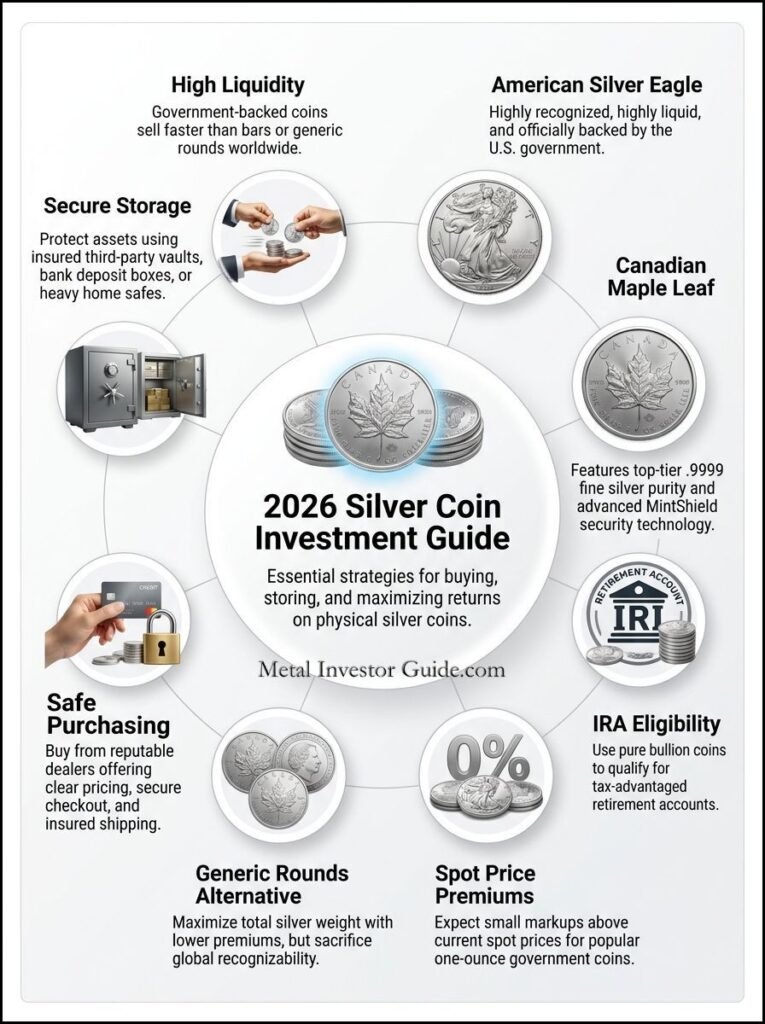
Why Investors Choose Silver Coins Over Bars and Rounds
Most investors don’t notice the difference between coins, bars, and rounds when they’re buying.
They notice it when they try to sell.
That’s where the gap shows up.
In the U.S., sovereign-minted silver coins tend to move faster and with less friction than bars or generic rounds. Not because they contain more silver, but because they’re easier for the next buyer to recognize, trust, and price immediately.
Bars and silver rounds can be excellent for building weight at a lower cost per ounce. But when it comes time to sell, especially in smaller quantities or in a hurry, many buyers gravitate toward familiar, government-backed coins.
That difference matters more than most people expect.
Why coins tend to win on resale:
- Faster resale: widely recognized coins don’t require explanation or verification delays
- Cleaner pricing: dealers quote buyback prices for major coins all day, every day
- Standardized packaging: tubes and sealed boxes make transactions easier to process
- IRA compatibility: many sovereign coins fit more cleanly into self-directed IRA rules
Liquidity and Ease of Resale
The American Silver Eagle and the Canadian Maple Leaf are two of the easiest products to move in U.S. markets.
Most dealers don’t need to inspect them closely or research the product before quoting a price. That speeds up the transaction and often results in tighter buy-sell spreads.
Packaging plays a bigger role than many investors realize. Coins stored in standard tubes or mint-sealed boxes are easier to handle, easier to count, and easier to resell in clean lots.
If you want a quick reality check before you buy, call a local coin shop and ask:
“Do you post your buy prices for Silver Eagles and Maple Leafs, and do you pay differently for loose coins versus tubes?”
That single question will tell you how liquid your investment really is in your local market.
Government-Backed Trust and Recognition
Sovereign-minted coins carry a simple but powerful advantage: built-in trust.
The issuing mint guarantees the coin’s weight and purity, which reduces the need for verification during resale.
Modern coins also include advanced security features. For example, the Royal Canadian Mint uses micro-engraved marks and radial lines on Maple Leafs, while the Royal Mint incorporates multiple anti-counterfeit features into Britannias.
These details matter most when you’re not dealing with a familiar buyer.
Recognizability brings the buyer in. Security features help close the deal.
What Makes a Silver Coin a Good Investment
A “good” silver coin is not about design, rarity, or what looks impressive in a collection.
It’s about how easily you can sell it later without giving up unnecessary value.
That’s where most investing mistakes happen. People focus on the metal itself, but overlook the factors that determine how that metal is priced, verified, and bought back in the real world.
If you want to avoid that trap, evaluate every coin using a simple framework: Can it be verified quickly, priced easily, and sold without friction?
Here are the factors that actually matter.
Standard Weight and Recognizable Format
Most investment-grade silver coins follow a simple standard: one troy ounce.
That consistency matters more than it seems.
Buyers can price a one-ounce coin instantly. There’s no need to convert weights or explain what you’re selling. The more standard the product, the wider your pool of potential buyers.
That’s why many experienced investors build their core positions around one-ounce coins and only add fractional pieces with a specific resale plan in mind.
Purity and Metal Content
Purity, or fineness, is a non-negotiable detail.
Most modern bullion coins are .999 or .9999 fine silver, and that level of purity is widely accepted across dealers, marketplaces, and IRA custodians.
Lower-purity coins, like pre-1965 U.S. “junk silver,” can still be valuable, but they are priced differently and require a different resale approach. They trade more on melt value and face value calculations than on simple “per coin” pricing.
Before you buy, always confirm both the weight and the exact silver content. That’s what determines how your coin will be valued later.
Sovereign Mint Backing
Coins produced by government mints have a built-in advantage: trust.
The issuing authority guarantees the coin’s weight and purity, which reduces the amount of verification a buyer needs to do. That translates directly into faster transactions and often tighter buy-sell spreads.
This is why sovereign coins like American Silver Eagles and Canadian Maple Leafs consistently outperform generic products when it comes to liquidity.
If your goal is flexibility at resale, sovereign backing should form the foundation of your holdings.
Security Features and Verifiability
Modern bullion coins are designed to be easy to authenticate.
Features like micro-engraved marks, radial lines, and latent images allow buyers and dealers to verify coins quickly, even in private transactions.
That matters more than most people expect.
The easier it is to confirm authenticity, the less hesitation there is on the other side of the trade. And less hesitation usually means a smoother sale and a better price.
If you’re buying from a new dealer or plan to resell privately, take a few minutes to learn the basic verification features of the coins you own.
Premiums Over Spot Price
The spot price tells you what silver is worth. The premium tells you what you’re actually paying.
This is where many investors lose money.
Before you buy, always calculate the premium on a per-ounce basis. That allows you to compare different products directly, even if they use different weights or formats.
A higher premium is not automatically a bad thing. Popular coins often carry higher premiums because they are easier to resell. In some cases, that premium can be partially recovered when you sell.
The key is understanding what you’re paying for.
You’re not just buying silver. You’re paying for liquidity, recognition, and ease of resale.
Liquidity and Resale Reality
Liquidity is not just about whether you can sell your silver. It’s about how much you have to give up to sell it quickly.
That difference shows up in the spread between buy and sell prices.
You can improve your position by focusing on a few controllable factors:
- Condition: avoid unnecessary handling and never clean coins
- Standard lots: tubes and sealed boxes are easier to sell than mixed loose coins
- Common issues: widely traded “random year” coins usually move fastest
- Documentation: keep invoices and records of where you purchased each lot
These details may seem small, but they directly affect how easily your coins move and how much you receive when you sell.
IRA Eligibility and Flexibility
If you’re buying silver for a self-directed IRA, the rules matter as much as the product.
The IRS allows certain coins and bullion that meet specific fineness standards, but the metals must be held by an approved custodian in a qualified depository.
That means you cannot treat IRA metals like personal holdings.
Before you buy, confirm your custodian’s approved product list and understand the storage requirements. Many investors choose widely recognized sovereign coins because they fit cleanly within these rules and remain easy to value and manage.
For broader diversification, some investors combine silver with gold, platinum, or palladium, depending on their overall strategy.
Best Silver Coins for Investment
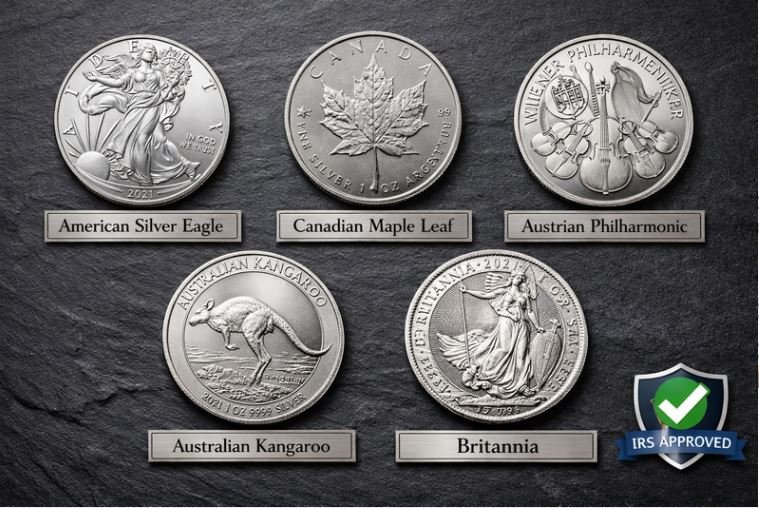
If your goal is to build a silver position that you can sell easily, start with coins that dealers price and buy back every day.
The coins below are widely recognized, actively traded, and consistently liquid in U.S. markets. Each one has a slightly different role depending on your priorities.
Use this table as a quick decision guide, then review the breakdown below to choose what fits your strategy.
Top Silver Coins Compared
| Coin | Mint | Weight | Fineness | Best For |
|---|---|---|---|---|
| American Silver Eagle | United States Mint | 1 troy oz | .999 | Maximum liquidity and fastest resale in the U.S. |
| Canadian Silver Maple Leaf | Royal Canadian Mint | 1 troy oz | .9999 | Lower premiums with strong global recognition |
| Austrian Silver Philharmonic | Austrian Mint | 1 troy oz | .999 | European demand and competitive pricing |
| British Silver Britannia | The Royal Mint | 1 troy oz | .999 | Advanced security features and broad acceptance |
| Australian Silver Kangaroo | The Perth Mint | 1 troy oz | .9999 | Sovereign coin with often favorable pricing |
| Mexican Silver Libertad | Casa de Moneda de México | 1 troy oz | .999 | Premium bullion with collector upside |
American Silver Eagle
American Silver Eagles are the benchmark for liquidity in the U.S. market.
Most dealers can quote buyback prices instantly, and many buyers specifically look for Eagles when purchasing silver. That consistent demand is what supports their higher premium.
If your priority is ease of resale and minimal friction, this is the safest starting point.
The tradeoff is cost. Eagles typically carry higher premiums than other sovereign coins, especially during periods of high demand.
Best use: core holding for beginners or anyone prioritizing fast resale.
Canadian Silver Maple Leaf
The Canadian Maple Leaf is one of the most efficient alternatives to the Silver Eagle.
It offers .9999 fine silver, strong global recognition, and advanced anti-counterfeit features, often at a lower premium than Eagles.
For many investors, this creates a simple strategy: use Maple Leafs to build ounces while maintaining strong liquidity.
If Eagle premiums rise significantly, Maples often become the better value without sacrificing resale flexibility.
Best use: building a core position with strong liquidity at a more efficient price.
Austrian Silver Philharmonic
The Austrian Philharmonic is a globally recognized bullion coin with particularly strong demand in European markets.
In the U.S., it often trades at competitive premiums compared to Eagles, making it a practical option for investors who want sovereign backing without paying a top-tier premium.
Its euro-denominated face value and consistent design also appeal to international buyers.
Best use: diversifying across sovereign mints while keeping premiums reasonable.
British Silver Britannia
The British Britannia stands out for its modern security features.
Recent versions include multiple anti-counterfeit elements such as latent images and micro-text, which can make verification easier when buying or selling outside of established dealer channels.
It also transitioned to .999 fine silver in 2013, aligning it with other modern bullion standards.
Best use: investors who value strong security features and global recognition.
Australian Silver Kangaroo
The Australian Silver Kangaroo is often one of the more competitively priced sovereign coins available through U.S. dealers.
It offers .9999 fine silver and backing from the Perth Mint, with a consistent bullion design that appeals to investors focused on simplicity and value.
While it may not have the same immediate recognition as Eagles, it still trades easily within dealer networks.
Best use: adding sovereign-backed silver at a lower premium.
Mexican Silver Libertad
The Mexican Silver Libertad sits in a different category from the others.
It is widely recognized but often carries higher premiums due to lower mintages and collector demand. That combination can make it more volatile from a pricing standpoint, but it also creates potential for premium retention over time.
Liquidity is still strong, but not as uniform as Eagles or Maples, especially in large quantities.
Best use: adding a premium component to your holdings with potential collector upside.
How to Choose the Right Coin for Your Strategy
If you’re unsure where to start, keep it simple:
- Want the easiest resale? Start with American Silver Eagles
- Want better pricing with strong liquidity? Focus on Maple Leafs
- Want diversification across mints? Add Philharmonics or Britannias
- Want lower premiums on sovereign coins? Consider Kangaroos
- Want collector upside? Add Libertads selectively
Most experienced investors don’t pick just one. They build a core around highly liquid coins, then add variety where it makes sense.
Compare Current Prices on Top Silver Coins
If you want to see how these coins are priced right now, it helps to compare a few dealers side by side.
- Check current premiums on Silver Eagles and Maple Leafs
- Compare availability across multiple dealers
- See how pricing changes based on quantity
👉 [Compare silver coin prices from trusted dealers]
Are Generic Silver Rounds a Good Alternative
Generic silver rounds can absolutely have a place in a silver investment strategy.
But they serve a different purpose than sovereign coins, and understanding that difference is what prevents problems later.
Most investors don’t notice the tradeoff when they’re buying.
They notice it when they try to sell.
Rounds are typically produced by private mints and often carry lower premiums than government-issued coins. That makes them attractive if your primary goal is to accumulate as many ounces as possible at the lowest cost.
In that context, they can be very effective.
When Silver Rounds Make Sense
Rounds work best as a bulk weight strategy.
If you are focused on maximizing ounces and you are comfortable selling back to a dealer rather than to a retail buyer, rounds can help reduce your overall cost per ounce.
- Lower premiums: often closer to spot price than sovereign coins
- Efficient stacking: ideal for building larger positions
- Simple pricing: especially when sticking to standard 1 oz rounds
One practical way to reduce risk is to choose well-known private mints that include anti-counterfeit features. For example, Sunshine Minting’s MintMark SI system allows quick verification with a decoder lens.
Where Rounds Can Create Friction
The tradeoff shows up at resale.
Rounds do not have sovereign backing, and many buyers are less familiar with private mint products. That means:
- Buyers may need more time to verify authenticity
- Some dealers offer lower buyback prices
- Private buyers may hesitate or negotiate more aggressively
In slower markets, or when selling quickly, that difference can translate into a wider spread between what you paid and what you receive.
This is where many investors underestimate the impact of product choice.
Coins vs Rounds: The Practical Difference
| Category | Strength | Tradeoff |
|---|---|---|
| Sovereign coins | Fast resale, strong recognition | Higher premiums |
| Silver rounds | Lower cost per ounce | More dependent on buyer trust at resale |
A Practical Strategy
Many experienced investors don’t choose one or the other. They combine both.
- Use sovereign coins as your liquidity layer
- Use rounds as your bulk weight layer
That approach gives you flexibility.
You maintain a portion of your holdings that can be sold quickly with minimal friction, while still benefiting from lower premiums on the rest of your position.
The key is being intentional.
Rounds are not “worse” than coins. They simply require a different resale plan.
Silver Coins vs Silver Bars: Which Is Better for Your Strategy
When you choose between silver coins and silver bars, you’re not choosing better or worse.
You’re choosing between flexibility and efficiency.
Both can work well, but they behave very differently when it comes time to sell. That’s where the decision really matters.
When Silver Coins Make More Sense
Silver coins are built for flexibility.
Because they are typically one-ounce units and widely recognized, they are easier to sell in smaller quantities without disrupting the rest of your holdings.
That gives you more control.
If you only want to sell a portion of your silver, coins allow you to do that cleanly. Most buyers already understand what they are, which reduces negotiation, verification time, and pricing friction.
Coins are often the better choice if:
- You expect to sell in smaller amounts over time
- You want access to the widest possible pool of buyers
- You value fast resale and predictable pricing
- You want products commonly used in IRA-eligible setups with an approved custodian
In short, coins prioritize liquidity.
When Silver Bars May Be the Better Choice
Silver bars are built for efficiency.
They typically carry lower premiums per ounce, especially in larger sizes like kilo or 100 oz bars. That makes them attractive if your goal is to maximize total silver exposure at the lowest cost.
But that efficiency comes with tradeoffs.
Larger bars are harder to sell in partial amounts. Selling often requires finding a dealer willing to take the full bar, and pricing may involve more verification depending on the brand and size.
Bars are often the better choice if:
- You are buying in larger quantities and want to reduce premium costs
- You plan to sell directly to dealers rather than private buyers
- You have a clear storage and resale plan in place
- You are comfortable trading some flexibility for cost efficiency
In short, bars prioritize cost efficiency.
The Real Difference Shows Up at Exit
Most investors focus on what they pay when they buy.
The more important question is what happens when they sell.
With coins, the process is usually straightforward. Buyers recognize the product, pricing is widely available, and transactions tend to move quickly.
With bars, especially larger ones, the process can require more coordination. You may need to sell the entire unit, accept dealer pricing, or allow additional verification.
That difference doesn’t matter until it does.
And when it does, it becomes very clear.
A Practical Allocation Strategy
Many experienced investors don’t treat this as an either-or decision.
They use both, but with a purpose.
- Coins: for liquidity and flexibility
- Bars: for cost-efficient bulk exposure
This approach allows you to maintain a portion of your holdings that can be sold quickly, while still benefiting from lower premiums on the rest of your position.
The key is balance.
If everything is optimized for low cost, you may give up flexibility later. If everything is optimized for liquidity, you may pay more than necessary upfront.
A combination of both lets you manage that tradeoff more effectively.
How Much Should You Pay Over Spot Price
This is where most silver investors make their biggest mistake.
They focus on the price of silver… and ignore the premium they’re paying to buy it.
That difference matters more than most people realize.
Two investors can buy silver at the same spot price, watch the market go up, and still end up with very different results when they sell. The one who paid too much in premium has to recover that cost before seeing any real gain.
That’s why premium is not a small detail. It’s a core part of your return.
How to Think About Premiums
The spot price is the base value of the metal. Your actual cost is:
Spot price + premium = your true entry price
The premium covers:
- Minting and distribution
- Dealer margins
- Market demand for specific products
But from an investor’s perspective, the key question is simple:
Will I be able to recover this premium when I sell?
That depends on the type of product you choose.
- Highly recognized coins (like Eagles and Maple Leafs) often retain more of their premium
- Generic rounds and bars usually have lower premiums, but also less premium recovery at resale
- Premium bullion (like Libertads or Pandas) can hold value, but only if demand remains strong
The goal is not to avoid premiums completely.
The goal is to pay for premiums that serve a purpose.
A Simple Way to Compare Premiums
Before you buy, always convert your cost to a price per troy ounce.
This is especially important when comparing:
- 1 oz coins
- Fractional coins
- Non-standard weights (like 30g Pandas)
Once everything is expressed per ounce, you can make a clean comparison.
This step alone prevents a large percentage of overpaying mistakes.
Typical Premium Ranges by Product Type
Instead of chasing a “perfect” number, think in relative terms:
| Product Type | Typical Premium Level | What You’re Paying For |
|---|---|---|
| Junk silver (90%) | Lower | Fractional flexibility and recognizability |
| Generic rounds | Low to moderate | Low-cost ounces |
| Silver bars | Low to moderate | Cost efficiency at scale |
| Sovereign coins (Maple, Britannia, Philharmonic) | Moderate | Liquidity and easy verification |
| American Silver Eagles | Higher | Maximum recognition and fastest resale |
| Premium bullion (Libertads, some Pandas) | Highest | Collector demand + bullion value |
Premiums can expand quickly in high-demand markets, especially for popular coins. That’s why it’s important to evaluate the premium as part of your total cost, not as an afterthought.
Warning Signs of Overpaying
Most overpaying doesn’t come from bad math. It comes from pressure or lack of comparison.
Watch for these signals:
- Urgency tactics: “limited supply” or “last chance” messaging designed to rush your decision
- Unclear pricing: sellers who won’t break down the premium over spot
- Outlier deals: pricing far below or above typical market ranges without a clear explanation
- Hidden costs: shipping, handling, or “processing” fees that increase your true cost
If something feels unclear, slow down and verify.
A Practical Rule of Thumb
Think of premiums as a tradeoff:
- Pay more → easier resale, stronger demand
- Pay less → more ounces, but potentially more friction later
There’s no single “correct” answer.
But if you understand what you’re paying for, you’re far less likely to overpay.
And that’s what protects your return.
Where to Buy Silver Coins Safely
Once you know what to buy, the next decision is where to buy it.
This matters more than most people expect.
Two investors can purchase the exact same coin, but have very different outcomes depending on pricing, fees, and how easy it is to resell later. The dealer you choose affects all of that.
The goal is not just to find silver. It’s to find clear pricing, reliable delivery, and a clean resale path.
Online Dealers vs Local Coin Shops
Both online dealers and local coin shops can be good options, but they serve slightly different purposes.
Online dealers typically offer:
- Larger inventory and consistent availability
- Transparent pricing across multiple products
- Easy comparison between coins and premiums
- Access to bulk formats like tubes and monster boxes
Local coin shops offer:
- Immediate, in-person transactions
- The ability to inspect coins before buying
- Insight into what actually sells in your local market
- A potential long-term relationship for future resale
Many experienced investors use both. They compare pricing online, then build a relationship locally for buying and selling.
What to Look for in a Dealer
Before placing an order, take a few minutes to verify the basics.
A reliable dealer should offer:
- Clear pricing: spot price and premium should be easy to understand
- Two-way markets: visible buyback prices or a stated buyback policy
- Straightforward fees: no hidden handling or surprise charges
- Secure shipping: insured delivery with tracking
- Return policies: clearly defined process if something arrives damaged or incorrect
If any of these are unclear, that’s a signal to slow down and compare alternatives.
How to Avoid Common Scams
Most problems in this space come from skipping verification.
Simple precautions go a long way:
- Stick with established dealers that have a consistent track record
- Avoid pressure tactics or “limited-time” urgency
- Never use payment methods that remove buyer protection
- Confirm product details before you pay (weight, purity, and condition)
- Keep invoices and transaction records
If something feels rushed or unclear, step back and verify before moving forward.
A Practical Way to Compare Dealers
If you want to make a confident decision, compare a few dealers side by side.
Look at:
- Price per ounce (including shipping and fees)
- Availability of the specific coins you want
- Buyback terms and resale flexibility
- Customer experience and consistency
This doesn’t need to take long. Even a quick comparison can prevent overpaying or choosing a dealer that’s harder to work with later.
Explore Trusted Dealers and Compare Options
If you’re starting your research, it can help to look at a few widely used dealers and compare how they price and structure their offers.
Many U.S. investors begin with names like:
- American Precious Metals Exchange (APMEX)
- JM Bullion
- Provident Metals
- SilverTowne
- Kitco
The goal is not to pick the first option you see.
It’s to understand how pricing works across multiple dealers so you can recognize a fair offer when you see one.
If you want to compare current pricing, product availability, and promotions, you can start by reviewing a few of these dealers side by side and see which one aligns best with your priorities.
How to Store Silver Coins Securely
Storage is not just about security.
It’s about protecting the value of your investment.
Most investors think about where to store their silver after they buy it. Experienced investors think about it before, because storage affects condition, resale, and overall risk.
A coin that is scratched, tarnished, or poorly handled may still contain the same amount of silver, but it can be harder to sell or priced less favorably.
That’s why storage is part of the investment decision, not an afterthought.
Home Storage: Control and Immediate Access
Home storage gives you full control and immediate access to your silver.
That flexibility can be valuable, especially if you want the option to sell quickly or keep your holdings private. But it also means you are responsible for security, organization, and environmental protection.
If you store silver at home:
- Use a burglary-rated safe (look for UL ratings such as TL-15 or higher)
- Store coins in tubes or capsules to prevent handling damage
- Control humidity using airtight containers and silica gel packs
- Keep a simple inventory record for insurance and resale purposes
Home storage works best for small to moderate holdings where access and flexibility are priorities.
Vault Storage: Security and Scale
For larger positions, off-site storage becomes more practical.
Third-party vaults and depositories offer:
- Professional security
- Insurance coverage
- Audited storage conditions
This is especially important for IRA-held metals, which must be stored with an approved custodian in a qualified facility.
Vault storage reduces personal risk, but it introduces tradeoffs:
- Ongoing storage fees
- Less immediate access
- Dependence on a third party
For investors with significant holdings, these tradeoffs are often worth it.
Bank Safe Deposit Boxes: A Middle Ground
Bank safe deposit boxes are a common option, but they are often misunderstood.
They provide physical security, but they do not include insurance coverage. The FDIC does not insure the contents of safe deposit boxes.
They can work well for compact, long-term storage, but you should not assume your metals are protected against loss unless you arrange separate insurance.
Choosing the Right Storage Strategy
The right choice depends on how much you own and how you plan to use it.
- Smaller holdings: home storage offers flexibility and control
- Larger holdings: vault storage provides stronger protection and oversight
- IRA metals: must be stored with an approved custodian
Many investors use a combination of these approaches to balance access, cost, and security.
The Real Goal of Storage
The goal is not just to prevent theft.
It’s to keep your silver in a condition that is easy to sell, easy to verify, and easy to value.
That means:
- Minimizing handling
- Preserving original packaging when possible
- Keeping clear records of your purchases
Because when it comes time to sell, condition and presentation still matter.
And that’s where good storage pays off.
Who Silver Coins Are Best For
Silver coins are not the right fit for every investor.
But for the right type of buyer, they offer a unique combination of tangible value, liquidity, and flexibility that’s hard to replicate with other assets.
The key is knowing whether your goals match what silver actually provides.
A Good Fit for These Investors
Silver coins tend to work best for investors who value control, flexibility, and long-term optionality.
They are a strong fit if you:
- Want a tangible store of value that you can physically hold and access
- Care about liquidity, meaning you can sell quickly without complex processes
- Prefer simplicity, with clearly priced, widely recognized products
- Are building a diversification layer alongside stocks, bonds, or other assets
- Want flexibility in how and when you sell, including smaller partial sales
For these investors, sovereign silver coins offer a balance of accessibility and resale convenience that is difficult to match.
Where Silver Coins May Not Fit Your Goals
Silver coins are less suitable if your priorities are different.
They may not be the best choice if you:
- Need income or cash flow, since silver does not generate yield
- Are focused on short-term trading, where spreads and premiums can work against you
- Want fully passive exposure, without storage or handling considerations
- Are primarily optimizing for lowest cost per ounce, where bars or rounds may be more efficient
In these cases, other assets or forms of silver exposure may align better with your strategy.
A Simple Way to Think About It
Silver coins are best viewed as a liquid, tangible reserve.
They are not designed to generate income or outperform other assets in the short term. Their strength is in flexibility, optionality, and the ability to convert into cash when needed without excessive friction.
If that aligns with your goals, they can play a valuable role in a broader portfolio.
If not, it’s better to recognize that early and choose a different approach.
Who Should Consider Alternatives Instead
Silver coins are a strong fit for many investors, but they are not the best solution for every objective.
Understanding that upfront helps you make a better decision.
Investors Focused on Income or Cash Flow
Silver does not generate income.
If your primary goal is steady cash flow, assets like dividend-paying stocks, bonds, or income-focused funds are typically more appropriate. In that case, precious metals may still play a role, but usually as a smaller diversification component rather than a core holding.
Investors Seeking Fully Passive Exposure
Physical silver requires storage, handling, and eventual resale planning.
If you prefer a more hands-off approach, some investors choose silver ETFs or other paper-based exposure. These eliminate storage concerns, but they also remove direct ownership of the underlying metal.
High-Volume Buyers Focused Purely on Cost Efficiency
If your only priority is minimizing cost per ounce, silver bars or generic rounds may be a better fit than coins.
These options typically carry lower premiums, especially at larger sizes. The tradeoff is reduced flexibility and potentially more friction at resale.
A Simple Way to Decide
If your priority is:
- Liquidity and flexibility → silver coins
- Lowest cost per ounce → bars or rounds
- Income or passive exposure → other asset classes
There’s no single “correct” choice.
The goal is to match the structure of the investment to what you actually want it to do.
Final Thoughts on Choosing the Best Silver Coins for Investment
The most important decision you make when investing in silver is not when you buy.
It’s what you buy.
Two investors can enter the market at the same time and get very different results, simply because one chose products that were easier to sell, easier to price, and more widely recognized.
That’s the difference between a smooth exit and a frustrating one.
If you keep your approach simple, you avoid most of the common mistakes.
Start with widely recognized, one-ounce sovereign coins. Pay attention to your premium over spot. Store your coins properly. And buy in formats that are easy to resell in standard lots.
That alone puts you ahead of most buyers.
From there, you can expand your strategy over time. Add lower-premium products if you want to increase your total ounces. Add premium coins selectively if you understand the tradeoffs. But keep your foundation centered on liquidity and flexibility.
Because in the end, the value of your silver is not just what it’s worth.
It’s what you can get for it when you decide to sell.
Ready to Compare Your Options
If you want to take the next step, start by comparing current pricing, availability, and buyback terms across a few reputable dealers.
Look for:
- Transparent premiums over spot
- Clear shipping and return policies
- Consistent buyback pricing
A quick comparison can help you recognize a fair offer and avoid overpaying.
You don’t need to rush the decision.
If you’re ready to move forward, comparing live pricing across a few trusted dealers is the simplest way to avoid overpaying
FAQs About Silver Coin Investing
Are silver coins a good investment?
Yes, silver coins can be a good investment if you prioritize liquidity and manage premiums carefully. Sovereign coins are widely recognized and easier to resell, which helps preserve value when you exit your position.
Their performance depends on the silver price, the premium you pay, and how easily you can sell them later.
What is the best silver coin for beginners?
For most beginners, American Silver Eagles are the best starting point because they are highly recognizable and easy to resell. Canadian Maple Leafs are a strong alternative if you want slightly lower premiums with similar liquidity.
Starting with one-ounce sovereign coins keeps things simple and flexible.
Are Silver Eagles worth the higher premium?
Silver Eagles are often worth the higher premium if you value fast resale and strong market demand. They are one of the most recognized silver coins in the U.S., which helps them retain value better than less familiar products.
However, if premiums become too high, alternatives like Maple Leafs may offer better value.
Can silver coins be held in an IRA?
Yes, certain silver coins can be held in a self-directed IRA if they meet IRS fineness requirements and are stored with an approved custodian. You cannot store IRA metals at home.
Always confirm your custodian’s approved product list before buying.
Do silver coins increase in value over time?
Silver coins can increase in value, but returns depend on the spot price of silver and the premium paid at purchase. Higher premiums can reduce or delay profits if they are not recovered at resale.
Some coins may also gain collector value, but that requires a different strategy than bullion investing.
Is it better to buy silver coins or bars?
Silver coins are generally better for liquidity and flexibility, while silver bars are better for minimizing cost per ounce. Coins are easier to sell in small amounts, while bars are more efficient for large purchases.
Many investors use a combination of both.
What is a good premium over spot for silver coins?
There is no fixed “good” premium, as it changes with market conditions. Instead, compare the price per ounce across products and focus on coins that balance reasonable premiums with strong resale demand.
Avoid overpaying for premiums you are unlikely to recover.
Where is the safest place to buy silver coins?
The safest places to buy silver coins are established online dealers and reputable local coin shops with transparent pricing and clear policies. Look for dealers that show both buy and sell prices and offer insured shipping.
Comparing multiple dealers helps you identify fair pricing.
How should silver coins be stored?
Silver coins should be stored in a secure, dry environment to protect both security and condition. Many investors use home safes for smaller holdings and vault storage for larger positions.
Keeping coins in tubes or protective cases helps preserve resale value.
Are silver rounds a good alternative to coins?
Silver rounds can be a good alternative if your goal is to maximize ounces at a lower cost. However, they are typically less recognizable than sovereign coins, which can make resale slightly more difficult.
Many investors use rounds for bulk and coins for liquidity.