
Silver Investing for Beginners: What Most Guides Don’t Tell You
Silver can strengthen your portfolio — or magnify its volatility.
The difference comes down to how you buy it.
Many beginner guides make silver investing sound simple. They focus on price charts and historical returns, but skip the details that actually determine your outcome: premiums over spot, liquidity spreads, tax treatment, storage friction, and how silver behaves differently from gold.
Silver is not just a precious metal. It is also a high-volatility industrial commodity. It can act like a safe-haven asset during financial stress — and like a growth-sensitive raw material when manufacturing demand surges. That dual identity creates opportunity, but it also creates confusion.
If you understand the mechanics before you invest, silver can become a disciplined long-term allocation.
If you don’t, it can become an expensive lesson in volatility.
In this guide, you’ll learn the practical side of investing in silver in the U.S. — how to choose between physical silver and ETFs, how premiums and taxes affect your real return, and how to build a strategy that fits your financial goals rather than the latest headline.
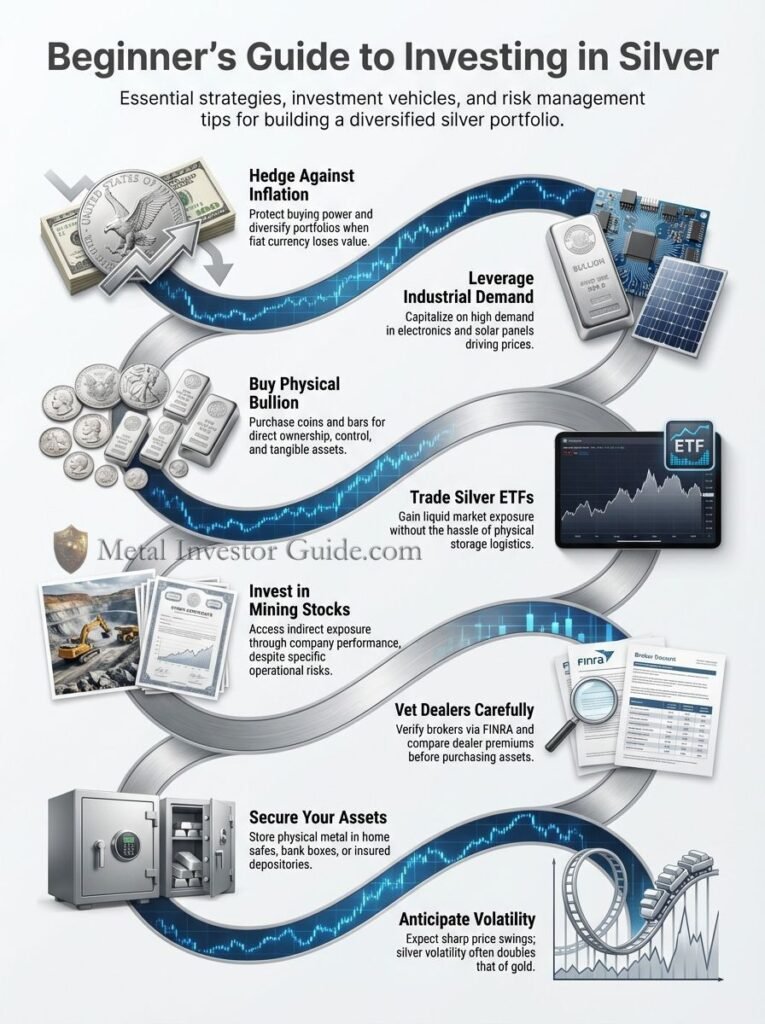
Key Takeaways
- Silver’s price is strongly tied to real-world manufacturing demand. The Silver Institute’s World Silver Survey 2025 reported industrial demand hit a record 680.5 million ounces in 2024, and the market ran a 148.9 million ounce deficit that year.
- Silver’s volatility can be extreme. A February 2026 market update noted the Cboe Silver ETF Volatility Index near 95 versus about 36 for gold, a reminder to size positions conservatively.
- Physical silver (silver coins, silver bars, and silver bullion) adds direct ownership, but premiums, spreads, and secure storage costs can be the difference between a good trade and a frustrating one.
- Silver ETFs can be simple to buy and sell in a brokerage account, but fees and taxes matter. The iShares Silver Trust’s SEC filing explains that long-term gains may be taxed at a maximum 28% collectibles rate for individual US shareholders.
- If you’re using an IRA, follow the rules closely. The IRS notes that most collectibles are prohibited inside retirement accounts, with limited exceptions for certain coins and qualifying bullion held by an approved trustee.
Why Consider Investing in Silver?
Silver sits in a unique spot among precious metals. It can behave like a safe-haven asset during stress, but it also relies heavily on industrial activity, so economic conditions can move the price of silver fast.
That’s why you’ll see investors track the spot price, the gold silver ratio, and macro signals like interest rate expectations from the Federal Reserve.
You can buy physical silver (silver coins, silver bars, and silver bullion) or choose financial investments like exchange-traded funds (ETFs), futures contracts, and silver mining stocks.
Hedge Against Inflation
People often buy silver as a way to protect purchasing power when money printing accelerates or inflation runs hot. In practice, silver can help, but it rarely moves in a straight line.
The real advantage is that silver gives you exposure to a hard asset with deep global trading, and you can access it through physical silver or liquid exchange-traded funds.
In the World Silver Survey 2025, the Silver Institute highlighted a multi-year stretch of supply deficits, a setup that can amplify price swings when demand heats up.
Action step: if your goal is inflation protection, treat silver as a satellite holding. Set a target percentage of your investment portfolio, then rebalance when silver prices spike instead of chasing the move.
- For direct ownership: physical silver tracks the spot price minus premiums and selling spreads.
- For faster liquidity: silver ETFs can track the spot price closely, but you pay ongoing fees.
- For short-term tactics: futures trading can react quickly to macro news, but leverage raises risk.
Diversification of Portfolio
Silver can help you diversify your portfolio because it often responds to different drivers than stock markets. The trade-off is that silver can swing harder than many asset classes, especially during commodity squeezes.
If you also hold gold and silver, you’ll notice they can move together, but not perfectly. The abrdn Physical Silver Shares ETF notes that, over 50 years, silver and gold prices moved in the same direction on about 71% of trading days.
Action step: use that relationship to set expectations. If you want a steadier diversifier, gold is often the calmer ride. If you want more torque, silver can provide it, but you must keep sizing tight.
| Goal | Silver approach that fits | What to watch |
|---|---|---|
| Reduce reliance on stocks | Small allocation to silver bullion or a low-fee silver ETF | Fees, bid-ask spread, and your rebalancing rules |
| Tactical risk-on/risk-off trading | Silver ETFs or (for experts) futures contracts | Volatility, margin requirements, and stop-loss discipline |
| Growth tied to miners | Silver-mining stocks or mining ETFs | Company execution, costs, and jurisdiction risk |
Industrial Demand for Silver
Industrial demand is the big distinction most beginners miss. Silver is a key input in electronics, electrical contacts, and solar, so supply and demand in commodities markets can move prices even when investors are quiet.
In its April 2025 release tied to the World Silver Survey 2025, the Silver Institute reported industrial demand rose 4% in 2024 to a record 680.5 million ounces, and global demand exceeded supply again, leaving a 148.9 million ounce deficit.
Action step: if you want to understand silver prices, follow the industries that consume it. You do not need to forecast every number, you just need to know what could shift demand quickly.
- Solar and grid buildout: rising installations can increase demand even if manufacturers reduce silver per unit.
- Electronics and data centers: growth in high-end electronics can lift silver usage in components.
- Automotive electrification: more electronics per vehicle can support incremental demand.
Popular Ways to Invest in Silver
You can invest in silver through physical holdings, exchange-traded funds, futures contracts, or equity securities tied to mining.
The best choice depends on what you want from your silver investment: direct ownership, trading flexibility, retirement account placement, or exposure to operating businesses.
Physical Silver (Coins and Bullion)
Physical silver is the straightforward route. You buy silver coins or silver bars, then you control storage and the timing of your sale.
For US investors, the American Silver Eagle is the flagship bullion coin. Federal law specifies it contains .999 fine silver, weighs 31.103 grams, and carries a $1 face value.
Where beginners get surprised is the all-in cost. A January 2026 report noted that American Silver Eagles were trading around a roughly $8 per ounce premium above spot in the secondary market, which can materially change your break-even point.
- Coins: often easier to sell in small increments, but premiums can run higher.
- Bars: often lower premium per ounce at larger sizes, but can be less convenient to sell in pieces.
- Rounds: can be cost-efficient, but brand recognition matters at resale.
Pro tip for DIY investors: pick products with practical anti-counterfeit features. Sunshine Minting bars use a “MintMark SI” security element that can reveal “VALID” when checked with a decoder lens.
Action step: before you place a lump sum order, compare the premium over spot price and the dealer’s buyback spread. That spread is the hidden “fee” you pay on day one.
Silver Exchange-Traded Funds (ETFs)
Silver ETFs let you add silver exposure through a standard brokerage account or IRA without handling physical silver coins or silver bars. For many beginners, this is the cleanest way to start.
The trade-offs are fees, structure, and taxes. Some popular physically-backed vehicles are structured as trusts, and that can affect how gains are taxed in a taxable account.
| Example ETF (ticker) | What it holds | Stated annual fee | Beginner takeaway |
|---|---|---|---|
| iShares Silver Trust (SLV) | Physical silver bullion | 0.50% sponsor fee | Easy access, but fees create tracking drag over time |
| abrdn Physical Silver Shares ETF (SIVR) | Physical silver bullion | 0.30% expense ratio | Lower fee can matter if you plan to hold for years |
Tax note: in an SEC filing for SLV, the trust explains that long-term gains for individuals may be taxed at a maximum 28% collectibles rate, which is higher than the usual long-term capital gains maximum for many stocks. This is one reason some investors prefer holding certain precious metals ETFs inside an individual retirement account.
Action step: before you buy, check the prospectus for the fund structure, the fee, and the tax treatment. Those details can outweigh small differences in tracking error.
Silver Futures Contracts
Silver futures contracts are derivatives. They let you control a large notional amount of silver with a smaller amount of cash posted as margin, which is why they are considered speculative investments for most beginners.
Contract sizing is the first reality check. Charles Schwab’s silver futures overview notes that standard silver futures represent 5,000 ounces, and micro contracts represent 1,000 ounces. Schwab also notes physical delivery is not permitted through its platform, so clients must close or roll positions before expiration.
- Know your “tick” risk: with a 5,000 ounce contract, small price moves can translate into large dollar swings.
- Expect margin calls: leverage can force you out at the worst time if the market moves against you.
- Avoid accidental delivery issues: learn the first notice date and last trading day rules for your contract.
Action step: if you want leveraged exposure without managing contract expirations, compare an actively managed futures fund to direct futures trading, and read the strategy and cost disclosures carefully.
Silver-Mining Stocks
Silver-mining stocks give you indirect exposure to the silver market, but your results also depend on business execution. Costs, debt, political risk, and operational problems can dominate the stock even if the spot price rises.
If you want specific examples to research, SIL’s holdings have included major names like Wheaton Precious Metals, Pan American Silver, Coeur Mining, Hecla Mining, and First Majestic Silver.
- Check cost sensitivity: miners with lower costs can hold up better if silver pulls back.
- Watch balance sheets: high debt can turn price volatility into solvency risk.
- Know revenue mix: many “silver” miners also depend on gold or base metals.
Action step: if you are new, consider starting with a basket approach (a mining ETF or mutual funds with diversified holdings) rather than betting on one company.
ETFs That Hold Silver Mining Companies
Mining ETFs trade like other exchange-traded funds, but they hold companies, not bullion. That means you can get dividends and equity upside, and you can also get equity drawdowns that have little to do with the price of silver.
Fees vary, and so does the “purity” of exposure. Some funds lean toward large producers, while others focus on smaller miners that can swing harder.
A
| Example mining ETF (ticker) | Focus | Expense ratio | Who it tends to fit |
|---|---|---|---|
| Global X Silver Miners ETF (SIL) | Established silver miners | 0.65% | Investors who want broad miner exposure in one trade |
| Amplify Junior Silver Miners ETF (SILJ) | Smaller and “junior” miners | 0.69% | Investors who can tolerate bigger swings and higher risk |
| iShares MSCI Global Silver and Metals Miners ETF (SLVP) | Global silver and metals miners | 0.39% | Investors who want a lower-fee global basket |
Action step: open the holdings list and look at the top 10 weights. If one or two stocks dominate, you may have more single-company risk than you think.
How to Start Investing in Silver
Start with your purpose, then pick the simplest investment vehicle that matches it. A clean plan beats a complicated plan, especially in a fast-moving silver market.
Use this section as your setup checklist, from choosing where to buy to deciding how you will store physical silver.
Research Reputable Dealers and Platforms
If you buy physical silver, the dealer matters as much as the product. High premiums, misrepresentations, and poor buyback terms can turn a “good” spot price into a bad trade.
The US Mint explains it does not sell bullion coins directly to the public. Instead, bullion moves through “authorized purchasers” who then create a two-way market through wholesalers, private investors, and local dealers.
- Start with the official channel list: the US Mint publishes authorized purchasers, which has included names like APMEX, Dillon Gage, and StoneX Bullion.
- Compare at least two quotes: ask for the all-in price, not just “premium over spot.”
- Get the buyback terms upfront: you want to know the spread before you buy.
- For brokerage products: use FINRA’s BrokerCheck to verify the firm and the person you’re speaking with.
Action step: if someone pressures you to move retirement money fast or buy “exclusive” collectible coins for an IRA, slow down. In a regulator-backed warning highlighted by Barron’s, the CFTC cautioned that spreads can be extreme in scams, sometimes reaching levels that make profits nearly impossible.
Understand Market Trends and Prices
Silver prices move for multiple reasons at once: industrial demand, interest rate expectations, currency moves, and risk appetite in the financial market.
So you want a simple monitoring routine that keeps you focused on what matters, without turning you into a day trader.
One reason beginners get shaken out is speed. In February 2026, a market commentary described a period where silver’s volatility index ran roughly three times gold’s, a meaningful gap for risk planning.
- Track spot price vs street price: for physical silver, your real cost is spot price plus premium.
- Watch the gold silver ratio: it can help you frame whether silver is expensive or cheap relative to gold price, even if it does not “predict” the next move.
- Follow supply and demand signals: industrial demand updates and deficit talk can drive fast sentiment shifts.
Action step: do not fund silver with loans, a credit card balance, or a line of credit like a HELOC. Silver’s price volatility can turn borrowing into forced selling.
Choose the Right Investment Type for Your Goals
This is where you match your silver investment to your time horizon and your tolerance for volatility. The right choice makes holding easier, which matters more than most people expect.
If you’re picking between physical silver and paper exposure, focus on friction. Physical has premiums and storage, ETFs have fees and possible collectibles tax rules, and futures contracts add leverage and timing pressure.
| If your goal is | Consider | Why it fits |
|---|---|---|
| Long-term hedge with direct ownership | Silver bullion, silver bars, or widely traded silver coins | You control custody and avoid fund fees, but you must manage secure storage |
| Convenient exposure in one click | Silver ETFs in a brokerage account or IRA | High liquidity, no storage, but fees and tax treatment can affect net return |
| Short-term tactical trades | Silver futures (experienced investors) | Leverage is powerful, and dangerous, without a disciplined risk plan |
| Equity upside tied to operations | Silver-mining stocks or mining ETFs | Potential for dividends and growth, plus added company-specific risk |
Action step: write down your exit rule before you buy. Examples: “rebalance if silver becomes 2% above target,” or “sell if the thesis breaks.” Your future self will thank you.
Evaluate Storage Options for Physical Silver
Storage is not a side detail, it is part of your return. Secure storage costs money, and insecure storage can cost you the whole position.
If you hold physical silver inside a retirement account, storage rules get strict. The IRS states that bullion can qualify under specific exceptions only if a bank or approved non-bank trustee keeps physical possession of it.
- Home storage: convenient, but you should confirm insurance coverage and keep purchase records and serial numbers.
- Bank safe deposit box: strong physical security, but access limits can slow a sale in a fast market.
- Third-party depository: designed for bullion custody, often with audited processes and dedicated insurance.
Also keep the protection question straight. SIPC explains that it protects customers if a brokerage fails, but it does not protect commodities or futures contracts, and it does not protect you from market losses.
Risks of Investing in Silver
Silver can be rewarding, and punishing, because it concentrates multiple risks into one asset. You get commodity risk, macro risk, and, if you use leverage, financing risk.
If you plan for those risks upfront, silver becomes much easier to hold through the noise.
Price Volatility
Silver’s swings can be dramatic, even in a single trading session. WisdomTree noted that January 30, 2026 saw extreme intraday volatility, with silver plunging about 26% in one day, a sharp reminder that position sizing matters more than predictions.
This volatility shows up across vehicles. ETFs can gap like equities, and futures contracts can magnify a small move into a large profit or loss because of leverage.
- Reduce the odds of panic selling: keep position size modest relative to your investment portfolio.
- Respect rebalancing: trim after big runs, add only when your plan says to add.
- Avoid leverage as a beginner: the learning curve is expensive in futures trading.
Storage and Security Challenges
With physical silver, you take on real-world security risk: theft, loss, and damage. You also take on transaction risk, counterfeit products, and unclear documentation.
With “stored for you” programs, your risk shifts to custody terms and counterparty strength, so you need to read what you are agreeing to.
- Use documented products: look for clear purity marks, weight, and a recognizable refiner or mint.
- Prefer verifiable security features: anti-counterfeit elements reduce resale friction.
- Keep clean records: invoices, photos, and serial numbers support insurance and smoother selling.
- Understand coverage limits: SIPC coverage is about missing securities at a failed brokerage, not about protecting the value of your silver.
Tips for Beginner Silver Investors
If you treat silver like a disciplined allocation instead of a headline trade, you improve your odds fast. Most beginner mistakes come from over-sizing, over-paying premiums, or mixing up long-term investing with short-term speculation.
Start Small and Diversify
Start with an amount that will not change your sleep. Silver’s volatility makes “too big” feel obvious only after the move hits.
Action step: build in layers. A small starter position teaches you the mechanics of premiums, spreads, and how you react to price volatility.
- Pick one vehicle to start, a silver ETF or a common silver coin.
- Set a target allocation range for your portfolio.
- Add only on a schedule, not on adrenaline.
- Rebalance when your allocation drifts outside your range.
Monitor Market Trends Regularly
You do not need to watch every tick. You do need a repeatable process that helps you act when it is time to act.
A simple routine keeps you grounded when silver prices get loud.
- Weekly: check spot price, your average cost, and your allocation versus target.
- Monthly: review premiums in the physical market if you plan to add more silver coins or silver bars.
- Quarterly: review your thesis, and whether industrial demand or recession risk changes your plan.
Action step: separate “news” from “signals.” A single hot take rarely changes the long-term supply and demand picture.
Seek Professional Financial Advice
If you want help, look for someone who can explain the trade-offs in plain English, including taxes, IRA rules, and how silver fits alongside other asset classes.
Investor.gov explains that FINRA’s BrokerCheck lets you review a broker’s employment history, licenses, and disclosures, including disciplinary actions and certain complaints.
- Ask for costs in writing: premiums, spreads, fees, and any storage charges.
- Ask about taxes: the collectibles rules can change your after-tax result.
- Watch for pressure: urgency is a common feature in scams and misrepresentations.
Conclusion
You can add silver to your investment portfolio without making it complicated.
Choose between physical silver, exchange-traded funds (ETFs), futures, or mining stocks, based on your investment goals and how much volatility you can tolerate.
Know the spot price, understand premiums and fees, and plan secure storage if you hold silver coins or silver bars.
Start small, diversify your portfolio thoughtfully, and keep your process disciplined as you continue investing in silver.