
Gold vs. Bitcoin: Which One Actually Protects Your Wealth in a Crisis?
In every inflation cycle, the same question resurfaces: what actually preserves purchasing power when monetary policy becomes unstable?
For centuries, the answer has been physical gold and other precious metals. Over the last fifteen years, bitcoin has entered the conversation as a digital alternative—scarce by code rather than geology.
Both are described as a “store of value.” But they protect wealth in very different ways, and they fail in very different ways.
This comparison looks at scarcity, volatility, liquidity, regulation, and operational risk to help you decide which asset fits your portfolio—and which risks you’re actually willing to accept.
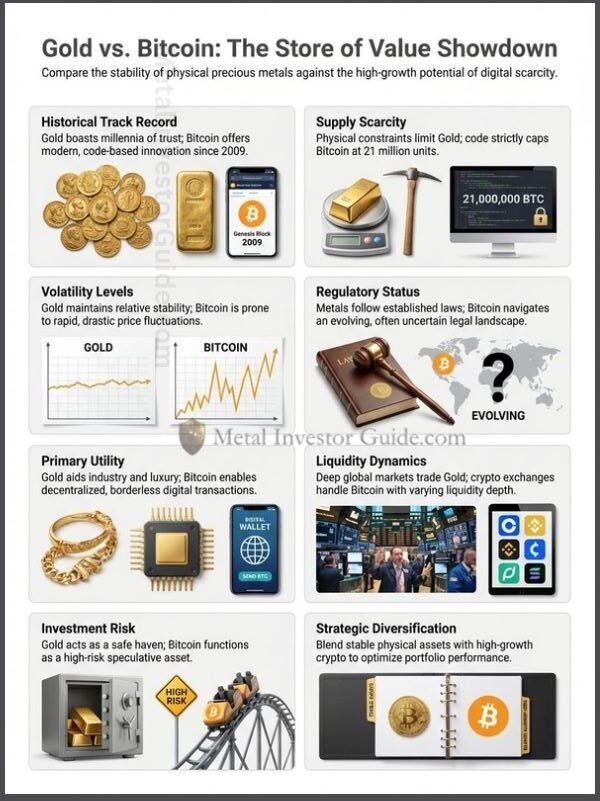
Key Takeaways
For U.S. investors evaluating gold and bitcoin as stores of value, the decision hinges on structure, risk, and operational reality — not marketing narratives.
- Gold supply is large but stable. The World Gold Council estimates total above-ground gold stock at approximately 219,891 tonnes at end-2025, including roughly 38,666 tonnes held by central banks. Gold’s supply responds slowly to price incentives and benefits from institutional reserve demand.
- Bitcoin supply is fixed by protocol. The network enforces a maximum cap of 21,000,000 coins. After the April 19, 2024 halving, issuance fell to 3.125 BTC per block, reinforcing predictable, algorithmic scarcity.
- Volatility differs materially. Recent data shows bitcoin’s realized volatility significantly exceeds gold’s over long periods, which makes position sizing more critical for bitcoin allocations.
- Liquidity depends on the wrapper. Gold ETFs such as GLD (0.40% expense ratio) and GLDM (0.10%) provide intraday liquidity within brokerage accounts, while crypto exchanges operate with platform-specific limits and withdrawal constraints.
- Regulatory treatment is not identical. The IRS treats bitcoin as property, creating taxable events upon sale or exchange. Businesses receiving more than $10,000 in cash for precious metals generally must file Form 8300, affecting certain physical transactions.
- Failure modes are different. Gold’s risks center on storage, spreads, and authenticity. Bitcoin’s risks center on custody errors, exchange failures, leverage-driven volatility, and regulatory shifts.
Both assets can preserve purchasing power over long horizons — but they protect against different threats and introduce different operational risks.
Historical Role of Precious Metals as a Store of Value
Gold has served as money, jewelry, and industrial input across centuries, which is why it’s still the default “safe haven” in a lot of portfolios.
What matters for you today is less the mythology and more the market structure: gold is globally recognized, physically verifiable, and easy to price across dealers.
In its February 2025 estimate, the World Gold Council put total above-ground stock near 219,891 tonnes (end-2025), and it breaks that into jewelry, bars and coins, and official holdings.
Gold kept value across empires, crises, and shifting monetary policy.
If you’re buying physical gold in the U.S., your biggest “store of value” risk is rarely the gold price. It’s the buy-sell friction and the authenticity workflow.
- Choose products with deep two-way markets: widely traded bullion coins like the American Eagle Gold Bullion Coin come in four sizes (1 oz, 1/2 oz, 1/4 oz, 1/10 oz), which helps you sell smaller lots without unloading an entire position.
- Know what you’re actually buying: American Gold Eagles are 22-karat coins that still contain their stated amount of pure gold, and the American Buffalo is a .9999 fine 24-karat one-ounce option (both are U.S. Mint bullion programs).
- Have a verification plan: reputable dealers rely on weight and dimensions plus non-destructive testing like XRF analyzers, which matters because convincing gold-plated counterfeits exist.
- Storage is part of your return: insured vault storage and careful handling can preserve resale value, especially for coins where damage can widen the spread.
Central banks still treat gold as a reserve asset, which gives it a demand base that is not purely retail sentiment.
Understanding Bitcoin as a Digital Store of Value
Bitcoin launched in 2009 as financial technology built on blockchain technology, with an explicit goal of digital scarcity.
Unlike gold, you don’t need a vault. You need reliable custody, which means controlling private keys and avoiding operational mistakes.
Bitcoin’s “digital gold” pitch comes from two design choices: a hard cap of 21 million coins, and a predictable issuance schedule that halves the mining reward about every 210,000 blocks.
On April 19, 2024, the mining reward dropped from 6.25 BTC to 3.125 BTC per block, which is the kind of mechanical supply constraint gold cannot replicate.
Bitcoin also sits inside a very U.S.-specific regulatory reality. The SEC approved the listing and trading of spot bitcoin exchange-traded products on January 10, 2024, which made bitcoin exposure easier inside standard brokerage accounts.
- Tax treatment changes your “real return”: the IRS treats virtual currency as property, so using bitcoin, trading it, or converting it can create taxable events you need to track.
- Market plumbing matters: the CFTC has stated in enforcement actions that bitcoin and other virtual currencies are commodities covered by the Commodity Exchange Act, which is relevant for futures contracts and derivatives activity.
- Custody is the tradeoff: self-custody can reduce counterparty risk, but it increases “you risk,” meaning lost keys and irreversible sends.
If you want bitcoin exposure without managing a hardware wallet, ETFs and ETPs can be a practical compromise. You trade that simplicity for ongoing fees and reliance on custodians and fund operations.
Comparing Scarcity: Gold vs. Bitcoin
Scarcity is the cleanest comparison, because it forces you to separate “limited” from “predictable.”
| Attribute | Gold | Bitcoin | Notes |
|---|---|---|---|
| Total Supply | Estimated 219,891 tonnes of above-ground stock (end-2025). | Maximum 21,000,000 coins, fixed by protocol rules. | Gold supply is large and durable; bitcoin supply is digitally capped. |
| Type of Scarcity | Physical scarcity shaped by geology, mining costs, and recycling. | Programmed digital scarcity enforced by network consensus. | Gold scarcity is economic and physical; bitcoin scarcity is algorithmic. |
| Supply Dynamics | Mine supply can rise modestly with price incentives. | Issuance halves about every 210,000 blocks (roughly every 4 years). | Gold responds to incentives; bitcoin follows a schedule. |
| Creation Method | Mined, refined, and assayed. | Mined via proof-of-work, with blocks validated by nodes. | Both require energy and capital, but the “production” process differs. |
| Verifiability | Weight, dimensions, assays, and chain-of-custody documentation. | Public ledger verification and cryptographic signatures. | Gold verification is physical; bitcoin verification is mathematical. |
| Longevity | Used for millennia as a store of value and as money in various systems. | Launched in 2009, with a shorter track record. | Time is gold’s advantage; portability and auditability are bitcoin’s. |
| Scarcity Risks | Recycling flows and supply responses can increase available metal. | Custody loss, protocol risk, and market structure changes can impact usable supply. | Gold’s risk is mostly physical and economic; bitcoin’s is operational and technical. |
| Market Signals | Jewelry, investment flows, and central bank purchases. | Adoption, ETF flows, miner economics, and network activity. | Different demand engines can dominate at different times. |
| Use Cases | Jewelry, reserves, and industrial applications. | Digital store of value, settlement asset, and speculative trading vehicle. | Utility shapes the narrative and, eventually, the floor of demand. |
| Summary Points | Deep history, broad acceptance, and physical finality. | Hard cap, portability, and public auditability. | If your goal is predictability, bitcoin’s issuance schedule is clearer. |
Volatility and Risk Assessment
Volatility is where most “store of value” debates get real, because it affects whether you can hold through stress without bailing at the wrong time.
A 2025 analysis from NYDIG put bitcoin’s annualized realized volatility around 52.2% as of the end of Q1 2025, versus 15.5% for gold, which helps explain why position sizing matters more for bitcoin than most investors expect.
In February 2026, a market analysis reported 30-day volatility around 44% for gold and 39% for bitcoin, a reminder that “stable” can change fast in macro-driven markets.
| Risk Metric | Gold | Bitcoin |
|---|---|---|
| Price history (key dates) | – Early 2019, price sat just below $1,300 per ounce. – Mid‑2020, price rose to nearly $2,100 per ounce. – End of 2025, the World Gold Council reported an annual average gold price of about $3,431/oz. | – Start of 2021, price was $32,782. – Peak occurred at $69,000 in November 2021. – March 14, 2024, bitcoin traded above $73,000 and closed above $71,000. |
| Volatility level | – Usually lower than crypto, but can spike during macro shocks. – Often reacts to real interest rate expectations and U.S. dollar moves. | – Typically high, with sharp drawdowns and fast recoveries. – Can trade like a high-beta risk asset when equities deleverage. |
| Primary risk drivers | – Interest rates and inflation expectations. – Central bank reserves and investment flows. – Physical premiums and dealer spreads for coins and bars. | – Leverage and liquidation cascades in crypto markets. – Regulatory shifts, exchange outages, and custody errors. – Miner economics after halving events. |
| Liquidity and market depth | – Deep global markets for bullion and gold ETFs. – Physical liquidity depends on product type and dealer inventory. | – Liquid on major venues, but liquidity can thin out during panics. – Exchange limits and banking rails can slow fiat withdrawals. |
| Typical investor behavior | – Many use gold for capital preservation and portfolio ballast. | – Many use staged buying and long holding periods to survive volatility. |
| Tail risk and systemic shocks | – Less likely to fail from one operational event. – Still exposed to forced selling and liquidity shocks in extreme scenarios. | – Exposed to exchange failures, stablecoin stress, and rapid deleveraging. – Operational errors can create permanent loss (wrong address, lost keys). |
| Risk mitigation tools | – Insured storage, segregation options, and disciplined position sizing. – Using ETFs for quick rebalancing if you accept ongoing fees. | – Hardware wallet workflows and redundant backups for recovery phrases. – Position sizing, planned rebalancing, and limiting leverage exposure. |
| Practical takeaway | – Often better for steadiness and “sleep-at-night” allocation. | – Better for asymmetric upside, if you can tolerate large drawdowns. |
Liquidity and Accessibility
Liquidity is not just “can I sell,” it’s “can I sell quickly, at a fair price, in the way I need to sell.”
Gold liquidity changes with the form you hold. Coins and small bars are accessible, but they can carry wider spreads than an ETF share you can trade in seconds.
For ETF access, fund structure and fees matter. For example, GLD lists a 0.40% gross expense ratio and reported assets over $171 billion as of February 6, 2026, while GLDM lists a 0.10% gross expense ratio.
Bitcoin liquidity is exchange-driven, and it’s gated by identity verification, banking rails, and platform limits.
Coinbase’s help documentation notes that limits vary by verification and payment method, and Coinbase Exchange lists a default $100,000 per day fiat withdrawal limit for USD methods like ACH and Fedwire.
| How you hold it | What’s easy | What trips people up | Best fit |
|---|---|---|---|
| Physical gold (coins, bars) | Direct ownership of tangible assets, no platform login. | Spreads, storage, insurance, and authenticity checks. | Long-term holders who value physical finality. |
| Gold ETFs (exchange-traded funds) | Fast trading and easy rebalancing inside brokerage accounts. | Ongoing fees reduce ounces per share over time, plus market-hours limits. | Investors who prioritize liquidity and simplicity. |
| Bitcoin on an exchange | Convenient trading, fast conversion between assets. | Limits, outages, and counterparty risk in a crisis. | Active investors who need fast execution. |
| Bitcoin self-custody (hardware wallet) | Control of coins without relying on an exchange. | Key loss and irreversible transactions if you make a mistake. | Investors who want fewer intermediaries. |
| Bitcoin ETPs (spot ETF wrapper) | Bitcoin exposure in a standard account, easy reporting and trading. | Fees, tracking differences, and reliance on custodians and fund operations. | Investors who want exposure without wallet management. |
Pacific Precious Metals supports investors who want authenticated gold bars and coins with an in-person dealer experience, which can be helpful if you value inspection, pickup, and guidance on product selection.
Regulation and Transparency
In the U.S., regulation is one of the clearest differences between precious metals and crypto assets, and it can change your operational plan even if your investment thesis is the same.
Here’s the practical version of the rulebook, based on IRS guidance, FinCEN interpretations, SEC actions, and CFTC enforcement history.
- Bitcoin taxes: the IRS treats virtual currency as property, which means you track gains and losses when you sell, trade, or spend it.
- Bitcoin market oversight: the CFTC has stated bitcoin is a commodity under the Commodity Exchange Act, and the SEC approved spot bitcoin exchange-traded products on January 10, 2024.
- Crypto business compliance: FinCEN has explained that exchangers and administrators of “convertible” virtual currency can be treated as money transmitters under Bank Secrecy Act rules, which drives KYC and reporting obligations at many platforms.
- Gold cash reporting: the IRS notes that businesses that receive more than $10,000 in cash in a single transaction (or related transactions) generally must file Form 8300.
Transparency works differently, too. Gold relies on physical assays and chain-of-custody. Bitcoin relies on public ledger auditability, but your identity and your exchange balances are not public in the same way.
Utility and Use Cases
Utility is the underrated part of the store-of-value debate, because utility creates baseline demand even when investors lose interest.
Gold has multiple demand sources: jewelry, industrial uses, and official reserves. That demand diversity helps when one segment slows.
Bitcoin’s core utility is digital settlement on a decentralized network (and, in some discussions, a “decentralised network” of nodes). It’s portable and can move value without relying on a bank transfer, which is why some investors treat it as a hedge against financial system friction.
Derivatives also matter because they create liquidity. For example, CME’s Micro Bitcoin futures are sized at 0.1 bitcoin, while the standard bitcoin futures contract represents 5 bitcoin, which affects how institutions hedge or gain exposure.
Inside crypto markets, stablecoins are a common “cash-like” tool for trading, collateral, and moving between exchanges. Coins like Tether (USDT) aim to stay pegged to the U.S. dollar, but they still carry issuer and liquidity risk, so treat them as infrastructure, not a guaranteed bank deposit.
Diversification Potential: Combining Gold and Bitcoin
For many U.S. investors, the best answer is not “gold or bitcoin.” It’s “how much of each, and why.”
A useful way to think about it is role-based: gold can be your portfolio ballast, and bitcoin can be your convex bet, meaning it can add upside while you keep the position sized so a drawdown does not wreck your plan.
In its full-year 2025 report, the World Gold Council highlighted 863 tonnes of central bank net purchases and reported gold ETF holdings growth of 801 tonnes in 2025, which reinforces that gold demand can show up through multiple channels.
- Set a rebalancing rule before you buy: rebalancing forces you to trim what ran up and add to what fell, instead of chasing headlines.
- Keep “liquid assets” liquid: if you might need the money quickly, consider ETF wrappers for at least part of the allocation.
- Do not ignore correlation: a 2026 NYDIG market note said bitcoin’s correlation with U.S. equities can rise into the 0.4 to 0.6 range during stress, which means it may not hedge equity market drawdowns the way people expect in the moment.
Pacific Precious Metals often sees investors combine authenticated bullion with select crypto exposure, which can make sense if you’re clear on what each piece is supposed to do.
Long-Term Outlook: Gold’s Stability vs. Bitcoin’s Growth Potential
Over the long run, gold’s case is durability and broad acceptance. Bitcoin’s case is adoption and programmatic scarcity.
Gold has stayed relevant because central banks hold it, and because it tends to benefit when confidence in fiat currency weakens or real interest rates fall.
The World Gold Council reported the LBMA gold price set 53 new all-time highs during 2025, with an annual average around $3,431/oz, and Q4 averaging about $4,135/oz, which shows how quickly the “steady” asset can still reprice.
Bitcoin’s track record is shorter but dramatic. On March 14, 2024, bitcoin traded above $73,000, and its cycle-to-cycle drawdowns remain the price of admission for holders who want long-term upside.
The clean takeaway is this: if you need reliability month to month, bitcoin will test you. If you need an asset that can move outside legacy rails, gold cannot do what bitcoin can.
Factors Influencing Market Demand for Gold and Bitcoin
Demand drivers are what separate “a price chart” from a real store of value thesis.
For gold, demand tends to show up through central banks, bar and coin buying, and ETFs. Those channels respond to inflation rate expectations, monetary policy, and trust in the value of the U.S. dollar.
The World Gold Council’s 2025 demand report also noted that bar and coin buying hit a 12-year high and that mine production was about 3,672 tonnes in 2025, which helps explain why supply did not flood the market even in a strong price year.
Bitcoin demand leans more on adoption, liquidity conditions, and risk appetite. When markets deleverage, bitcoin can trade like a high-volatility extension of the equity market instead of an uncorrelated hedge.
- ETF access: spot bitcoin ETPs have made bitcoin easier to own inside brokerage accounts, which can change who buys and how long they hold.
- Corporate treasuries: Strategy (formerly MicroStrategy) has continued to accumulate bitcoin, and a February 2026 disclosure cited holdings of about 714,644 BTC, which is large enough to matter for sentiment.
- Derivatives and leverage: perpetual futures, options, and trading bots can boost liquidity in good times, but they can also accelerate forced selling during downturns.
Is Bitcoin the New Digital Gold?
Bitcoin can function like digital gold, but only if you define the job precisely.
Gold’s job is to be a widely accepted store of value with minimal operational risk. Bitcoin’s job is to be a scarce digital asset you can custody and move without asking permission, which is a different kind of value.
In a strong version of the “digital gold” story, bitcoin becomes a long-duration asset that is harder to debase than fiat currency and easier to move than metal.
In a weak version of the story, it becomes a risk-on asset that drops alongside stocks when liquidity tightens.
If you’re deciding which one earns space in your portfolio, use a simple checklist based on how you actually use money:
- Store of value: can you hold it through a 50% drawdown without selling in panic?
- Medium of exchange: do you realistically plan to spend it, or is it purely investment returns?
- Unit of account: do you think in dollars anyway, or do you want part of your net worth measured outside fiat currency?
- Operational fit: are you willing to manage a hardware wallet, or do you need an ETF wrapper?
For many U.S. investors, gold remains the more proven store of value. Bitcoin is the higher-volatility bet on a new monetary network, and that distinction matters more than the label.
Conclusion
Gold and btc can both play the store of value role, but they serve different constraints.
Physical gold tends to cushion portfolios during equity market stress, and it’s still favored by central banks and long-term holders.
Bitcoin runs on blockchain technology, it moves fast, and it can offer outsized upside, but you pay for that with volatility, custody responsibility, and changing regulation.
Your best choice is the one that matches your risk profile, liquidity needs, and how you want to relate to money and fiat currency over the next decade.