
American Gold Eagle 1 oz Review: The True Cost of Owning America’s Most Popular Gold Coin
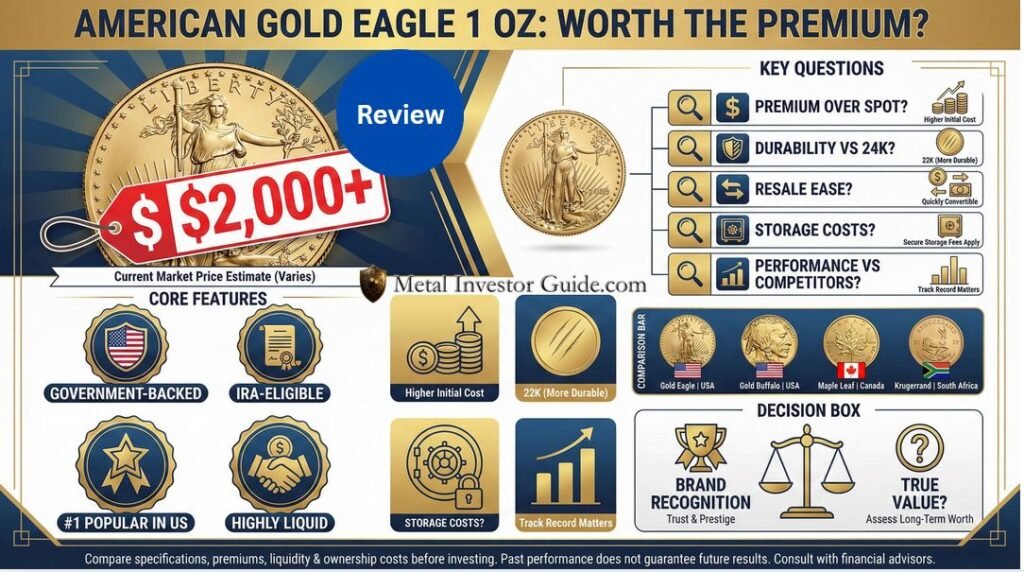
If you’re considering buying a 1 oz American Gold Eagle, you’re about to spend more than $2,000 on a single coin. That’s not a casual purchase. It’s a serious capital allocation decision.
The American Gold Eagle is the most popular gold bullion coin in the United States. It’s widely recognized, IRA-eligible, government-backed, and deeply liquid. But popularity alone doesn’t make something the best choice.
When you strip away the marketing language, what really matters comes down to a few practical questions:
- What exactly are you getting for the premium over spot?
- How durable is it compared to pure 24-karat coins?
- How easy is it to resell?
- What are the long-term storage and ownership costs?
- And does it actually outperform the main alternatives like the Gold Buffalo, Maple Leaf, or Krugerrand?
We spent time comparing specifications, premiums, historical liquidity, and total ownership costs to see whether this coin truly earns its reputation — or whether investors are simply paying extra for brand recognition.
Let’s start with the fundamentals.
The Basics: What You’re Actually Buying
The American Gold Eagle 1 oz contains exactly one troy ounce of pure gold. However, the total coin weight is 1.0909 troy ounces because it is struck in 22-karat gold (91.67% purity), with the remaining composition consisting of 3% silver and 5.33% copper.
This alloy is intentional.
Pure gold is highly malleable and prone to scratches. The addition of copper and silver increases durability without reducing the guaranteed gold content. Congress mandated this composition in 1985 to ensure the coin could withstand handling and long-term storage.
You receive one full ounce of gold — simply reinforced within a more durable structure.
Specifications:
- Thickness: 2.87 mm
- Face value: $50 (nominal; intrinsic value tracks gold price)
- Diameter: 32.7 mm
Premiums: The Real Cost of Entry
The American Gold Eagle does not trade at spot price. Expect to pay a premium of $75–$165 above spot under normal market conditions.
At a $2,000 gold price, that equates to a 4–8% markup.
Premiums reflect minting costs, distribution layers, dealer margins, and market demand. The U.S. Mint sells only to authorized purchasers, meaning every coin passes through intermediaries before reaching retail buyers.
Compared to alternatives:
- Gold Buffalo: $110–$250 over spot
- Canadian Maple Leaf: $100–$200 over spot
- Krugerrand: often $20–$30 less than Eagles
The Eagle sits in the middle — not the cheapest, but consistently competitive relative to its liquidity and IRA status.
For larger purchases, premiums compound quickly. A $50,000 allocation could involve $2,500–$4,000 in upfront premium.
That is the real cost of physical ownership.
Durability: Why the Alloy Matters
Durability is not cosmetic — it affects resale condition.
24-karat coins such as the Gold Buffalo and Maple Leaf are softer and more susceptible to surface wear from routine handling. Minor abrasions may not affect melt value but can widen resale spreads with certain buyers.
The American Gold Eagle’s alloy composition provides greater resistance to scratches and dents. For investors who handle, inspect, or relocate their holdings periodically, this reduces anxiety and long-term cosmetic degradation.
If coins remain untouched in a sealed vault, durability is less relevant. For private holders, it matters.
Liquidity and Market Recognition
Minted continuously since 1986, the American Gold Eagle has nearly four decades of market recognition.
Liquidity is one of its strongest advantages.
- Universally recognized by U.S. dealers
- Accepted internationally
- Strong buyback markets
- Established pricing spreads
Resale execution is typically straightforward, especially compared to niche or newly introduced bullion products.
Recognition reduces friction.
Storage and Long-Term Carrying Costs
The purchase premium is only the first cost.
Physical gold requires secure storage. Over time, storage and insurance can rival the initial premium.
Home Safe
- $500–$2,000 upfront
- Insurance rider typically 0.5–1% annually
- Full personal security responsibility
Bank Safe Deposit Box
- $50–$150 annually
- Limited access hours
- Insurance clarity varies
Professional Vault Storage
- 0.5–1% annually
- Often $100–$300 additional flat fee
On a $50,000 position, annual storage may range from $250–$800. Over 10 years, that becomes $2,500–$8,000.
Physical gold protects purchasing power — but it is not costless to hold.
Authenticity
Counterfeiting risk exists primarily in peer-to-peer marketplaces, not established dealer channels.
Reputable dealers verify:
- Weight
- Diameter
- Thickness
- Metal composition (XRF or ultrasound testing)
Type 2 Eagles (2021–present) include enhanced anti-counterfeiting features.
The practical risk of receiving a counterfeit from a recognized dealer is extremely low.
The risk increases when attempting to save small amounts via private sales.
Stick with known dealers (Monument Metals and Scottsdale Mint both have good reputations for authentic product and fair pricing), and you’re not going to have counterfeit issues.
IRA Eligibility and Regulatory Status
The American Gold Eagle qualifies for inclusion in self-directed precious metals IRAs.
This allows:
- Tax-deferred growth (Traditional IRA)
- Tax-free qualified withdrawals (Roth IRA)
Not all bullion coins qualify. Notably, Krugerrands are not IRA-eligible.
For retirement-focused investors, this distinction materially affects long-term after-tax returns.
Comparison to Competing Coins
So after looking at all this, I wanted to see how the American Gold Eagle stacks up against the main competitors.
| Coin | Purity | Premium Range | IRA Eligible | Durability | U.S. Market Recognition |
|---|---|---|---|---|---|
| American Gold Eagle | 91.67% (22k) | $75-165 | Yes | High | Excellent |
| Gold Buffalo | 99.99% (24k) | $110-250 | Yes | Medium | Very Good |
| Canadian Maple Leaf | 99.99% (24k) | $100-200 | Limited | Medium | Good |
| Krugerrand | 91.67% (22k) | $50-140 | No | High | Very Good |
Looking at this breakdown, each option has clear tradeoffs.
Gold Buffalo: You get pure 24-karat gold, which some people prefer because they want most gold content. But you’re paying higher premiums (sometimes $100+ more per coin), and the pure gold scratches more easily.
The Buffalo is also a bit less established in terms of market history, though it’s gained strong recognition since 2006.
Canadian Maple Leaf: Another 24-karat pure gold option with beautiful design and strong international recognition (probably better than the Eagle overseas, especially in Asia and Europe). Similar premium structure to the Buffalo.
The IRA situation is complicated depending on which custodian you use.
Krugerrand: This your interesting because it matches the Eagle’s composition exactly (91.67% purity, copper/silver alloy for durability), weighs about the same, and often trades at noticeably lower premiums. Sometimes you can find Krugerrands $20-30 cheaper per coin than Eagles.
But the IRA ineligibility kills it for retirement account purposes.
For someone building an IRA position, the choice is basically between the Eagle and the Buffalo. The Eagle wins on durability and typically lower premiums.
The Buffalo wins if you want pure gold and don’t mind the extra cost.
For non-IRA purchases, the Krugerrand deserves serious consideration just based on the lower premiums.
Fractional Sizes
Fractional Eagles (1/2 oz, 1/4 oz, 1/10 oz) offer lower entry points but significantly higher percentage premiums.
A 1/10 oz coin often carries a 25–40% premium relative to melt value.
Liquidity flexibility improves with smaller units, but cost efficiency declines.
For capital efficiency, the 1 oz format remains optimal.
Final Investment Assessment
The American Gold Eagle 1 oz remains the dominant gold bullion coin in the United States for structural reasons, not marketing alone.
Its advantages are clear:
- Strong domestic liquidity supported by nearly four decades of issuance
- Broad dealer recognition and tight resale spreads
- Greater durability than 24-karat alternatives
- Full eligibility for inclusion in self-directed IRAs
- Competitive (though not lowest) premium structure
The premium range of 4–8% over spot is meaningful but not excessive relative to comparable sovereign-minted coins. Investors are paying for liquidity, regulatory clarity, and durability — not simply branding.
However, total ownership cost extends beyond the initial premium. Storage, insurance, and custody logistics can add 5–10% over a 10-year holding period depending on the chosen storage method. For long-term holders, this carrying cost must be factored into allocation decisions.
The coin is particularly well suited for:
- Investors building IRA-based precious metals exposure
- U.S.-based buyers prioritizing resale efficiency
- Long-term wealth preservation strategies
- Investors who value durability over maximum purity
It may be less optimal for:
- Buyers seeking the lowest possible premium (Krugerrands often trade lower)
- Investors prioritizing 24-karat purity (Gold Buffalo or Maple Leaf)
- Individuals unwilling to manage physical storage logistics
From a portfolio construction perspective, the American Gold Eagle functions as a stable, liquid physical gold allocation vehicle rather than a speculative asset. It is designed for capital preservation and diversification, not aggressive appreciation.
For investors allocating 5–10% of portfolio assets to precious metals, the Eagle provides a balanced mix of liquidity, durability, regulatory acceptance, and market depth.
Its popularity reflects structural advantages — not hype.
Position Sizing and Acquisition Strategy
Building a physical gold allocation is most effective when approached as a structured portfolio decision rather than a one-time purchase.
Dollar-Cost Averaging and Timing Discipline
Gold prices fluctuate based on macroeconomic variables including real interest rates, inflation expectations, and currency movements. Attempting to time a single optimal entry point introduces unnecessary price risk.
A disciplined accumulation strategy — purchasing at regular intervals over 6–24 months — reduces exposure to short-term price spikes and spreads premium exposure across different market conditions.
Premium compression often occurs during periods of stable demand, while premiums can expand significantly during periods of heightened investor fear. Staggered purchases mitigate this variability.
Portfolio Allocation Framework
For diversification purposes, many allocation models recommend maintaining 5–10% of total portfolio assets in precious metals.
At a portfolio value of $500,000, this equates to:
- $25,000–$50,000 in physical gold
- Approximately 12–24 American Gold Eagle 1 oz coins at current pricing levels
Position sizing should align with the role gold is intended to serve:
- Inflation hedge
- Currency diversification
- Crisis hedge
- Long-term capital preservation
Gold is not typically positioned as a growth driver but as a volatility dampener within a broader portfolio structure.
Liquidity and Storage Planning Before Scale
Scaling a position without a clear custody plan increases operational risk.
Before accumulating large quantities, investors should determine:
- Storage method (home, bank, professional vault)
- Insurance coverage structure
- Access requirements
- Geographic diversification considerations
Acquiring gradually allows time to refine storage logistics and reduces the risk of overexposure before operational systems are established.
Execution Considerations
When acquiring multiple coins:
- Compare premiums across multiple reputable dealers
- Monitor bid–ask spreads
- Evaluate bulk pricing discounts
- Consider wire pricing vs credit card pricing differences
Price discrepancies of $20–$40 per coin are common across dealers and can materially impact total acquisition cost over larger allocations.
Strategic Summary
The American Gold Eagle 1 oz is most effective when integrated into a structured, long-term wealth preservation strategy.
Accumulating gradually, sizing appropriately relative to total assets, and planning custody logistics in advance enhances risk control and capital efficiency.
Physical gold rewards patience and discipline. It is not designed for short-term trading but for long-duration balance sheet stability.
Dealer Selection and Purchasing Considerations
Acquiring physical gold requires selecting a reputable distribution channel. The quality of the dealer relationship directly impacts pricing transparency, execution reliability, shipping security, and eventual resale flexibility.
Unlike publicly traded securities, bullion markets operate through a network of authorized distributors, wholesalers, and retail dealers. The U.S. Mint does not sell American Gold Eagles directly to individual investors. All purchases occur through intermediaries.
Reputable Dealer Characteristics
When evaluating dealers, investors should prioritize:
- Transparent premium disclosure above spot price
- Clearly published buyback policies
- Established operating history
- Verified customer reviews across independent platforms
- Secure, insured shipping with signature confirmation
- Clear refund and return policies
Major national bullion dealers often provide competitive pricing and consistent inventory availability. Well-known firms such as Monument Metals, Scottsdale Mint, and APMEX are widely recognized in the market for established distribution operations and structured pricing systems.
However, dealer selection should be based on pricing, transparency, and service reliability — not brand familiarity alone.
Pricing and Premium Comparison
Premiums fluctuate daily based on:
- Spot price movements
- Wholesale supply availability
- Retail demand surges
- Shipping and logistics constraints
Price differences of $20–$40 per coin between reputable dealers are common on the same trading day.
Before executing a purchase:
- Compare at least two to three dealers
- Review wire pricing vs credit card pricing (wire transfers typically reduce cost)
- Confirm total delivered cost, including shipping and insurance
Small pricing differences compound materially when acquiring multiple coins.
Payment Methods and Security
Reputable dealers typically accept:
- Bank wire transfers
- ACH transfers
- Checks
- Credit cards (usually at higher pricing tiers)
Wire transfers often offer the lowest premium structure but require heightened vigilance regarding payment instructions. Always verify wire instructions through direct communication with the dealer to reduce fraud risk.
Secure shipment should include:
- Fully insured transport
- Signature confirmation
- Discreet packaging
Investors should track shipments and confirm receipt promptly.
Buyback Programs and Liquidity Planning
Most established dealers offer buyback services. While buyback prices are typically slightly below prevailing retail market value, having a defined exit channel reduces liquidity friction.
Before purchasing, investors should review:
- Published buyback spreads
- Minimum quantity requirements
- Processing timelines
Understanding the exit process before entering the position improves long-term planning.
Red Flags to Avoid
Investors should exercise caution when encountering:
- Unusually low pricing below market norms
- High-pressure sales tactics
- Upselling into high-markup numismatic products
- Lack of transparent premium disclosure
- Requests for unconventional payment methods
- Limited or unverifiable operating history
Peer-to-peer marketplaces and social media listings present elevated counterfeit and fraud risk, particularly when pricing appears materially below prevailing market rates.
Strategic Summary
Dealer selection is not simply a transactional decision; it is part of the overall risk management framework of physical gold ownership.
Selecting established, transparent, and operationally disciplined dealers reduces pricing inefficiencies and execution risk. Comparing premiums systematically and understanding buyback mechanics enhances long-term capital efficiency.
Physical gold ownership requires deliberate execution. Purchasing discipline is as important as product selection.
Suggested Dealers
Monument Metals tends to have competitive pricing and are transparent about their premiums.
Scottsdale Mint is another solid option with good reviews and secure shipping.
For comparing many options side-by-side (Eagles vs Krugerrands vs Buffalos based on current premiums), APMEX has detailed comparison tools that show you exactly what you’re getting with each coin type.