
A Gold IRA lets you hold eligible physical precious metals within a retirement account. It can appeal to investors who want bullion as part of their retirement savings, but it comes with costs and responsibilities that differ from a conventional brokerage IRA.
Before opening one, it helps to separate two questions: whether precious metals belong in your portfolio and whether an IRA that directly holds bullion is the right way to own them.
This guide explains the account structure, the people involved, the basic rules, and the tradeoffs to consider before moving retirement money.
Quick Answer
A Gold IRA is a self-directed individual retirement account used to hold eligible physical gold and, depending on the provider, other qualifying precious metals. It is not a separate tax category: the account can follow traditional or Roth IRA rules, subject to eligibility and provider support.
The account purchases metal through its custody arrangements, and the bullion remains in required trustee custody rather than in your personal possession. You generally pay dealer transaction costs alongside account administration and storage expenses.
A Gold IRA changes how you hold gold. It does not remove price risk, make bullion produce income, or guarantee inflation protection.
Key Takeaways
A Gold IRA combines physical precious metals ownership with an IRA structure. The account’s tax treatment and its investment choices are separate considerations.
Only eligible products can be held under the precious metals exceptions to the IRA collectibles rules. Product eligibility and custody requirements both matter.
Gold may diversify some portfolio risks, but it can decline in price and lag inflation. IRA ownership does not improve the metal’s underlying investment performance.
Physical bullion pays no interest or dividends. Investors relying on retirement withdrawals should consider liquidity, ongoing expenses, and the assets a gold purchase would replace.
Selling bullion inside an IRA is different from withdrawing money or taking the metal home. Transfers, conversions, and distributions also have different tax consequences.
What Makes a Gold IRA Different?
The term Gold IRA usually describes a self-directed IRA that supports eligible physical precious metals. Despite the name, the account may also hold qualifying silver, platinum, or palladium.
A self-directed IRA allows investment choices beyond those offered by many conventional brokerage IRAs. The custodian administers the account, but you are responsible for understanding the investments you select.
Custodian acceptance is not a recommendation that an investment is suitable or reasonably priced. You still need to evaluate the dealer, products, fees, and effect on your overall finances.
Gold IRA vs Conventional Brokerage IRA
A conventional brokerage IRA typically provides access to securities such as stocks, bonds, mutual funds, and exchange-traded products. A physical-metal IRA adds bullion purchase procedures and custody arrangements.
Either arrangement may use traditional or Roth tax treatment. A traditional Gold IRA is still a traditional IRA; the difference from a conventional brokerage account is primarily what it holds and how those assets are managed.
If convenient gold-price exposure is your objective, an eligible physically backed exchange-traded product in a brokerage IRA may be simpler. A Gold IRA becomes relevant when you specifically want the retirement account to own eligible physical metal.
Our comparison of physical gold, gold ETFs, and Gold IRAs explains these ownership choices in more detail.
Traditional vs Roth Tax Treatment
A traditional IRA generally defers taxation of investment activity until distributions. Whether contributions are deductible depends on the applicable rules and your circumstances. Distributions are generally taxable except for amounts attributable to previously taxed basis.
A Roth IRA uses different contribution and withdrawal rules. Qualified distributions are tax-free, but opening a Roth account does not make every withdrawal automatically tax-free.
Holding bullion does not create extra tax advantages beyond those of the applicable IRA structure. Tax treatment should be evaluated alongside costs, access needs, and the investment itself.
How Does a Gold IRA Work?
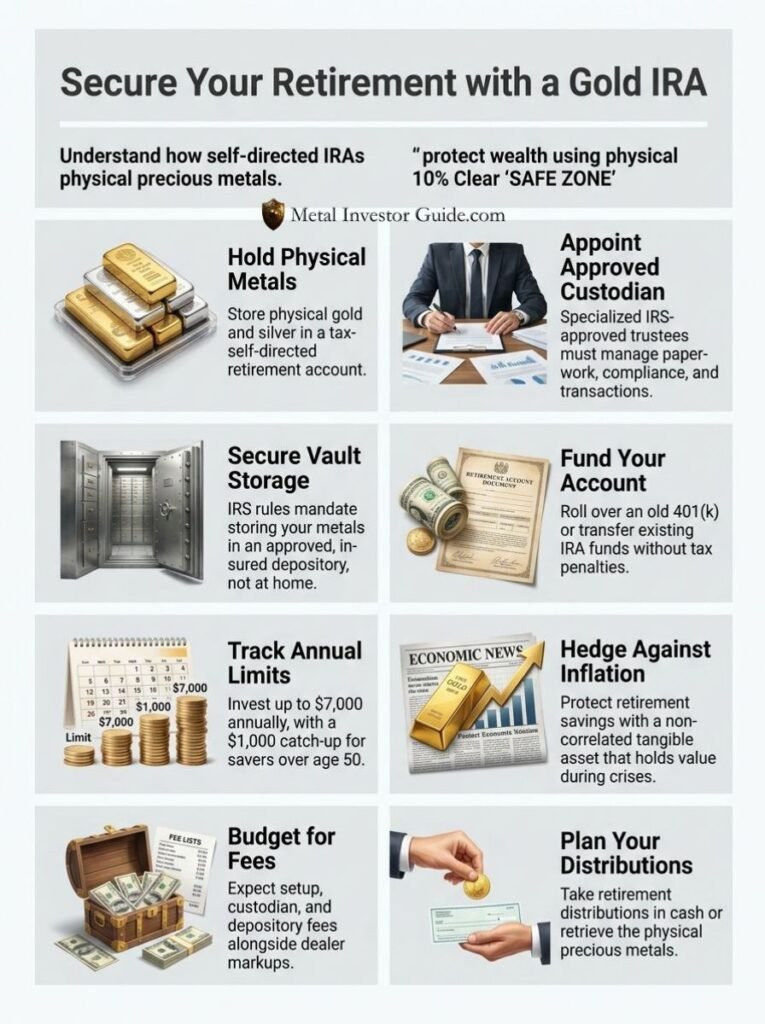
The basic process is to establish the account, fund it, select eligible products, arrange purchases through the IRA, and maintain the metals in required custody. Later, you may sell holdings within the account or arrange distributions.
Open an Account With a Suitable Custodian
Choose a custodian that supports physical precious metals and the IRA tax structure you intend to use. Review account terms, administration charges, storage arrangements, and transaction procedures before signing.
You will generally complete an application, name beneficiaries, and establish funding instructions. Identify the actual custodian rather than assuming the company advertising the account performs every service.
Fund the Account
Funding may come from eligible annual contributions, an IRA-to-IRA transfer, or a rollover of eligible employer-plan funds. Which options are available depends on your accounts and circumstances.
A properly handled transfer between IRAs with matching tax treatment can generally avoid immediate tax. However, transferring untaxed traditional IRA funds into a Roth IRA is a conversion, not a tax-free move merely because institutions handle it directly.
The IRS IRA FAQs explain that a Roth conversion results in taxation of untaxed amounts. Check both the source account and destination tax structure before authorizing a move.
Annual contributions follow contribution limits and eligibility rules. Transfers and eligible rollovers follow different rules and are not the same as new annual contributions.
Our guide to funding a Gold IRA covers the available methods. If you are considering employer-plan funds, the 401(k) to Gold IRA rollover guide addresses that process specifically.
Select and Purchase Eligible Metal
Once funds are available, you select products that meet legal eligibility requirements and the custodian’s policies. The purchase uses IRA funds and follows the account’s procedures.
A dealer supplies the metal, while the custodian administers the account transaction. The metal is delivered into the required storage arrangement, rather than to you for personal safekeeping.
Ask for a written purchase quote showing the products, quantities, prices, and applicable charges. Eligibility does not establish whether a product’s premium or sales price is reasonable.
Maintain Required Custody
Qualifying bullion must remain in the physical possession of a bank or approved nonbank trustee under the applicable rules. Providers commonly arrange storage through a depository within that custody structure.
Confirm who holds the metal, how ownership is recorded, what insurance applies, and what the storage terms mean. Labels such as segregated or non-segregated should be explained in the actual agreement.
Do not confuse an account’s custody arrangement with permission to keep IRA-owned metal in a personal safe or safe deposit box.
What Precious Metals Can a Gold IRA Hold?
Federal law generally restricts IRA investments in collectibles, including metals and coins, but provides exceptions for certain coins and qualifying bullion. Gold, silver, platinum, and palladium can qualify when the relevant conditions are met.
The IRS explanation of precious metals exceptions identifies the distinction between eligible products and prohibited collectibles, including the trustee-possession requirement for qualifying bullion.
Commonly used products include qualifying bullion bars and certain bullion coins. American Gold Eagles qualify under a statutory coin exception, so a simple purity test alone is not sufficient to determine every coin’s eligibility.
Jewelry and many collectible products do not qualify. Conversely, a marketing label or grading designation is not a substitute for examining the specific product and applicable exception.
Do not assume personally owned bullion can simply be contributed to the IRA. A regular IRA contribution generally must be in cash; eligible retirement-account transfers and rollovers are different transactions.
Confirm eligibility before buying. Our guide to Gold IRA rules and IRS requirements covers the product and account requirements in greater detail.
Potential Benefits of a Gold IRA
The principal benefit is the ability to hold eligible physical metal within an IRA. Other potential benefits come from the metal’s role in the portfolio, rather than from the Gold IRA label.
Exposure to a Different Asset
Gold has different price drivers from stocks and bonds. In some conditions, that can help diversify portfolio exposure.
Those relationships are not constant. Gold can decline alongside other investments, and replacing one holding with gold can reduce some risks while increasing others. Diversification does not eliminate losses.
Potential Purchasing-Power Diversification
Gold may help preserve purchasing power in some market conditions, but it does not reliably track consumer prices or cover rising retirement expenses. Long holding periods do not guarantee inflation-beating returns after costs.
Holding gold inside an IRA does not change those limitations. Evaluate it alongside your withdrawal needs and other approaches to inflation rather than assuming an account structure provides additional protection.
See Is Gold a Good Inflation Hedge for Retirement? for a closer examination of that role.
Tangible Metal Within an IRA Structure
Bullion does not depend on a company’s earnings or a borrower’s promise to repay. That characteristic appeals to some investors seeking exposure to a tangible asset.
However, IRA-held metal remains dependent on custody, storage, and account administration. It does not offer the same personal access or independence from intermediaries as bullion you lawfully own outside an IRA and physically possess.
Costs and Drawbacks to Consider
The tradeoffs matter especially when retirement savings must support ongoing spending. Review them before choosing an account or committing to an allocation.
Fees Reduce the Money Available to Invest
Costs may include account setup, annual administration, storage, insurance, transaction charges, and dealer premiums or spreads. Some services may be bundled, so compare the complete schedule rather than adding assumptions to an advertised price.
Fixed charges can be substantial relative to a small account. Promotional fee waivers also deserve scrutiny: establish what you will pay after the promotion and whether other costs offset the apparent saving.
Ask for an itemized quote and a realistic explanation of resale pricing. Our guide to Gold IRA fees explains how these expenses affect ownership.
Bullion Produces No Income
Physical gold pays no interest or dividends. Its investment return depends on price changes, reduced by ownership and transaction costs.
If you need to use the holding for retirement spending, you generally must sell some metal or distribute it and arrange a sale personally. The available price may be unfavorable when the money is needed.
Consider whether a purchase would reduce the investments available for near-term spending, income, or long-term growth.
Price Declines Can Last Beyond a Short Market Fluctuation
Gold prices reflect interest rates, currency movements, demand, and economic expectations as well as inflation. The metal can fall substantially or underperform for extended periods.
A reputation as a store of value does not ensure recovery by your intended withdrawal date. Assess your ability to absorb losses and meet expenses without relying on a timely rebound.
Selling Requires Account Coordination
Liquidating IRA-held bullion generally requires coordination among the custodian, dealer, and storage provider. That differs from placing a brokerage order for a liquid security.
Ask how sale prices are established, what fees apply, and when proceeds become available inside the account. Then separately consider the time and rules involved in taking a distribution.
What Happens When You Take a Distribution?
You can sell metal inside the IRA and leave the cash in the account. That internal sale is distinct from withdrawing the proceeds.
A cash distribution moves money out of the IRA. An in-kind distribution moves metal out of the IRA, after which you personally own it. The custodian should explain valuation, reporting, shipping, and related charges before an in-kind distribution.
Traditional IRA distributions are generally taxable as ordinary income except for amounts attributable to previously taxed basis. Qualified Roth distributions are tax-free. Other withdrawals may have tax consequences or additional early-distribution tax, depending on the circumstances.
Required Minimum Distributions Depend on the Account
Traditional Gold IRAs follow the applicable traditional IRA required minimum distribution rules. Roth IRA owners do not have required minimum distributions during their lifetime, although beneficiaries have different requirements.
The IRS RMD guidance explains the account distinctions. If withdrawals are required, plan ahead for valuation and distribution procedures rather than assuming physical metal can be converted into cash immediately.
Who Might Consider a Gold IRA?
A Gold IRA may deserve consideration when eligible physical bullion inside a retirement account is a specific objective, the costs are acceptable, and the holding fits a diversified financial plan.
Concern about inflation, interest in diversification, or access to an old 401(k) does not by itself establish suitability. Those concerns require an investment decision first and an ownership-method decision second.
You may not need this structure if you prefer personally owned bullion, want simpler gold exposure through an eligible brokerage product, or need to prioritize income and liquidity. Having rollover-eligible funds is an opportunity to evaluate choices, rather than a reason to buy metal.
There is no allocation that every retiree should own. Count all your precious metals exposure across accounts and consider what you would reduce to fund a purchase. Our guide to how much gold you should buy explains those allocation considerations.
How to Evaluate Providers Before Opening an Account
Identify the dealer, custodian, and storage provider, including which party performs each service. A company marketing a Gold IRA may coordinate the process without being the custodian itself.
Request written information about product pricing, annual fees, storage terms, insurance, buyback arrangements, and distribution procedures. Ask what happens if you want to change custodians or sell only part of the position.
A buyback offer is not a guarantee that you will recover your purchase price. Similarly, a custodian’s willingness to hold a product does not establish that the dealer’s price is fair.
Be cautious about urgent sales pitches and claims of guaranteed protection. Our guide to common Gold IRA mistakes covers issues to address before investing.
Once you have decided this ownership method fits your needs, our Gold IRA company comparison can help you evaluate providers alongside your own written quotes and account requirements.
Final Thoughts
A Gold IRA provides a way to hold eligible physical precious metals within a retirement account. Its distinctive features are bullion ownership, specialized custody, and additional administration and expenses.
It does not make gold an income-producing asset, guarantee inflation protection, or remove the possibility of losses. The account’s tax treatment also needs to be distinguished from the performance of the metal.
Start with your retirement spending needs and overall investments. If physical bullion has a defined role, compare ownership methods and total costs before moving funds. The account should serve your plan at an allocation you can manage.
Frequently Asked Questions
Is a Gold IRA a separate type of IRA under the tax code?
No. Gold IRA is a common term for an IRA used to hold eligible physical precious metals. Traditional and Roth describe tax treatment; gold describes the investment held through the account.
Is a Gold IRA a good investment?
Suitability depends on the metal’s role in your portfolio, the account’s costs, and your retirement needs. The IRA structure does not improve gold’s underlying returns or guarantee safety. Decide whether you need bullion exposure before choosing the account.
Can I keep Gold IRA metal at home?
IRA-owned metal must remain within the applicable custody arrangements. Taking personal possession can create distribution treatment and tax consequences. Personally owned bullion outside an IRA is a different arrangement.
Can I transfer an existing IRA without paying tax?
A correctly handled transfer between compatible IRA structures can generally avoid immediate tax. Moving untaxed traditional IRA funds into a Roth IRA is a conversion with potential taxable income. Confirm the source and destination tax treatment before proceeding.
Can I use an old 401(k) to fund a Gold IRA?
Eligible employer-plan funds may be rolled into an appropriate IRA, subject to plan and tax rules. Not every balance or distribution is rollover-eligible, and a Roth destination can change the tax consequences. Having an old account does not establish that a Gold IRA is the best destination.
Can a Gold IRA hold silver?
Yes, when the product meets the applicable eligibility rules and the custodian supports it. Qualifying platinum and palladium may also be held. Combining metals does not guarantee reduced risk or better returns.
Do Roth Gold IRAs require minimum distributions?
The original Roth IRA owner has no lifetime required minimum distributions. Beneficiaries follow different rules. Traditional Gold IRAs follow the applicable traditional IRA distribution requirements.
Can I contribute gold I already own?
Regular IRA contributions generally must be made in cash. Personally owned bullion cannot simply be deposited as a regular contribution. Eligible transfers or rollovers of retirement-account assets are different transactions and require proper handling.
How much money do I need to open an account?
Provider minimums vary. Assess the total ongoing costs relative to your planned balance rather than treating a company minimum as an appropriate investment amount. A smaller allocation may be more economical through a different ownership method.
Can I receive my metal instead of cash?
An in-kind distribution may allow metal to leave the IRA and become your personal property. It is still a distribution, with valuation, reporting, and potential tax consequences. Confirm procedures and costs with the custodian before arranging it.