
Why Gold Investing Is a Trusted Long-Term Investment
Gold has protected wealth for thousands of years.
Empires have collapsed, currencies have failed, and markets have crashed — yet gold has consistently remained one of the few assets trusted across generations.
But many new investors don’t realize that how you invest in gold matters just as much as whether you invest in it at all.
Some gold investments can help preserve wealth for decades. Others come with hidden fees, unnecessary premiums, or risks that investors only discover after they’ve already made a purchase.
Understanding the difference is essential.
In this guide, we’ll explore how to invest in gold for long-term wealth and the key factors every investor should understand before buying gold.
Along the way, we’ll answer several important questions:
- What are the safest ways to invest in gold today?
- Is physical gold better than gold ETFs for long-term investors?
- How much gold should be in a diversified portfolio?
- And how can gold be used inside retirement accounts like Gold IRAs?
By the end of this guide, you’ll have a clear understanding of how gold fits into a long-term investment strategy and how to approach gold investing with confidence.
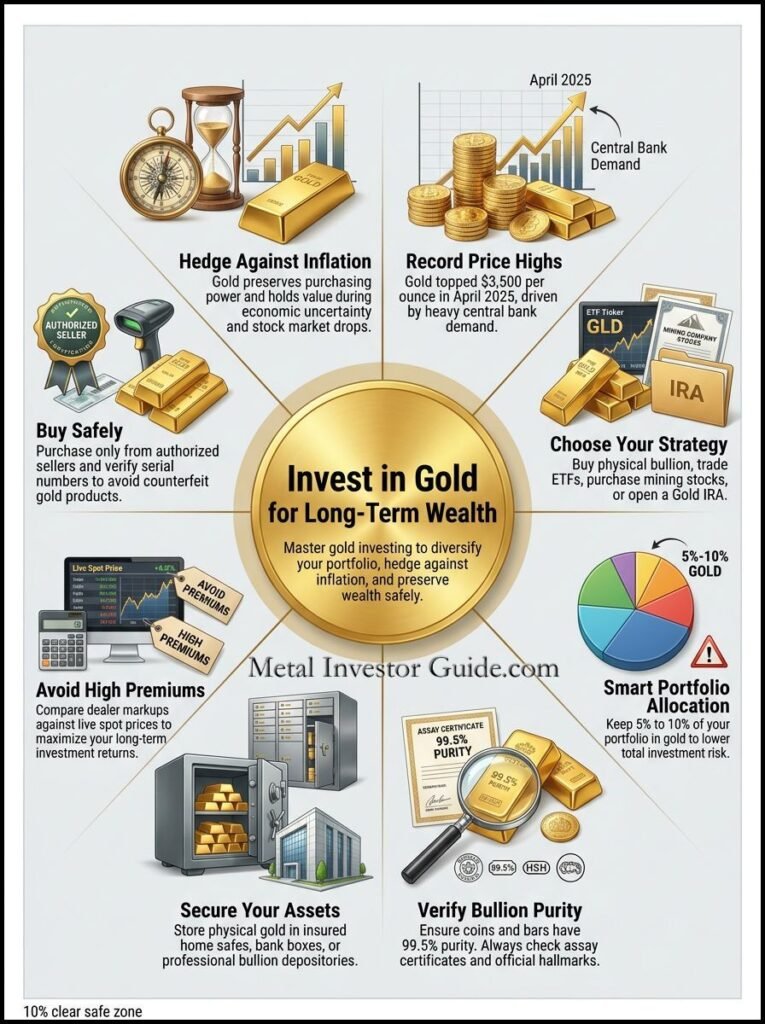
Gold as a Hedge Against Inflation
When inflation rises faster than expected, your portfolio needs something that is not tightly tied to corporate earnings or bond coupon payments.
Gold can play that role, but the way you hold it matters. For a closer look at the evidence and limitations, see is gold an inflation hedge for retirement?. Physical bullion gives you direct exposure, while exchange-traded funds and futures contracts introduce structure, fees, and sometimes counterparty considerations.
If your goal is an inflation hedge, keep it simple: use unleveraged gold exposure, size it modestly, and rebalance on a schedule so you are not chasing spikes in the price of gold.
- Physical gold: Best for investors who want direct ownership and are willing to handle storage, insurance, and resale logistics.
- Gold ETFs: Best for investors who want liquidity and simple access through a brokerage account or IRA.
- Futures contracts: Best for experienced futures traders who understand leverage, margin calls, and contract expirations.
Gold’s Role in Portfolio Diversification
Gold can act as ballast for a mixed portfolio.
Diversification is not about owning many things, it is about owning assets that do not all fail at the same time.
That is the core case for gold long term investment planning. A small gold allocation can lower portfolio-wide volatility without forcing you to reduce exposure to growth assets like stocks. Our guide to how much gold you should buy explores the allocation decision in more detail.
In a February 2026 portfolio study, the World Gold Council found that adding 5% gold to a hypothetical USD portfolio increased annualized returns and reduced volatility and maximum drawdown over multiple time windows.
20-year results (hypothetical USD portfolio)
| Metric | No gold | With 5% gold |
|---|---|---|
| Annualized return | 6.7% | 7.0% |
| Annualized volatility | 9.9% | 9.6% |
| Maximum drawdown | -34.9% | -32.7% |
The practical takeaway: gold can help smooth the ride, but it works best as a measured slice of your assets, not the whole plan.
Why Investors Turn to Gold During Economic Uncertainty
Gold demand tends to spike when investors lose confidence in the usual playbook and rush to hedge risk.
In April 2025, AP News reported that spot gold closed at about $3,424 per troy ounce and gold futures briefly crossed $3,500 during the same surge in uncertainty. Later in October 2025, AP reported spot gold closing at a record $4,326 per troy ounce during another sharp rally.
Those price moves do not prove that gold always goes up in a crisis. They show why investors treat gold as a safe haven when volatility hits stock markets, credit conditions tighten, or exchange rates swing.
- Policy stress: Shifts in interest rates and inflation expectations can change demand fast.
- Currency stress: A weaker U.S. dollar often supports gold prices, while a stronger dollar can weigh on them.
- Geopolitical shocks: Sudden risk events can push money into precious metals for defensive positioning.
The Historical Performance of Gold
Gold has had strong periods, flat decades, and painful drawdowns. That is why you should treat it as a risk-management asset, not a guaranteed return engine.
It also does not generate income. Unlike dividend stocks or bonds that pay interest rates, gold’s return depends on the price you buy at versus the price you sell at.
If you want gold as an investment but also need income, a common approach is to keep gold smaller and let stocks and bonds carry the long-term compounding.
- Use gold for the job it does well: hedging and diversification.
- Use income assets for the job they do well: cash flow and reinvestment.
- Expect cycles: plan your allocation so you can hold through multi-year swings.
Gold Investing: The Main Ways to Invest in Gold
You can invest in gold through physical bullion, exchange-traded funds, mutual funds, mining stocks, a gold IRA, or advanced instruments like options and futures.
The right choice depends on what you care about most: direct ownership, liquidity, retirement tax treatment, or tactical trading flexibility. If you are comparing ownership structures, see physical gold vs. gold ETFs vs. Gold IRAs.
SIPC explains that brokerage protection (for eligible securities and related cash held at a broker-dealer) is capped at $500,000, including a $250,000 limit for cash. Physical gold held outside a brokerage account is not covered by SIPC.
| Method | What you own | Liquidity | Key trade-off |
|---|---|---|---|
| Physical coins and bars | Gold bullion | Medium | Storage, insurance, and buy-sell spreads |
| Gold ETFs | Shares tracking gold (often via vaulted bullion) | High | Ongoing sponsor fee and market trading costs |
| Mutual funds | Portfolio of gold-related holdings | Medium | Trades once per day, manager and strategy risk |
| Mining stocks | Equity in miners | High | Company and operational risk beyond gold prices |
| Futures and options | Derivative exposure | High | Leverage and complexity |
| Gold IRA | Eligible bullion held by a custodian | Medium | Fees and strict storage rules |
Buying Physical Gold (Coins and Bars)
Buying physical gold for investment is straightforward: you pay a dealer, and you own the precious metal.
The work starts after the purchase. You need to manage authenticity checks, storage, and an eventual resale plan. For a broader purchasing checklist, see how to invest in gold.
If you want a simple baseline for vetting, the U.S. Mint publishes a list of Authorized Purchasers for its bullion coins and also notes that not all Authorized Purchasers sell directly to consumers.
- Start with spot price: Treat spot as the raw material cost, then compare premiums across the same product type.
- Prefer investment-grade products: Standard bullion coins and bars are easier to resell than jewelry or novelty items.
- Insist on verifiable details: Look for fineness, weight, mint or refiner name, and serial numbers on bars when available.
- Use practical verification: Weigh and measure coins, and use a reputable dealer or assay for high-value purchases.
- Plan storage before you buy: Home safe, bank safe deposit box, or professional bullion depositories all have different costs and risks.
- Keep records: Save invoices and photos so you can prove what you own when you sell or insure it.
Investing in Gold ETFs and Mutual Funds
Gold ETFs are the cleanest way to get gold exposure with high liquidity. You can buy and sell shares through a brokerage account or IRA the same way you trade stocks.
The key is to know what the fund holds. Some exchange-traded funds hold physical gold, while others use futures contracts, mining shares, or a blended approach.
Charles Schwab’s education on commodity ETFs highlights a common pitfall: funds that use futures must roll contracts, and that structure can help or hurt returns depending on the futures curve.
| Well-known physically backed gold ETFs | Typical sponsor fee | Why it matters |
|---|---|---|
| SPDR Gold Shares (GLD) | 0.40% | Often favored for deep trading liquidity |
| iShares Gold Trust (IAU) | 0.25% | Lower ongoing fee for long holds |
| SPDR Gold MiniShares (GLDM) | 0.10% | Lower fee, smaller share size |
- Check the structure: physical bullion, futures contracts, or mining stocks.
- Check the fee: sponsor fees compound over time.
- Check the tax form: some gold-backed products can be taxed differently than stock ETFs.
- Check the spreads: a tight bid-ask spread can matter more than a tiny fee difference for frequent trading.
Investing in Gold Mining Stocks
Mining shares can be a powerful way to invest in gold, but they are not pure gold exposure. You are buying an operating business with costs, management decisions, and country-specific risks.
That extra leverage can cut both ways. In strong bull markets for gold prices, miners can outperform, but they can also drop even when the underlying asset holds steady.
- Single stocks: Higher upside, higher single-company risk.
- Mining ETFs: Diversifies across multiple miners and jurisdictions.
- What to review: all-in sustaining costs, debt levels, and how the company hedges production.
Gold Futures and Other Advanced Instruments
Futures and options are built for precision hedging and active speculation, not set-and-forget investing in gold for retirement.
CME Group’s COMEX specifications list the standard gold futures contract at 100 troy ounces with minimum 995 fineness, plus smaller E-mini and E-micro contract sizes for traders who want less exposure per contract.
- Leverage: You can control large exposure with a smaller amount of money, which magnifies gains and losses.
- Expiration: Contracts have set months, and you must close, roll, or accept delivery rules.
- Complexity: Options pricing, margin requirements, and volatility spikes can make outcomes unpredictable.
Investing in Gold Through a Gold IRA
A gold IRA is a self-directed IRA structure that can hold certain precious metals, but it has strict operational rules.
The IRS explains that bullion can qualify only when a bank or approved non-bank trustee keeps physical possession of the metals, which is why reputable custodians require approved depository storage and do not let you keep IRA gold at home.
For the specific custody and product requirements, review our guide to Gold IRA rules and IRS requirements.
Eligibility also comes down to product type. Many IRA-eligible gold bullion items meet the same minimum fineness used for deliverable futures contracts, and COMEX lists that minimum for gold as 995 fineness.
- Confirm IRA eligibility before purchase: do not assume every coin or bar qualifies.
- Get a written fee schedule: setup, annual admin, storage, and transaction fees can add up.
- Ask about storage type: segregated versus non-segregated storage changes how your metal is held and priced.
- Document everything: product descriptions, serial numbers for bars, and the named depository in your paperwork.
Physical Gold Investing Explained
Physical gold investing means you own the metal in coins, bars, or other bullion forms.
You are also responsible for the operational side: premiums, storage, insurance, and the resale spread.
If you want physical gold to work for long-term wealth, treat the purchase like an investment process, not a souvenir purchase.
- Pick a purpose: long-term hedge, diversification, or a tactical position.
- Pick a form: common bullion coins for resale ease, bars for larger buys and potentially lower premiums.
- Pick a storage plan: home safe, bank box, or professional custody.
- Pick an exit path: local dealers, online buybacks, or coin shows, then keep the documentation that supports a smooth sale.
Gold Coins vs Gold Bars
Coins and bars can both be excellent, but they fit different needs.
Coins often win on retail resale convenience. Bars often win on cost efficiency per ounce when you buy larger sizes. See our detailed gold coins vs. gold bars comparison for the trade-offs.
A detail many investors miss: fractional coins can carry noticeably higher premiums than 1-ounce pieces. The U.S. Mint’s published premium schedule for its Authorized Purchasers is higher for fractional American Gold Eagles than for 1-ounce coins, and retail premiums tend to follow that pattern.
- Coins: easier to sell in smaller increments, strong recognition, often better local liquidity.
- Bars: efficient for larger allocations, require more careful verification at resale.
- Collectible risk: numismatic premiums can be real, but they depend on collectors, not just gold weight.
- Storage: coins store easily in small spaces, larger bars can make professional storage more practical.
- Verification: bars benefit from serial numbers and assay packaging, coins benefit from standard dimensions and known designs.
- Transaction costs: compare buy and sell spreads before committing meaningful money.
Popular Gold Coins for Investors
If your goal is buying gold for investment, stick with widely recognized bullion coins. Recognition reduces friction when you sell.
These are common choices in the U.S. market, each with a clear reason they is favored for liquidity and trust. Our best gold coins for investment guide compares the leading options.
- American Gold Eagle: U.S. Mint coin struck in 22-karat gold, but the 1-ounce version contains one full troy ounce of fine gold.
- American Gold Buffalo: U.S. Mint bullion coin struck in .9999 fine gold, popular for investors who prefer 24-karat purity.
- Canadian Gold Maple Leaf: typically .9999 fine gold, and the Royal Canadian Mint describes added security features such as micro-engraving.
- South African Krugerrand: widely recognized, historically one of the most traded bullion coins.
- Austrian Philharmonic: widely recognized in global bullion markets and commonly minted in high purity.
- Mexican Libertad: respected bullion coin with collector interest in some dates, which can affect premiums.
Understanding Gold Purity and Hallmarks
Purity is the first thing buyers and dealers verify, because it drives resale value.
Hallmarks and assay marks reduce counterfeit risk because they give you standardized details to confirm: weight, fineness, mint or refiner, and sometimes a serial number.
- Fineness: common investment standards include 995 (99.5%), 999 (99.9%), and 9999 (99.99%).
- Assay packaging: sealed assay cards can help at resale, but you still need a reputable seller.
- Serial numbers: more common on bars, helpful for recordkeeping and resale documentation.
- Verification tools: reputable dealers may use XRF testing, while you can still do basic weight and dimension checks.
How to Buy Gold Safely
Buying safely is about controlling three risks: overpaying, buying a counterfeit, and buying a product that is hard to resell.
Use the U.S. Mint’s Authorized Purchasers directory as a starting point for dealer vetting, and take note of the Mint’s warning that not all Authorized Purchasers sell directly to consumers.
From there, you compare premiums, confirm authentication practices, and insist on clear paperwork. It also helps to understand the warning signs covered in our guide to gold investment scams.
- Know the product: buy common bullion items before you experiment with specialty pieces.
- Shop the all-in cost: include premium, shipping, and payment method fees.
- Demand documentation: invoices, product descriptions, and bar serials where applicable.
- Match the seller to the job: a strong buyback program matters more than flashy marketing.
Choosing a Reputable Gold Dealer
A reputable dealer is transparent about premiums, authentication, and buyback terms.
That transparency protects your liquidity, which is the real goal when you plan to sell later.
- Verify the business: confirm a real address, clear policies, and a long track record.
- Ask about authentication: learn what tests they use and how they handle disputes.
- Get buyback terms in writing: understand how they price repurchases relative to spot.
- Compare like-for-like: compare the same coin or bar across sellers, not “similar” items.
- Avoid pressure tactics: urgency is not a feature in a rational long-term investment decision.
- Keep your receipts: paperwork speeds resale and supports insurance claims.
Understanding Spot Price and Premiums
The spot price is the live market reference for gold, quoted per troy ounce.
Your real purchase price is spot plus a premium. That premium covers minting, distribution, dealer overhead, and market demand, and it is where many investors accidentally overpay. Our article on gold coin premiums explains how to compare those costs.
- Premium: what you pay above spot to buy a specific product.
- Spread: the gap between what a dealer sells for and what they will buy back for.
- Rule of thumb: compare your all-in premium per ounce across products, then decide whether the added liquidity of a well-known coin is worth it.
How to Avoid Counterfeit Gold Products
Counterfeit risk is real, and it rises in private-party and high-pressure sales environments.
You can reduce that risk by combining dealer vetting with simple verification steps.
- Buy common products: widely traded coins and bars are easier to verify and resell.
- Check weight and dimensions: reputable bullion coins have tight standards.
- Use advanced testing for large buys: XRF testing or professional assay reduces uncertainty.
- Inspect packaging and marks: look for clear fineness marks, mint names, and bar serial numbers.
- Watch for underpriced offers: below-market pricing should trigger extra scrutiny.
- Keep a clean chain of custody: invoices and photos help prove authenticity later.
How Much Gold Should Be in Your Portfolio
The common starting point for gold as an investment is a modest allocation, often 5% to 10% depending on your risk tolerance and goals.
The World Gold Council’s 2026 portfolio analysis showed improved risk-adjusted results across several tested gold weights (including 2.5%, 5%, 7.5%, and 10%), which supports the idea that small allocations can matter without dominating your investment plan.
Start by choosing a target percentage you can hold through volatility, then rebalance back to that target over time.
- If you want a light hedge: consider a smaller allocation and prioritize liquidity through gold ETFs.
- If you want stronger diversification: consider a mid-range allocation and split between an exchange-traded fund and a small amount of physical gold bullion.
- If you are tempted to go all-in: pause and stress test your plan against long flat periods for gold prices.
Typical Gold Allocation Strategies
Allocation strategy is where gold investing becomes practical. You pick a role for gold, then you choose the vehicle that fits that role.
- Strategic core: a steady allocation you rebalance periodically to maintain diversification.
- Tactical tilt: a temporary overweight based on your view of inflation, interest rates, or market risk.
- Split exposure: a mix of physical bullion for direct ownership and gold exchange-traded funds for liquidity.
- Higher-risk satellite: a small sleeve of miners or options for investors who can tolerate larger swings.
Factors That Influence Your Gold Allocation
Your best allocation depends on your time horizon, liquidity needs, and comfort with volatility.
Taxes can also change the math. IRS guidance for investors references a “collectibles (28%) gain” category, and physical precious metals can fall into that bucket outside retirement accounts, which can reduce your after-tax investment return.
- Risk tolerance: higher volatility sensitivity usually means a smaller gold slice.
- Liquidity: if you might need cash quickly, gold ETFs can be easier than selling coins.
- Tax location: holding choices can differ between taxable accounts and IRAs.
- Premium environment: high retail premiums can make physical gold less attractive at the margin.
Storing Your Gold Securely
Storage is where physical gold investing gets real. Security mistakes can erase years of gains. For a more detailed overview of your options, read how to store gold securely.
Use home storage for smaller amounts you can protect well, and consider professional custody for larger holdings.
For bank safe deposit boxes, the FDIC notes that the contents of a safe deposit box are not insured by FDIC deposit insurance.
Home Storage Options
Home storage can work, but it needs real security, real documentation, and realistic limits.
- Use a true burglary-rated safe if the value is meaningful: insurers and safe-rating guides often reference UL tool-resistant ratings like TL-15 and TL-30 as a higher security tier than basic cabinets.
- Anchor it: bolt the safe down and place it out of obvious sight lines.
- Insure it properly: confirm whether your policy covers bullion and coins, and whether special sublimits apply.
- Keep an inventory: photos, serial numbers for bars, and copies of receipts stored separately.
- Limit disclosure: the fewer people who know, the better your security profile.
- Audit twice per year: quick checks reduce the odds of a surprise loss.
Bank Safe Deposit Boxes
Safe deposit boxes offer offsite storage with controlled access and strong physical security.
The trade-offs are access limits (bank hours and bank policies) and insurance. You should assume you need separate coverage for valuables stored there.
- Best for: small to moderate holdings you do not need daily access to.
- Ask about: box sizes, access rules, and what happens if you need access during unusual events.
- Keep paperwork: store ownership records somewhere other than the box itself.
Professional Bullion Depositories
Professional bullion depositories are built for large holdings and long-term custody. They can offer insurance, audited inventory, and detailed statements.
If you are using a gold IRA, depository storage is typically required because the custodian must maintain physical possession through an approved arrangement. These arrangements can also affect the fees associated with a Gold IRA.
For context on institutional-grade custody, CME Group’s COMEX materials list approved depositories used for gold deliverable against its futures contracts, including named vault operators such as Brink’s and Delaware Depository.
- Ask about insurance: limits, exclusions, and how claims work.
- Ask about audits: frequency, third-party verification, and how you receive reports.
- Ask about storage type: segregated versus non-segregated, and how fees are calculated.
- Ask about withdrawals: process, timing, and shipping insurance options.
When and How to Sell Gold
Selling is where liquidity becomes more than a keyword. The product you bought and the paperwork you kept will affect how fast you can exit and what you net after spreads.
Before you sell, check spot price, then gather receipts, assay cards, and any grading documents. That preparation often improves your offers and reduces delays.
- Decide what you are optimizing: speed, maximum price, or minimal hassle.
- Get multiple quotes: compare dealer bids, not just advertised buy prices.
- Understand the spread: your premium on the way in and the discount on the way out both matter.
- Sell in the right venue: common bullion fits dealer buybacks, specialty items may need collector channels.
Understanding the Gold Resale Market
The resale market is mostly a spread game. Dealers must protect themselves against price swings, verification costs, and inventory risk.
Gold bullion coins and common bars are usually easiest to sell. Jewelry and highly specialized collectibles are harder, because buyers price in uncertainty and resale effort.
- Fastest sales: widely recognized coins and standard bars.
- Slowest sales: jewelry, niche collectibles, and items without clear provenance.
- Speed booster: clean documentation and an established dealer relationship.
Where to Sell Gold for the Best Price
You get better results when you treat selling like buying: compare offers and stay disciplined.
- Local coin shops: quick transactions, especially for common coins.
- Major online buybacks: competitive pricing, but you must follow shipping and insurance rules.
- Coin shows: multiple competing bids in one place, useful for price discovery.
- Authorized purchasers and wholesalers: can be attractive for larger lots, but not always retail-friendly.
- Peer-to-peer markets: potentially higher prices, with higher fraud and logistics risk.
- Original dealer buyback: sometimes smoother because they already know the product line and paperwork standards.
Common Mistakes Gold Investors Should Avoid
Gold can support long-term wealth, but mistakes turn it into an expensive hobby.
- Overpaying premiums: the wrong premium can take years to recover.
- Buying collectibles by accident: numismatic pricing is not the same as bullion pricing.
- Skipping the storage plan: security and insurance are part of the investment cost.
- Failing to vet dealers: authenticity and buyback terms matter more than marketing.
- Overconcentrating: too much gold increases portfolio concentration risk.
- Ignoring taxes and account rules: tax treatment and IRA custody rules can change net outcomes.
Overpaying High Premiums
Premiums are normal, but they vary by product, size, and market stress. In particular, one-ounce and fractional gold coins can have noticeably different costs per ounce.
To keep costs under control, compare the premium per ounce across the exact same item and payment method, then decide whether extra liquidity is worth paying for.
- Lower premium tendency: larger bars from well-known refiners.
- Higher premium tendency: small bars, fractional coins, and items with collector demand.
- Simple discipline: if you cannot explain why the premium is high, do not pay it.
Buying Collectible Coins Instead of Bullion
Collectible coins can be legitimate, but they are a different market with different risks.
Bullion buyers care about gold content and liquidity. Collectors care about condition, rarity, grading, and demand cycles, and those variables can be unpredictable.
Third-party grading services such as NGC and PCGS can support resale for collectibles, but grading does not guarantee a fast sale or a good price.
Ignoring Storage and Security
Storage is not an afterthought, it is part of the investment decision.
If you cannot store gold securely and insure it appropriately, a gold ETF may be a better fit because it avoids the physical custody burden while preserving liquidity.
Is Gold Still a Good Investment Today
Gold is still a useful tool for diversification and hedging, but you should judge it by what it does in a portfolio, not by headlines.
The big picture is that gold has remained in demand through recent volatility, both from investors using exchange-traded funds and from official-sector buying by central banks.
If you keep gold as an investment to a strategic allocation, focus on costs, liquidity, and rules, not excitement.
Central Bank Demand for Gold
Central banks buy gold to diversify reserves and manage long-term financial risk.
In its January 2026 Gold Demand Trends report, the World Gold Council reported total central bank buying of 863 tonnes in 2025, with buying accelerating in the fourth quarter.
That kind of steady demand does not guarantee rising prices of gold, but it helps explain why gold remains a core asset in the broader precious metals landscape.
- What it signals: long-term reserve diversification, not short-term speculation.
- Why it matters to investors: official-sector flows can create a structural layer of demand.
Global Economic Trends Affecting Gold Prices
Gold prices respond to a mix of inflation expectations, interest rates, currency strength, and risk sentiment.
A stronger U.S. dollar can pressure gold in dollar terms, while a weaker dollar can lift it. Shifts in exchange rates matter because gold is priced globally.
If you want a practical way to track the drivers, watch the direction of real yields, the dollar trend, and how quickly risk moves through the financial market during stress events.
FAQs
1. Is gold a good long-term investment?
Gold has historically been viewed as a store of value and a hedge against inflation, which is why many investors include it in a long-term portfolio. Unlike paper currencies, gold has a limited supply and cannot be created by governments. Over long periods, gold has often helped preserve purchasing power during times of inflation, economic instability, and currency devaluation. While gold may not generate income like stocks or bonds, it can play an important role in diversifying a portfolio and protecting wealth over time.
2. What is the safest way to invest in gold for the long term?
For many investors, the safest way to invest in gold is through physical bullion such as gold coins or bars purchased from reputable dealers. Physical gold removes counterparty risk because you directly own the asset. Other options include gold ETFs, mining stocks, and gold-backed retirement accounts, each with different risks and benefits. Regardless of the method you choose, it is important to buy from trusted sources, understand pricing premiums, and store gold securely.
3. What percentage of a portfolio should be in gold?
Financial professionals often suggest allocating 5% to 10% of a portfolio to gold as part of a diversified investment strategy. Investors who are particularly concerned about inflation or economic uncertainty sometimes allocate slightly more, such as 10–15%. The ideal allocation depends on factors such as your risk tolerance, investment timeline, and overall financial goals. Gold is typically used as a diversification and wealth-preservation asset, rather than the primary driver of portfolio growth.
4. Is physical gold better than gold ETFs for long-term investors?
Physical gold and gold ETFs each have advantages depending on an investor’s goals. Physical gold offers direct ownership and eliminates reliance on financial institutions, which appeals to investors focused on wealth preservation and financial independence. Gold ETFs, on the other hand, provide liquidity and can be easily traded through brokerage accounts. Long-term investors who prioritize security and tangible assets often prefer physical gold, while others may choose ETFs for convenience and accessibility.
5. Can you hold gold in a retirement account or Gold IRA?
Yes, certain retirement accounts allow investors to hold physical gold through a self-directed Gold IRA. These accounts enable individuals to include IRS-approved precious metals such as gold bullion within a tax-advantaged retirement portfolio. Gold held in an IRA must meet specific purity standards and be stored in an approved depository. Gold IRAs are often used by investors who want to diversify retirement savings beyond traditional stocks and bonds.
6. What are the risks of investing in gold?
Although gold is often viewed as a stable asset, it still carries some risks. Gold prices can fluctuate in the short term, and physical gold may involve additional costs such as storage, insurance, and dealer premiums. Unlike stocks, gold does not generate dividends or interest income. For this reason, gold is typically best used as one component of a diversified investment strategy, rather than a standalone investment.
7. When is the best time to buy gold?
Trying to perfectly time the gold market can be difficult, even for experienced investors. Our comparison of buying gold all at once or over time examines two practical approaches. Many long-term investors focus less on short-term price movements and more on gradually building a position over time. Buying during periods of economic uncertainty or inflation concerns often increases demand for gold, but the most important factor is ensuring gold fits your overall investment strategy and long-term goals.
8. How can you verify that gold is authentic before buying it?
To verify gold authenticity, investors should purchase from reputable dealers and well-known mints that produce bullion coins and bars with recognized purity standards. Gold products often include hallmarks indicating weight and purity, and dealers may provide certificates of authenticity. Additional verification methods include weight measurements, magnetic tests, and professional appraisal services. Taking these steps helps reduce the risk of purchasing counterfeit gold.
Final Thoughts on Investing in Gold for Long-Term Wealth
Gold has played a unique role in the global financial system for thousands of years. While markets, currencies, and financial institutions have evolved over time, gold has consistently remained a trusted store of value.
For modern investors, gold can serve as an important tool for diversification, inflation protection, and long-term wealth preservation. Whether purchased as physical bullion, held through investment funds, or included in a retirement account, gold offers a way to balance risk and protect purchasing power during periods of economic uncertainty.
Like any investment, however, gold should be approached thoughtfully. Understanding how gold fits within a broader portfolio, where to purchase it safely, and how to store it securely are all important considerations.
By taking the time to learn about the different ways to invest in gold, investors can make more informed decisions and build a strategy designed to support long-term financial stability and wealth preservation.
Investors interested in learning more may also want to explore our guides on choosing the best gold coins, buying gold safely online, and using gold within retirement accounts.