
How to Start Investing in Gold and Silver: A Beginner’s Step-by-Step Guide
Many people first become interested in gold and silver after a moment of financial doubt.
It might happen during a period of rising inflation, a major market crash, or simply after noticing that everyday expenses seem to rise faster than their savings.
At some point, the question naturally arises:
What assets actually hold their value when everything else becomes uncertain?
For thousands of years, investors have turned to gold and silver when they wanted protection from unstable currencies, economic turbulence, and financial systems they no longer fully trust.
Today, these precious metals continue to serve the same purpose.
If you’re considering investing in gold or silver for the first time, this guide will walk you through the fundamentals and help you take your first steps with confidence.
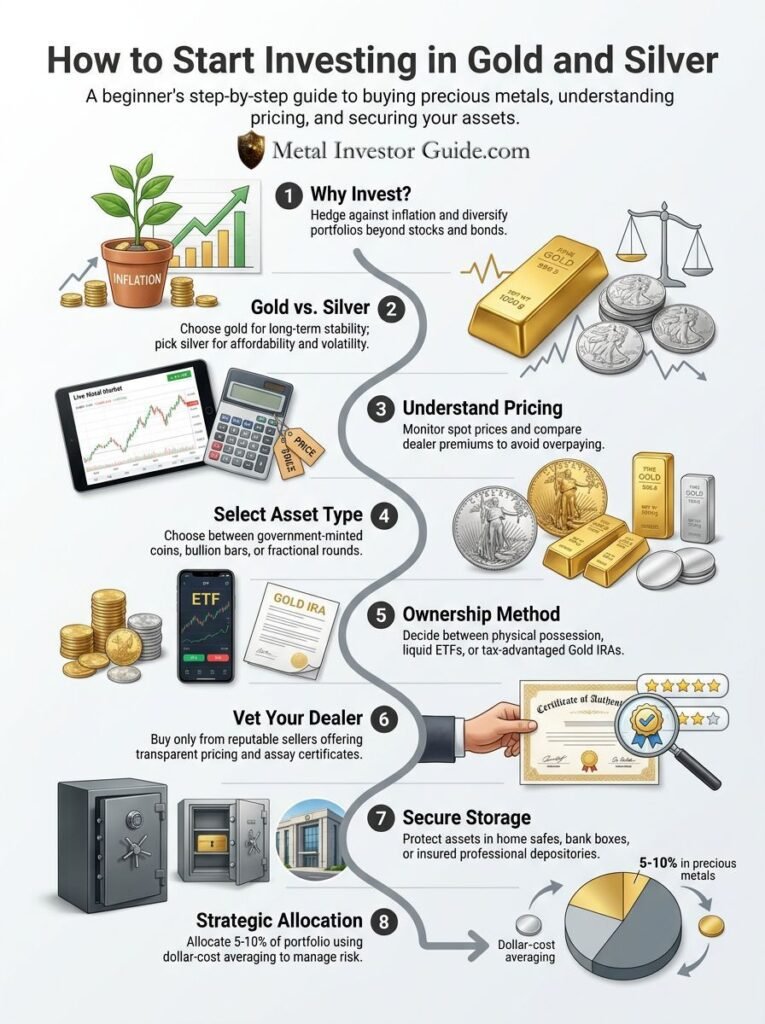
Why Investors Buy Gold and Silver
Gold and silver sit in a unique corner of the financial market. They are globally priced commodities, but you can also own them as physical gold, gold bars, and widely traded exchange-traded funds (ETFs).
In the latest Gold Demand Trends update from the World Gold Council, total global gold demand reached 5,002 tonnes in 2025, and central banks were net buyers of 863 tonnes in 2025. That matters because it shows demand is not driven by one type of buyer, and it helps explain why investors keep returning to precious metals when markets feel uncertain.
- Inflation hedge: many investors use hard assets to help protect purchasing power.
- Portfolio diversification: gold and silver often move differently than stocks and bonds.
- Tangible ownership: physical bullion can sit outside brokerage accounts and bank systems.
- Crisis behavior: safe-haven buying can increase during economic uncertainty and market volatility.
Gold and Silver as Protection Against Inflation
Hard assets can keep value when prices rise.
Gold and silver are often used as an inflation hedge because they are scarce, globally priced, and not tied to a single company’s earnings. When paper money loses purchasing power, investors often look for assets that are harder to “print.”
If your main goal is protecting cash value, treat precious metals like a dedicated sleeve in your asset allocation, not a substitute for your emergency fund.
- Use metals for long-term protection: think years, not weeks.
- Know your alternatives: Treasury Inflation-Protected Securities (TIPS) adjust with CPI and can complement a gold investment.
- Pick the simplest tool you will actually hold: physical gold for direct ownership, or gold ETFs for quick liquidity.
Diversifying Your Investment Portfolio
A small, intentional allocation to gold and silver can improve portfolio diversification because these metals often behave differently than equities and bonds during stress.
The practical move is to set a target range and rebalance, instead of buying based on headlines.
- Set a range: for example, a 5% to 10% precious metals target, then define what would trigger a rebalance.
- Separate metal types: physical bullion and gold ETFs can play different roles (access vs. control).
- Keep miners in perspective: gold stocks and gold mining stocks can add leverage to the gold price, but they also add equity-like risk.
Tangible Assets Outside the Banking System
Physical gold includes gold bars, gold coins, and some forms of jewelry, and you can hold it outside the banking system. That appeals to investors who value direct control and want an asset that does not depend on a broker-dealer’s platform being available.
If you buy bullion coins, it helps to understand the distribution chain. The US Mint explains that it distributes bullion coins through Authorized Purchasers, who then sell into the secondary market through wholesalers and retailers.
- Keep your “why” specific: control and privacy are different goals than short-term trading.
- Plan the exit: decide in advance where you would sell (local coin shop, dealer buyback program, or other channel).
- Match storage to value: a small amount at home for convenience can be reasonable, but larger holdings usually call for stronger security.
Why Precious Metals Perform Well During Economic Uncertainty
During economic uncertainty, investors often treat gold as a safe haven. You will also see activity from hedgers, central banks, and futures traders, which can amplify moves in commodities markets.
If you want to understand the plumbing behind day-to-day price moves, it helps to know how derivatives work. CME Group’s COMEX gold futures are commonly sized at 100 troy ounces per contract, which is meaningful leverage for most first-time investors.
If you are new, avoid using futures contracts or options for “simple gold exposure.” Leverage can turn a small price move into a forced sale.
Gold vs Silver: Which Metal Should Beginners Start With?
Gold tends to behave like monetary insurance, while silver has a split personality: it can act like a safe haven and an industrial metal at the same time.
For beginners, the best choice is usually the metal you can hold through volatility without changing your investment strategy midstream.
| Factor | Gold | Silver |
|---|---|---|
| Typical role | Store of value, wealth management hedge | Diversification plus industrial demand exposure |
| Volatility | Often lower than silver | Often higher, can move fast |
| Storage practicality | High value per ounce, compact | Lower value per ounce, bulkier |
| Common starter products | Gold coins, gold bars, gold ETFs | Silver coins, silver bars, silver ETFs |
Advantages of Investing in Gold
Gold has a long history as a medium of exchange and store of value, and many investors use it as an inflation hedge. It also tends to support portfolio diversification because it does not always move in lockstep with the stock market.
If you want widely recognized US bullion, the American Gold Eagle is a classic choice. It is a 22-karat coin (91.67% gold) but is minted to contain a full troy ounce of fine gold content in the 1 oz version. If you want a US Mint coin that is .9999 fine, the American Gold Buffalo is the flagship option.
It often acts as a hedge against inflation and economic stress.
- For resale simplicity: stick to common sovereign bullion coins and standard bar sizes.
- For convenience: gold exchange-traded funds can track the gold price without home storage.
- For “gold plus business risk”: gold mining stocks and gold mining ETFs can add upside and downside beyond the metal.
Advantages of Investing in Silver
Silver coins and bars usually cost less per piece than gold, so DIY investors can start small and build over time. The trade-off is that silver can be more sensitive to economic conditions because of its industrial demand.
The Silver Institute reported that industrial silver demand reached a record 680.5 million ounces in 2024. If you are buying silver, that “industrial floor” is part of why silver prices can swing with manufacturing trends, solar demand, and broader commodity prices.
- For smaller budgets: silver bullion and silver ETFs can help you build a position gradually.
- For flexibility: 1 oz coins are easy to sell in small quantities.
- For planning: storage and shipping matter more with silver because you need more ounces for the same dollar value.
Which Metal Is Better for First-Time Investors?
Gold usually fits first-time buyers who want liquidity, lower volatility, and a straightforward resale market through gold coins, gold bullion, gold bars, or gold ETFs.
Silver can be a strong complement if you want smaller entry points and you can tolerate market volatility.
- If you want “steady and simple”: start with gold.
- If you want “more movement and smaller buys”: add a modest silver position.
- If you want balance: set a split (for example, 70% gold and 30% silver inside your metals allocation) and rebalance on a schedule.
Understanding How Precious Metals Are Priced
To buy well, you need to separate the market value of the metal from the all-in price you pay. That means understanding the spot price, dealer premiums, and how products like exchange-traded funds (ETFs) and futures contracts relate to the underlying asset.
In the London market, the LBMA Gold Price is set twice daily (10:30 and 15:00 London time) in US dollars per troy ounce, and it is administered by ICE Benchmark Administration. That benchmark influences pricing for many bullion products you see in the US.
What Is the Spot Price of Gold and Silver?
The spot price is the current market price for immediate delivery of gold or silver. Quotes move throughout the trading day because supply and demand shift continuously across global markets.
Most quotes are shown per troy ounce. A troy ounce is a precious-metals weight measure equal to 31.1034768 grams.
- Use spot for comparison: always anchor your shopping to spot, then evaluate the premium.
- Expect fast updates: “the price of gold” on a chart can differ from what a dealer quotes once premiums and spreads are included.
- Know what you are tracking: some charts follow futures trading, others reference London benchmarks.
What Is a Premium Over Spot Price?
A premium over spot is the extra amount you pay above the market spot price. It typically covers fabrication, distribution, dealer margin, and transaction handling.
The clean way to compare two offers is to convert everything into a percentage of spot.
| Cost piece | What it usually covers | How you use it |
|---|---|---|
| Spot price | Metal value | Your baseline for comparing offers |
| Premium | Minting, wholesale, dealer margin | Compare as % of spot, not just dollars |
| Shipping and insurance | Delivery risk and handling | Include it in your all-in cost |
| Sales tax (state-dependent) | Local rules | Check your state before checkout |
Example: if spot gold is $2,000 per ounce and your 1 oz product costs $2,070 all-in, your premium is $70, which is 3.5% over spot.
Why Premiums Vary Between Coins and Bars
Coins often carry higher premiums than bars because coins have higher production costs, stronger retail demand, and more branding built into sovereign issues.
Bars often trade closer to spot, but your resale experience depends heavily on recognizability and documentation. In practice, bars from well-known refiners can be easier to sell, especially when they come sealed with an assay card and a serial number.
If you want to stack bars for long-term investment, look for refiners connected to widely recognized quality standards, such as those on the LBMA Good Delivery lists, and keep all packaging intact.
Step 1: Decide What Type of Gold or Silver to Buy
Start by choosing the form that matches your goals and your risk tolerance. Your choice here affects premiums, liquidity, and how much work you will do later when you sell.
- If you want the easiest resale: common bullion coins.
- If you want lower premiums per ounce: standard bars.
- If you want smaller increments: fractional coins.
- If you want retirement exposure: check Gold IRAs and IRA-eligible products first.
Gold and Silver Bullion Coins
Bullion coins are issued by governments and minted to a stated weight and purity. In the US, the American Gold Eagle and American Silver Eagle are the best-known examples, and they tend to be easy to recognize and resell.
Coins often carry higher premiums over spot price, but they can be highly liquid. If you expect to sell in smaller pieces later, coins can make life easier than a single large bar.
- Ask for specifics: weight, purity, and whether the coin is bullion or a collectible version.
- Keep it simple: avoid paying extra for “limited edition” claims if your goal is bullion exposure.
- Plan IRA eligibility early: not all coins qualify for precious metals IRAs.
Gold and Silver Bars
Bars come in many sizes and often have lower premiums than coins. Common retail sizes include 1 oz, 10 oz, 100 grams, and 1 kilogram.
When you buy bars, documentation matters. Look for sealed packaging, an assay card, a matching serial number (when available), and a brand that most dealers recognize, such as PAMP Suisse, Valcambi, Argor-Heraeus, or other established refiners.
- Think about resale: a 10 oz gold bar can be harder to sell than ten 1 oz coins, even if the math looks great.
- Protect condition: keep bars sealed to avoid questions at resale.
- Budget for storage: gold storage becomes a real line item as your holdings grow.
Fractional Coins for Smaller Investments
Fractional coins (like 1/2 oz, 1/4 oz, and 1/10 oz) let you start a gold investment with less cash and can support dollar-cost averaging.
The trade-off is straightforward: you almost always pay a higher premium per ounce for smaller pieces. That premium buys you flexibility.
- Use fractions for optionality: they can be easier to sell in stages.
- Mix sizes: many investors pair a core 1 oz position with a smaller “liquidity stack” of fractional gold coins.
Step 2: Choose How You Want to Own Your Precious Metals
This is the decision that drives everything else: do you want physical gold you control, or paper exposure you can trade instantly?
You can also combine approaches, for example holding physical gold for control and gold ETFs for liquidity.
Physical Gold and Silver
Physical gold and silver include bars, coins, and some jewelry. You can buy through reputable bullion dealers and local coin shops without opening an investment account.
If you go the physical route, build a basic authenticity process. A dealer can help, but you should still know how you will verify what you bought.
- Check the basics: weight and dimensions with a scale and calipers.
- Use modern verification tools when available: many coin shops use devices like the Sigma Metalytics Precious Metal Verifier for non-destructive testing.
- Prefer products with anti-counterfeit features: some private mints use visible verification systems, such as Sunshine Minting’s MintMark SI feature used with a decoder lens.
Precious Metals ETFs
Gold ETFs and silver ETFs trade like stocks, so you can buy and sell through a brokerage account. If you want “click-to-trade” exposure to the gold price, this is usually the cleanest route.
Major physically backed trusts publish fees in their prospectuses. For example, SPDR Gold Shares (GLD) lists a 0.40% gross expense ratio, iShares Gold Trust (IAU) lists a 0.25% sponsor fee, and iShares Silver Trust (SLV) lists a 0.50% sponsor fee.
| Vehicle | What you own | Typical ongoing fee (prospectus) | Best for |
|---|---|---|---|
| GLD | Fractional interest in gold held by the trust | 0.40% | High liquidity gold exposure |
| IAU | Fractional interest in gold held by the trust | 0.25% | Lower-fee gold exposure |
| SLV | Fractional interest in silver held by the trust | 0.50% | Simple silver exposure |
One detail investors miss: these trusts may sell small amounts of metal to pay expenses, so the amount of gold or silver represented by each share can decline over time.
Gold IRAs for Retirement Investing
A Gold IRA is a type of self-directed IRA that can hold certain precious metals. You get retirement-account tax treatment, but you also take on stricter rules and more moving parts.
The IRS states that certain bullion can be excluded from the collectible rules only if a bank or approved non-bank trustee keeps physical possession of it. That is why reputable Gold IRAs use custodians and approved depositories, not home storage.
- Confirm eligibility first: the product must meet required fineness standards (and specific coin rules).
- Choose a qualified custodian: they handle the account administration.
- Select an approved depository: this is where the metal is stored for the IRA.
- Understand the full fee stack: setup fees, storage fees, and dealer premiums.
Step 3: Buy from Reputable Precious Metals Dealers
Your dealer choice can matter as much as your product choice. A fair premium and a clean buyback process are the difference between a smooth investment and a lingering headache.
You want a dealer that can explain the spot price, the premium, and the exact product you are receiving, in plain language.
What to Look for in a Trusted Bullion Dealer
Start with transparency. A reputable dealer clearly separates spot price, premium, shipping, and any payment method fees.
- Clear pricing: live or frequently updated pricing tied to the market.
- Product specifics: weight, purity, and brand or mint listed upfront.
- Authentication support: willingness to provide invoices and product details that help at resale.
- Two-way market: a realistic buyback policy (and a clear explanation of the spread).
Warning Signs of Precious Metals Scams
Precious metals scams tend to follow a pattern: urgency, fear, and confusing pricing. Be especially cautious with “can’t lose” claims or “guaranteed returns.”
Regulators like the Commodity Futures Trading Commission have issued consumer advisories warning about precious metals fraud, including situations where sellers do not clearly identify where metal is stored, who the lender is (if leverage is involved), or what fees apply.
- High-pressure calls: “buy today or miss the window.”
- Huge markups: prices that are far above normal premiums over spot.
- Leverage without clarity: financed or margined metals deals you do not fully understand.
- Vague storage: “a vault” with no named facility, no statements, and no clear ownership record.
- Misleading protection claims: SIPC protects certain brokerage assets, but it does not cover physical bullion.
Online Dealers vs Local Coin Shops
Both can work. The right choice depends on whether you value selection and pricing, or in-person inspection and relationships.
| Channel | Strength | Trade-off |
|---|---|---|
| Online dealers | Selection, easy price comparison | Shipping risk, you cannot inspect before delivery |
| Local coin shops | Inspect in person, immediate delivery | Inventory varies, premiums can be higher in some markets |
If you buy online, prioritize insured shipping and keep every invoice. If you buy locally, ask how they set buyback prices and what they require for resale.
Step 4: Store Your Gold and Silver Safely
Gold storage is part of the investment. Your plan should match the value you hold, the access you need, and your tolerance for risk.
- Small holdings: home safe can be practical.
- Moderate holdings: safe deposit boxes can reduce home risk.
- Large holdings: professional depositories can add controls, insurance, and documentation.
Home Storage Options
Home storage gives you immediate access, but it puts security on you. If you keep metals at home, treat security like a system, not a single purchase.
- Choose a quality safe: fire-resistant, anchored to a wall or floor.
- Control information: fewer people should know you own bullion.
- Layer defenses: alarms, cameras, and good physical concealment.
Home storage usually fits smaller holdings or metals you want quick access to, not the bulk of a high-value position.
Bank Safe Deposit Boxes
Safe deposit boxes can be a solid middle ground for offsite storage with bank-grade physical security and controlled access.
The FDIC explains that safe deposit box contents are not insured by FDIC deposit insurance. If you use a box for precious metals, ask your insurance agency what coverage you have and what you would need to add.
- Know access limits: you can only access it during bank business hours.
- Understand costs: bank fee schedules show pricing that varies widely by size and location.
- Keep documentation elsewhere: store purchase records and serial details separately from the box.
Professional Precious Metals Depositories
Professional depositories store bullion with institutional security, inventory systems, and insurance structures designed for high-value holdings. They are also the standard solution for Gold IRAs.
- Allocated storage: specific bars or coins are held in your name.
- Unallocated storage: you have a claim on metal, but not necessarily specific serial-numbered pieces.
- Audit and reporting: ask how inventory is reconciled and how often audits occur.
Before you choose a depository, confirm how you can access or liquidate holdings and what the fee schedule looks like as your position grows.
Step 5: Build Your Precious Metals Position Over Time
Most beginners get better outcomes by building positions gradually instead of trying to time the gold price. Dollar-cost averaging and clear rebalancing rules can reduce emotional decisions.
Tracking matters too. You want a clean record of what you own, where it is stored, and what you paid.
Dollar-Cost Averaging with Gold and Silver
Dollar-cost averaging means buying a fixed amount on a set schedule, such as monthly or quarterly. It reduces timing risk and fits a steady investment strategy.
- For ETFs: set an automated recurring purchase through your brokerage account.
- For physical metals: build a plan for order size (and shipping costs) so you do not overpay in small transactions.
- For fractional coins: use them for flexibility, while still aiming for reasonable premiums.
Balancing Gold and Silver in Your Portfolio
Gold and silver can complement each other, but you should decide what each is doing in your investment portfolio. Gold often acts as the steadier anchor, while silver can add more upside and more swings.
| Profile | Example metals allocation | Example split |
|---|---|---|
| Conservative | 2% to 5% | Mostly gold, small silver |
| Moderate | 5% to 10% | Gold core plus meaningful silver |
| Aggressive | 10%+ | Gold and silver, plus miners if desired |
Rebalance on a calendar (for example, quarterly or annually) so you adjust risk in a disciplined way.
When to Buy More Precious Metals
Buy more when it supports your plan, not when a chart is exciting. The best triggers are usually boring.
- Allocation drift: your precious metals position falls below your target range.
- Premium improvement: the all-in premium drops compared with your typical buying conditions.
- Goal change: you are intentionally increasing your inflation hedge or diversifying away from equities.
Avoid panic buying during price spikes. If you feel rushed, pause and run the numbers on premiums and sellback spreads first.
Common Mistakes New Precious Metals Investors Should Avoid
Most beginner mistakes are not about metal selection. They are about overpaying, buying the wrong product for the goal, or skipping a storage plan.
- Overpaying premiums: paying for marketing, not metal.
- Collectibles confusion: mixing bullion investing with numismatic speculation.
- Storage gaps: buying first, planning security later.
- Unverified sellers: taking on counterfeit and pricing risk.
Overpaying High Premiums
Premiums matter because they create a hurdle rate. The higher the premium, the more the metal must rise before you break even after the spread.
- Compare premium as a percentage: not just “$ over spot.”
- Ask for the buyback price: get a realistic sense of the spread.
- Watch stress periods: premiums can jump when demand spikes.
Buying Collectible Coins Instead of Bullion
Collectible coins can be legitimate collectibles, but they are often a poor fit for someone who wants straightforward exposure to gold bullion or silver bullion.
Grading services like PCGS and NGC can be useful in the collector market, but grading and rarity pricing add complexity and wider spreads. If your goal is bullion exposure, stick to common bullion coins and bars priced close to spot.
Ignoring Storage and Security
Lack of secure storage exposes your physical gold, gold coins, and gold bars to theft, loss, and paperwork problems at resale.
Decide on gold storage before your first purchase, then scale security as your holdings grow.
Buying from Unverified Dealers
Buying from unverified dealers raises the risk of counterfeit coins, fake bars, unclear documentation, and inflated pricing. It can also create problems when you try to sell.
- Check reputation and business history: look for long-standing presence and consistent customer feedback.
- Prefer transparent pricing: spot plus clear premium.
- Keep records: invoices, product details, and photos help later.
How Much Gold and Silver Should You Own?
Your target allocation should reflect your risk tolerance, time horizon, and the role metals play in your broader wealth management plan.
Many investment advisers suggest keeping precious metals to a modest slice of the portfolio, often in the 5% to 10% range, so you get diversification benefits without letting commodities dominate your outcomes.
Suggested Portfolio Allocation Ranges
Use ranges instead of a single number. Ranges give you room to rebalance without constantly trading.
- Starter range: 2% to 5% if you are learning and testing your process.
- Common planning range: 5% to 10% if you want meaningful portfolio diversification.
- Higher allocations: only if you fully accept higher concentration in alternative assets.
Once you set a range, write down what would make you change it (time horizon, income stability, retirement timeline).
Precious Metals for Retirement Planning
Gold IRAs can add physical gold and silver to retirement accounts, but they add complexity and costs. Custodian requirements, approved products, and depository storage rules all affect net returns.
For many investors, a simpler approach is to hold gold ETFs in retirement accounts for liquidity, while holding a separate physical position outside retirement for direct control.
When a Gold IRA May Make Sense
A Gold IRA can make sense if you want physical metal in a tax-advantaged account and you are willing to follow strict rules.
- Good fit: you want long-term diversification with IRA custody and approved depository storage.
- Not a fit: you want home storage, quick access, or low fees.
- Key rule: the IRS requires an approved trustee to keep physical possession for IRA bullion to qualify under the exceptions to the collectible rules.
Final Thoughts: Getting Started With Investing in Gold and Silver
You can start small, keep it simple, and still build real diversification with precious metals.
Focus on the basics: buy common gold coins or gold bars at fair premiums, choose secure gold storage, and use gold ETFs when you want liquidity inside your investment portfolio.
If you stay consistent with your asset allocation plan, investing in gold and silver becomes a repeatable process instead of a reaction to market volatility.
Next Steps for New Precious Metals Investors
Once you understand your “why,” the next step is choosing a starter product and building a simple process you can repeat.
- Pick your first product: a widely traded bullion coin, a standard bar, or a low-fee gold ETF.
- Choose your storage plan: home safe, safe deposit box, or professional depository.
- Write a one-page rule set: allocation range, buying schedule, and when you will rebalance.
Learn the Best Gold Coins for Investment
Start with coins that are easy to recognize, easy to resell, and priced close to spot compared with specialty products.
- American Gold Eagle: widely recognized US Mint bullion coin with strong secondary market demand.
- American Gold Buffalo: a US Mint .9999 fine gold option for buyers who prefer higher purity.
- Canadian Maple Leaf and Austrian Philharmonic: common sovereign alternatives many dealers buy and sell daily.
If you want to compare options quickly, ask dealers for the all-in price and the buyback price for the same coin on the same day.
Explore Silver Coins for First-Time Buyers
For silver, focus on investment-grade coins with clear hallmarks and strong market demand.
- American Silver Eagle: a standard US choice for liquidity and recognizability.
- Canadian Silver Maple Leaf and Austrian Silver Philharmonic: popular sovereign options with broad resale markets.
- Plan for bulk: silver takes more space, so decide early if you will use a safe, a bank box, or a depository.
Understand How Gold IRAs Work for Retirement Planning
A Gold IRA holds physical gold or silver inside a tax-advantaged retirement account, using a self-directed IRA custodian and an approved depository.
Before you commit, verify three things: the product is eligible, the storage is compliant, and the fee stack fits your plan.
- Eligibility: confirm fineness requirements and allowed coins and bars.
- Custody: the account requires a qualified custodian and approved storage.
- Costs: compare setup, annual, storage, and transaction fees, plus dealer premiums.
FAQs
1. What are the main ways to invest in gold and silver?
You can invest in gold and silver in several ways. Many beginners choose physical metals, such as gold coins or bullion bars, which they can hold directly. Others prefer paper investments like gold ETFs or mining stocks, which trade through brokerage accounts and track the price of precious metals.
2. How much of my investment portfolio should go to precious metals?
Many financial professionals suggest allocating 5–15% of a diversified portfolio to precious metals. The exact amount depends on your investment goals, risk tolerance, and overall asset allocation strategy.
3. Do gold and silver protect against market volatility and economic uncertainty?
They can act as an inflation hedge, and they often rise when economic conditions slip, but they do not always move up during every crisis. Industrial demand, hedgers, and speculators can push the gold price up or down, so expect market volatility.
4. How should I store physical gold, and what taxes apply?
Physical gold should be stored securely. Many investors use home safes, safe-deposit boxes, or professional vault storage offered by bullion dealers. If you hold metals inside a Gold IRA, IRS rules require the metals to be stored in an approved depository rather than at home.
5. Should I buy gold ETFs, physical metal, or gold stocks as part of my investment strategy?
Choose based on cost, convenience, and goals: gold ETFs track the metal and suit easy trading, physical gold suits long-term holding, and gold stocks or mining stocks may pay a dividend but act like equity securities. Big firms, like JPMS or JPMC B products, offer funds, but note some are more suited to speculating than to steady income.
6. How do I start, step-by-step, as a beginner?
If you’re new to precious metals, start by defining your goals and deciding how gold or silver might fit into your overall portfolio. Many beginners begin with physical bullion coins or bars purchased from reputable dealers. From there, you can monitor prices, adjust your allocation over time, and explore other options such as Gold IRAs or exchange-traded funds depending on your investment strategy.
7. Is now a good time to invest in gold or silver?
The best time to invest in precious metals depends on your long-term goals rather than short-term market timing. Many investors buy gold and silver gradually over time as part of a diversification strategy rather than trying to predict short-term price movements.