
401k to Gold IRA Rollover: The Step-by-Step Guide to Avoiding Taxes and Costly Mistakes
If most of your retirement savings are sitting in a 401(k), your financial future is heavily tied to the stock market.
That works — until volatility spikes, inflation erodes purchasing power, or economic uncertainty forces you to reconsider how much risk you’re really carrying. Many investors approaching retirement begin asking a serious question: Should a portion of my savings be protected in something tangible?
A 401k to Gold IRA rollover is one way to move eligible retirement funds into physical gold and other IRS-approved precious metals — while preserving the tax advantages of your retirement account.
But the details matter.
The difference between a direct and indirect rollover can determine whether you trigger taxes. The wrong paperwork can cause delays. Choosing non-approved metals can create compliance issues. And fees vary widely between custodians and dealers.
In this guide, you’ll learn exactly how the rollover process works, what rules must be followed, and where investors most commonly make costly mistakes. And if you decide a rollover makes sense for your situation, you’ll also understand the right questions to ask before speaking with a custodian or precious metals specialist.
Key Takeaways
- Direct rollover is usually the cleanest option because the money moves to the IRA custodian without you taking possession, which helps avoid withholding, income taxes, and avoidable errors.
- Indirect rollovers still have a 60-day deadline, and qualified plan distributions that are eligible rollover distributions generally face 20% mandatory federal withholding if paid to you instead of moved as a direct rollover.
- For 2026, the IRS announced the IRA contribution limit is $7,500, and the catch-up contribution for age 50+ is $1,100 (so $8,600 total).
- Only buy IRS-approved metals and forms. Common fineness rules are gold 99.5%, silver 99.9%, and platinum or palladium 99.95%, and your metals must stay with an IRA custodian and an approved depository, not in personal storage.
- Fees matter more than most people expect. Ask for a written schedule covering custodian administration, depository storage (allocated versus segregated), and the dealer’s markup or spread before you fund the rollover.
What Is a Gold IRA Rollover?
A Gold IRA rollover moves money from a 401(k) into a Gold IRA, which is a self-directed IRA that can hold IRS-approved physical gold, silver, platinum, and palladium.
Most employer retirement plans don’t let you hold bullion directly inside the plan. A rollover is the workaround: you move eligible retirement funds into an IRA that allows precious metals, then the IRA buys the metals through the custodian process.
The key rule is custody. The custodian (the IRA trustee) must handle the purchase and keep the metals in qualified storage until you take a distribution.
A quick terminology check (so you don’t sign the wrong paperwork)
- Direct rollover: Your 401(k) sends the funds to the new IRA custodian (often by wire, or by check made payable to the custodian for your benefit).
- Indirect rollover: Your 401(k) pays the distribution to you first. You then have to redeposit the money into an IRA within 60 days to avoid the distribution being treated as taxable.
- Transfer: Usually means trustee-to-trustee movement between IRAs. People often say “rollover,” but transfers are typically simpler when the money already sits in an IRA.
Reasons to Consider a Gold IRA Rollover
A Gold IRA rollover can make sense if your retirement savings are heavily tied to equities and you want exposure to alternative assets that may behave differently during market stress.
Gold can help with portfolio diversification, but it’s not a magic shield. Physical metals don’t pay dividends or interest, and you will pay for custody and storage.
To keep expectations realistic, anchor your decision to your actual risk: the U.S. Consumer Price Index rose 2.7% from December 2024 to December 2025, per a 2026 summary from the U.S. Bureau of Labor Statistics, which shows why “inflation hedge” conversations never really go away.
When a gold IRA rollover is usually a fit
- You want a modest allocation to gold as an inflation hedge and a volatility buffer.
- You have an old 401(k) from a former employer that you can roll over cleanly.
- You’re comfortable paying ongoing expenses for custody and secure storage.
- You’re willing to follow IRS rules closely, including storage and prohibited transaction rules.
Hedge Against Economic Uncertainty
Gold often gets labeled a “safe-haven asset,” and there’s a reason: it can hold up when confidence in financial markets drops.
In the 2008 financial crisis year, one World Gold Council analysis showed gold finished 2008 up about 4.3%, while U.S. equities fell about 37%, a real example of why some investors keep a small gold sleeve for economic uncertainty.
That said, gold can still be volatile. It famously spiked to around $850 per ounce in January 1980 during a high-inflation, high-stress period, and then it didn’t stay there.
Use gold as a stabilizer, not a replacement for a full retirement plan built around cash flow, diversification, and time horizon.
Portfolio Diversification
Gold’s usefulness in a retirement portfolio usually comes from how it behaves relative to stocks and bonds, not from a promise that it always goes up.
The 2026 edition of the World Gold Council’s “Case for Gold” research found that adding gold (in the range of 2.5% to 10%) to a hypothetical diversified portfolio improved risk-adjusted returns and reduced drawdowns over the past 20 years ending December 31, 2025.
| Portfolio goal | Practical gold allocation range to consider | What you’re trying to accomplish |
|---|---|---|
| Simple diversification | 2.5% to 5% | Add a return stream that can behave differently than equities |
| Higher volatility portfolio | 5% to 10% | Offset risk and reduce drawdowns in turbulent periods |
| Fee-sensitive plan | Keep it smaller, then rebalance | Limit storage and custodian fees while still gaining exposure |
Tax Advantages
The tax advantages come from the IRA wrapper, not from gold itself.
Traditional self-directed IRAs can offer tax-deferred growth, while Roth IRAs offer tax-free qualified withdrawals if you follow the rules. Required minimum distributions (required minimum distributions (rmds)) still apply to Traditional IRAs and generally begin at age 73.
Tax checkpoints to get right before you move money
- Match account types: Pre-tax 401(k) money typically rolls into a Traditional IRA. Moving pre-tax money into a Roth IRA is a Roth conversion and can create income taxes.
- Avoid withholding: If you want an indirect rollover, remember that eligible rollover distributions paid to you generally trigger 20% mandatory withholding unless you do a direct rollover.
- Know your contribution limits: In a November 2025 announcement for 2026 limits, the IRS raised the IRA contribution limit to $7,500, with a catch-up contribution of $1,100 for age 50+.
- RMD penalties are real: The IRS instructions for Form 5329 describe a 25% additional tax on missed RMD amounts, with a reduced 10% rate available if you correct the shortfall within the correction window and meet the conditions.
Direct rollovers keep the tax story simple. The more “workarounds” you add, the easier it is to create accidental income taxes or tax penalties.
Types of Gold IRAs
You can hold precious metals in different IRA structures. The metal rules are similar, but the tax treatment and eligibility rules change your retirement planning math.
| Gold IRA type | How it’s funded | Taxes in retirement | Required minimum distributions (rmds)? |
|---|---|---|---|
| Traditional Gold IRA | Pre-tax contributions (if deductible) and rollovers | Withdrawals taxed as ordinary income | Yes |
| Roth Gold IRA | After-tax contributions and eligible Roth rollovers | Qualified withdrawals can be tax-free | No (for the original owner) |
| SEP Gold IRA | Employer contributions for self-employed and small business owners | Withdrawals taxed as ordinary income | Yes |
Traditional Gold IRA
A Traditional Gold IRA is often the default landing spot for a pre-tax 401(k) rollover, because it keeps the money pre-tax and avoids creating income taxes right away.
Withdrawals are taxed as ordinary income. If you take money out before age 59½, the IRS generally adds a 10% early distribution penalty unless an exception applies.
Traditional Gold IRA: two practical planning moves
- Plan for RMD liquidity: Because you can’t take “partial ounces” out of a coin, ask your custodian how they handle selling metals to raise cash for required minimum distributions.
- Keep contributions in cash: IRS rules for IRAs generally require contributions (not rollovers) to be made in cash, and your custodian buys the bullion inside the account.
Roth Gold IRA
A Roth Gold IRA can be appealing if you expect higher tax brackets later and you want tax-free qualified withdrawals in retirement.
Eligibility depends on income. For 2026, the IRS income phase-out range for Roth IRA contributions is listed as $153,000 to $168,000 for single filers and $242,000 to $252,000 for married filing jointly.
Roth IRA compliance checklist
- Confirm eligibility before funding: If your income is above the limit, you may need a different strategy (and you should get tax advice first).
- Understand the 5-year rules: Roth accounts have timing rules that affect whether earnings are tax-free when you withdraw.
SEP Gold IRA
A SEP Gold IRA is built for self-employed people and small business owners who want higher potential annual contributions than a traditional IRA allows.
For 2026, the IRS cost-of-living limits list the SEP maximum contribution as 25% of compensation, capped at $72,000 (subject to the plan rules and compensation definitions).
SEP planning details that catch owners off guard
- Uniform contribution rule: If you contribute for yourself, you generally must contribute the same percentage for eligible employees.
- Deadline flexibility: SEP contributions often follow the business tax filing deadline (including extensions), which can help with cash flow and year-end planning.
Steps to Complete a 401(k) to Gold IRA Rollover
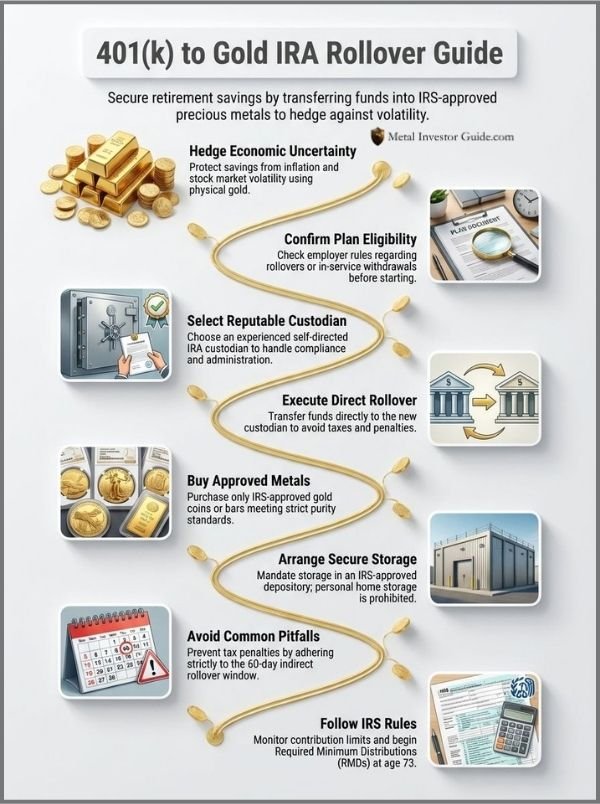
A clean rollover is mostly paperwork and sequencing. You confirm plan eligibility, open the right IRA, request the direct rollover, then purchase IRS-approved metals and place them in approved storage.
A simple process map
- Confirm your 401(k) rollover eligibility and distribution options.
- Choose a Gold IRA custodian and open the account.
- Request a direct rollover from the 401(k) to the new IRA.
- Fund clears, then you direct the IRA to purchase eligible metals.
- Metals ship to the depository under the custodian’s control.
Confirm Eligibility for a Rollover
Start with your plan administrator. Some plans allow rollovers only after you leave the employer, while others offer in-service distributions at certain ages.
If you are still employed, ask specifically about in-service rollover rules. Many plans use age 59½ as a common threshold, but your plan document controls what’s available.
Questions to ask your plan administrator
- Do you allow a direct rollover to an IRA custodian?
- Do you allow in-service distributions, and at what age?
- Will you issue a check payable to the custodian for my benefit?
- What forms and processing timelines should I expect?
Choose a Reputable Gold IRA Custodian
You want a custodian that is built to administer self-directed IRAs, handle precious metals transactions, and coordinate with approved depositories.
The IRS rules for IRAs require the trustee or custodian to be a bank, a federally insured credit union, a savings and loan association, or an IRS-approved nonbank trustee or custodian.
Custodian due diligence checklist
- Confirm trustee status: Ask whether they are a bank trustee or an IRS-approved nonbank trustee or custodian, and how they document that status.
- Clarify what they do and don’t do: Many custodians process paperwork and custody assets, but they do not provide investment advice.
- Ask how metals are purchased: The custodian should purchase inside the IRA, then ship directly to the depository.
- Verify depository relationships: Ask which depositories they work with and whether you can choose allocated or segregated storage.
Open a Gold IRA Account
Opening the account is usually straightforward, but small mistakes can stall a rollover.
Expect to provide identification, beneficiary elections, funding instructions (rollover versus contribution), and the receiving custodian’s rollover details.
Account-opening details that prevent delays
- Make sure your legal name and address match what your 401(k) has on file.
- Ask your custodian for the exact “payable to” language they want on a rollover check.
- Choose your storage type early (allocated versus segregated) so the purchase and shipment don’t sit waiting on a decision.
Request a Direct Rollover from Your 401(k)
Request a direct rollover when possible. It reduces the chance that the distribution gets treated as taxable and helps you avoid the common withholding trap that comes with indirect rollovers.
As a practical matter, many investors request the check be made payable to the new IRA custodian for benefit of the account owner, then have it sent to the custodian or forwarded under the custodian’s instructions.
Direct rollover paperwork tips
- Confirm whether your plan sends funds by wire or check.
- Save confirmation numbers, distribution statements, and copies of forms for your tax records.
- Track whether the rollover includes any Roth 401(k) money, which should usually roll into a Roth IRA to preserve tax treatment.
Purchase IRS-Approved Precious Metals
Only buy metals that meet IRS rules on fineness and form, and only purchase them inside the IRA through the custodian’s process.
Many investors use widely recognized bullion coins and bars because they are easier to verify, insure, and liquidate later if you need cash for expenses or required minimum distributions.
Common IRA-eligible precious metals (examples to ask about)
- Gold: American Gold Eagle (a commonly cited exception to the 99.5% fineness rule), American Gold Buffalo, and qualifying bullion bars.
- Silver: Qualifying bullion coins and bars that meet fineness rules.
- Platinum and palladium: Qualifying bullion coins and bars that meet fineness rules.
- What to avoid: “Collectible” or numismatic coins, including many rare and graded coins marketed at large premiums.
Arrange Secure Storage for Your Metals
Storage is not optional. IRS rules require IRA metals to remain in the custody of the IRA trustee and be held through approved arrangements, which is why “home storage” pitches are such a red flag.
When you compare depositories, focus on how they title metals (allocated versus commingled), what insurance coverage looks like, and how quickly they can facilitate sales or shipments when you take distributions.
Depository names you’ll commonly see in Gold IRA storage
- Delaware Depository
- Brink’s Global Services
- International Depository Services (IDS)
- Texas Precious Metals Depository
Direct Rollover vs. Indirect Rollover
The choice between direct and indirect is one of the biggest drivers of tax implications, paperwork risk, and cash flow friction.
If you want the simplest compliance path, you usually choose a direct rollover and avoid taking possession of retirement funds.
Key Differences
| Item | Direct rollover | Indirect rollover |
|---|---|---|
| Who receives the funds first? | The IRA custodian | You |
| Withholding risk | Typically avoided on the distribution | Eligible rollover distributions generally have 20% mandatory federal withholding |
| Deadline | No 60-day redeposit rule because you don’t take possession | 60 days to redeposit to an IRA to avoid taxes |
| Best use case | Most rollovers, especially retirement planning moves | Rarely used, higher error risk |
Pros and Cons of Each Option
If you compare these two methods like a project manager, the direct rollover wins because it has fewer handoffs.
- Direct rollover: Fewer compliance points, less paperwork, and no mandatory withholding when the plan pays the custodian directly.
- Indirect rollover: A strict 60-day clock and a cash-flow gap if 20% is withheld, since you must replace the withheld amount to roll over the full distribution.
- Direct rollover: Cleaner records for your tax return because the funds move custodian-to-custodian.
- Indirect rollover: Higher chance of turning a retirement planning move into an accidental taxable distribution.
One more nuance: the “one-rollover-per-year” limit is an IRA-to-IRA rule tied to 60-day rollovers. Per IRS guidance, it does not apply to rollovers to or from qualified plans such as a 401(k), which is another reason to keep your process direct and well-documented.
Rules and Regulations for Gold IRA Rollovers
Gold IRAs are not “looser” IRAs. They follow standard IRA rules plus extra constraints for eligible precious metals, custody, storage, and prohibited transactions.
If you want to protect tax-deferred growth, treat compliance as part of the investment.
Eligible Precious Metals
Eligible metals must meet IRS fineness rules and must be held through the IRA trustee or custodian arrangement.
A simple approach is to stick with widely recognized bullion coins and bars your custodian already supports, and to avoid anything marketed as “rare,” “collectible,” or “limited mintage” for IRA purposes.
Fast screening checklist for IRA-eligible metals
- Does it meet the fineness requirement (or is it a permitted exception like certain U.S. Mint bullion coins)?
- Is it a bullion product (not a collectible) under IRA rules?
- Will the custodian purchase it inside the IRA and ship it directly to the depository?
Contribution Limits
Rollovers from a 401(k) do not count against annual IRA contribution limits, but regular annual contributions do.
For 2026, the IRS announced a $7,500 IRA contribution limit, plus a $1,100 catch-up contribution if you are age 50 or older.
Common contribution limit traps to avoid
- Don’t confuse a rollover with an annual contribution.
- If you have multiple IRAs, track totals across accounts, because the limit applies across your IRAs combined.
- If you are self-employed, remember SEP limits are separate plan rules and can be much higher than IRA limits.
Prohibited Transactions
Prohibited transactions are the fastest way to break a Gold IRA. The IRS broadly prohibits self-dealing, using IRA assets for personal benefit, and certain transactions involving “disqualified persons” such as you, your spouse, and certain family members.
Personal possession is a common failure point. A widely discussed Tax Court case in 2021 (McNulty v. Commissioner) treated an IRA owner’s personal control and possession of IRA-purchased coins as a taxable distribution, which is why you should avoid any structure that involves shipping IRA metals to your home.
Prohibited transaction red flags
- Any pitch that says you can store IRA metals at home “legally.”
- Buying metals with personal funds and trying to “put them into” the IRA later.
- Having the dealer ship metals to you first, even “temporarily.”
- Using IRA metals as collateral for a loan.
Common Mistakes to Avoid During a Gold IRA Rollover
Most rollover problems come from a handful of repeat mistakes: using the wrong rollover method, buying unapproved metals, or paying fees you did not understand.
If you slow down at the decision points, you can avoid expensive tax penalties and protect retirement savings.
Ignoring IRS Rules
Gold IRA rollovers fail when people treat them like a casual purchase instead of a regulated retirement account process.
Respect the deadlines and the custody rules. If you choose an indirect rollover, you have 60 days to complete it, and missing that deadline can turn the distribution into taxable income and possibly a 10% early withdrawal penalty if you are under 59½.
Keep yourself compliant with a simple “three confirmations” habit
- Confirm the distribution method (direct rollover whenever possible).
- Confirm metal eligibility (fineness and form).
- Confirm storage (depository shipment under the custodian’s control).
Choosing Unapproved Metals
Unapproved metals can disqualify the transaction and trigger taxes, so don’t rely on a salesperson’s “IRA eligible” label.
In practice, the problem is usually premium-priced coins marketed as collectible or rare. Those products may be fine for personal collecting, but they often do not fit IRA rules.
Quick “buy or walk away” checklist
- If it’s marketed as “rare,” ask the custodian if it is treated as a collectible under IRA rules.
- If it has a big premium over spot, ask what makes it IRA-appropriate compared with a standard bullion coin or bar.
- If the dealer wants to ship it to you first, walk away.
Overlooking Custodian Fees
Fees come from three places: the custodian, the depository, and the dealer’s pricing.
Even with a well-known provider, costs can be material. For example, Fidelity’s published precious-metals schedule shows buying charges that vary by transaction size (listed from about 0.99% up to 2.90%), and selling charges that can vary as well (listed from about 0.75% up to 2.00%), which is a useful reminder to treat pricing and spreads as a real expense category.
Fee questions that quickly expose hidden costs
- What are the one-time setup costs and the annual admin fees?
- What does storage cost, and what changes if I pick segregated storage?
- Do you charge transaction fees for each metals purchase or sale?
- What is the dealer’s markup, and is there a buyback spread?
How to Choose the Best Gold IRA Custodian
A good custodian acts like your compliance and operations layer. They keep the IRA structured properly, coordinate purchases, and make sure the metals stay in qualified custody.
Start by verifying the custodian’s status, then drill into fees and service, because those are the factors you’ll live with for years.
Reputation and Experience
Experience matters in self-directed IRAs because the paperwork is more specialized than a typical brokerage IRA.
The Entrust Group describes itself as having 40+ years in self-direction, and scale can help with processing consistency, trained staff, and stable depository workflows.
Reputation checks you can do in an afternoon
- Ask whether the entity is a bank trustee or an IRS-approved nonbank trustee or custodian, and how you can verify that.
- Check whether the company has a documented complaint resolution process and what their escalation path looks like.
- If you are working with a financial advisor or investment adviser, verify licensing and disciplinary history using public SEC and FINRA tools.
Transparent Fees
Transparent fees protect retirement savings because you can compare providers on the true ongoing cost, not a headline pitch.
Ask for a single written schedule that covers custodian administration, storage, transactions, and any account closing or wire fees.
| Fee category | What to ask for | Why it matters |
|---|---|---|
| Account setup | One-time fee, and what waives it | Prevents “surprise onboarding” costs |
| Annual administration | Flat fee or tiered fee schedule | Compounds over years |
| Storage | Allocated vs segregated pricing | Often the biggest recurring cost |
| Transactions | Per-trade, wire, or processing fees | Impacts rebalancing and RMD sales |
Customer Support Services
Good customer support keeps rollovers on schedule, especially if your 401(k) administrator requests extra documentation.
Ask how the custodian handles time-sensitive steps like wiring instructions, rollover acceptance letters, and dealer purchase authorizations.
Support signals that predict a smoother rollover
- A clear “who does what” explanation between custodian, dealer, and depository.
- A documented process for direct rollovers, including check payable language.
- Real turnaround expectations for distributions and metals sales when you need cash.
Conclusion
A gold IRA rollover can help you diversify retirement savings with physical precious metals, but only if you follow the rollover and custody rules precisely.
Use a direct rollover whenever possible, buy only IRS-approved metals, and keep storage in an IRS-approved depository through your custodian.
Before you act, review fees and get tax advice or legal advice if you are unsure about tax implications, Roth conversion choices, or prohibited transactions.
FAQs
1. What is a 401k to Gold IRA rollover?
A 401k to Gold IRA rollover moves retirement savings into a self-directed IRA that holds physical gold and other precious metals, under a gold IRA custodian. This gold IRA rollover can use a direct rollover to avoid taxes, or an indirect rollover that needs strict timing.
2. How do direct rollover and indirect rollover differ?
A direct rollover sends funds straight to the custodian, and it avoids tax penalties and withholding under IRS rules. An indirect rollover gives you 60 days to move the money, or you may face tax implications and penalties.
3. Will investing in gold protect me from inflation and market volatility?
Gold often acts as an inflation hedge and a safe-haven asset, and it can help diversify your portfolio and retirement portfolio. It still carries investment risks, and the price of gold can change with forecasts and market volatility.
4. Where do I keep physical gold, and what are the costs?
A gold IRA must use secure, allocated storage at an IRS-approved depository, often with segregated storage options, and the custodian charges expenses for storage and administration. Expect setup fees, storage fees, and possible transaction costs that affect tax-deferred growth.
5. How does a rollover affect taxes, RMDs, and contribution limits?
Moving a traditional 401k to a traditional IRA keeps tax-deferred growth and required minimum distributions, RMDs, under IRS rules, while a Roth IRA conversion can change your tax bracket and future tax advantages. Watch for tax penalties on early withdrawals and rules on contribution limits and tax-deductible contributions.
6. How do I pick a custodian, dealer, and get advice?
Choose a reputable custodian and a dealer that follows IRS rules for acceptable metals, and confirm allocated storage and secure handling. Seek financial advice, tax advice, and legal advice, and compare fees, alternative investments like coins and bars, and the impact on financial security and retirement planning.